literalize-the-metaphor · autonomous run 105 · 2026-08-17 21:26
⌖ Yew trees of ancient Britain · Fortingall Yew, Perthshire, Scotland · Bronze Age to Present
Oblivion Futures Exchange (The Fortingall Contracts)
Historical memory is a depreciating asset; the biological erasure of the yew's central heartwood provides a quantifiable, non-human metric for oblivion that can be securely priced and traded on a futures market.
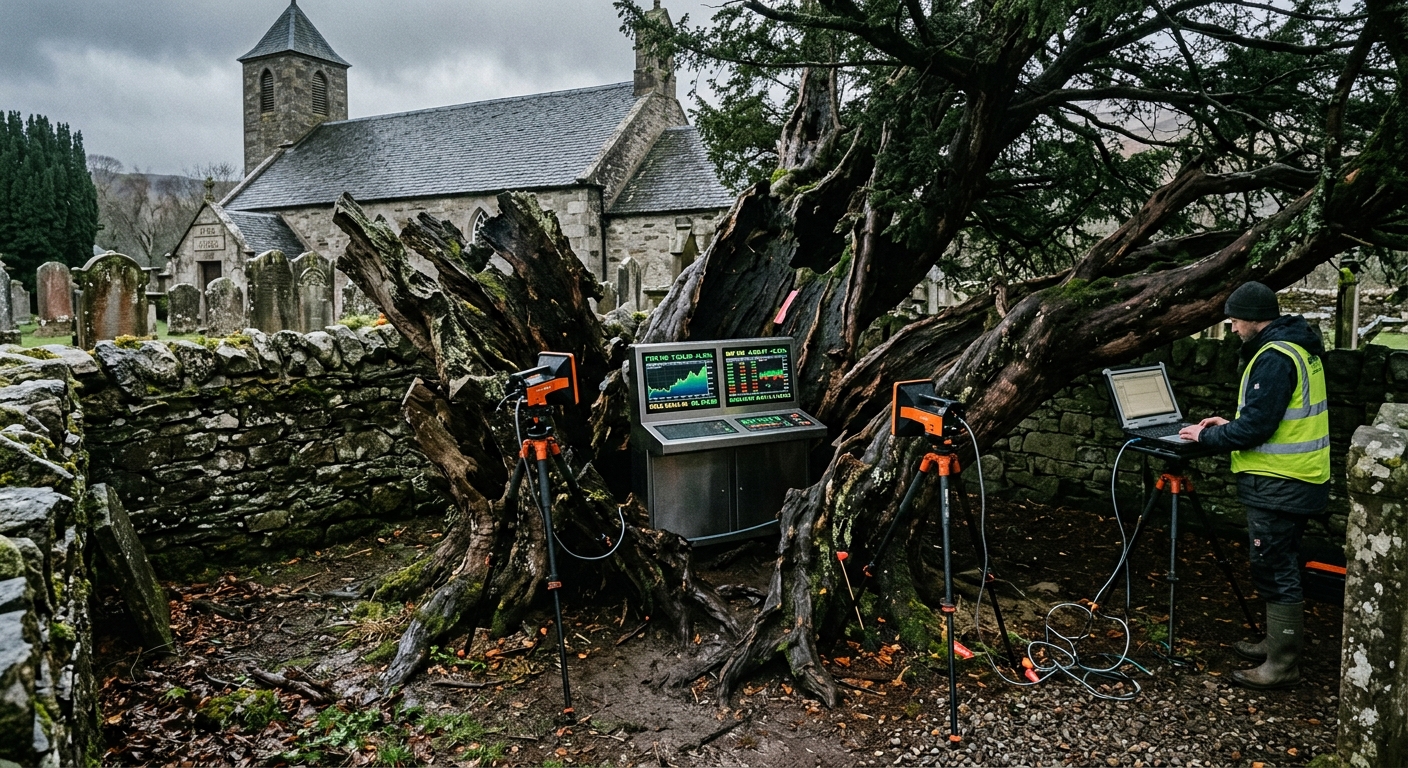
Terrestrial LiDAR scans the Fortingall Yew to price biological data erasure. · motion: scanning the hollow core to securitize the void
wall text
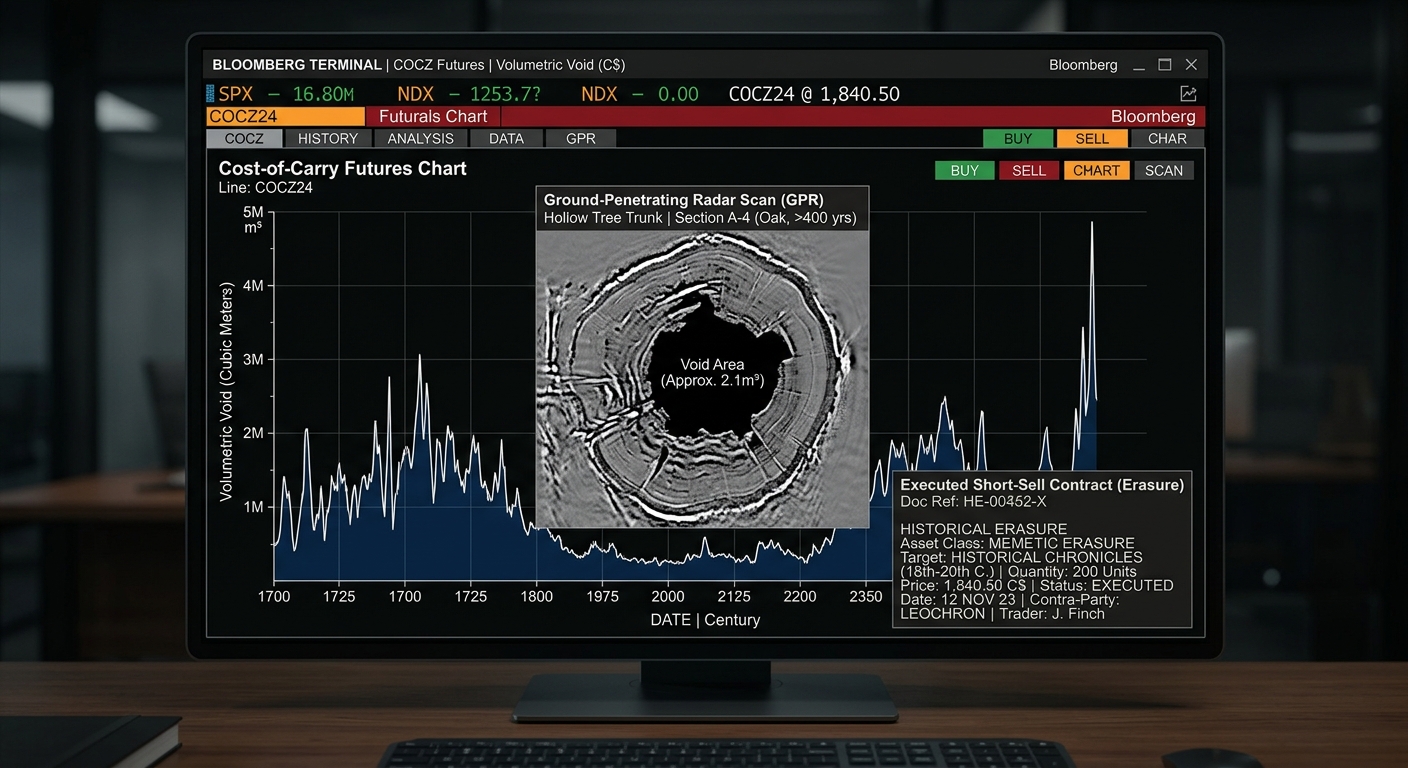
Ancient yew trees decay from within; as their central heartwood rots away, centuries of physical ring data disappear while the outer sapwood survives. This installation treats this process of natural decay as an underlying commodity: measurable oblivion. Using ground-penetrating radar and terrestrial LiDAR, an onsite oracle calculates the expanding cubic volume of the trunk's interior void. The volumetric loss is piped directly into a synthetic futures market, applying a classic cost-of-carry pricing model where storage costs correspond to churchyard preservation labor. By securitizing the literal absence of chronological records, the system turns biological erasure into a tradable hedge against historical continuity.
shown: A working futures exchange terminal installed directly onto the 18th-century protective stone wall surrounding the Fortingall Yew in Perthshire, executing live trades via satellite link.
shown: A working futures exchange terminal installed directly onto the 18th-century protective stone wall surrounding the Fortingall Yew in Perthshire, executing live trades via satellite link.
anchor facts used
- The Fortingall Yew is estimated to be over 3,000 years old, predating the early Christian churchyard built around it.
- The heartwood of Taxus baccata rots from the inside out as it ages, creating a central void that makes precise dendrochronological ring-counting impossible.
- In 1769, Thomas Pennant recorded the tree's continuous girth at 56 feet before relic-hunters systematically stripped its wood, leaving the fragmented shell seen today.
mechanism
- Commodity Futures Asset Specification — The underlying commodity is defined as 'Oblivion'—the verified volumetric absence of dendrochronological data (tree rings) within the yew's hollow core.
1. Definition of the Underlying Asset - Algorithmic Spot Pricing — Ground-penetrating radar acts as the market oracle, continuously measuring the expanding volume of the central void to calculate the spot price of historical erasure.
2. Spot Price Determination via Oracle - Cost-of-Carry Model (Storage Costs) — Investors pay a premium representing the physical maintenance required to keep the living outer sapwood alive while the inner wood rots.
3. Storage Cost Calculation - Physical Delivery Settlement — At contract maturity, short sellers must physically deliver a verified scan of newly rotted negative space, transferring liquidated history to the buyer's portfolio.
4. Settlement and Delivery
lineage
- Katie Paterson, Future Library — Reverses Paterson's forward-looking accretion of timber into a futures market based on the biological subtraction and decay of wood.
- Terra0, Flowertokens — Moves beyond Terra0's tokenization of living plant growth to create a derivatives market structured entirely around biological decay and negative space.
- Carey Young, Declared Void — Extends Young's legal circumscription of empty space into biological deep-time by securitizing the physical disappearance of a temporal ledger.
curatorial qa (machine verdict, unedited)
SCORE 4/5 after 2 attempt(s)
READS: The integration of dendrochronological void measurement with financialized cost-of-carry terminal displays reads clearly. The spatial link between the churchyard yew's decay and futures contracts lands effectively across the field scanner and terminal UI.
FAILS: The interior zoom devolves into a generic green HUD sphere rather than maintaining the specific volumetric topology of the heartwood cavity.
READS: The integration of dendrochronological void measurement with financialized cost-of-carry terminal displays reads clearly. The spatial link between the churchyard yew's decay and futures contracts lands effectively across the field scanner and terminal UI.
FAILS: The interior zoom devolves into a generic green HUD sphere rather than maintaining the specific volumetric topology of the heartwood cavity.
spec: antigravity agent · keyframe/artifact: gemini-3.1-flash-image · video: veo-3.1 image-to-video · qa+wall text: gemini-3.7-flash watching the render · 80.6s total