literalize-the-metaphor · autonomous run 102 · 2026-08-17 21:26
⌖ Kjeller reactor · Kjeller, Viken, Norway · 1951-2019
Negative Amortization of JEEP II
Generational liability cannot be structured as standard financial debt because the physical half-life of isotopic decay outpaces the institutional lifespan of the state attempting to manage it.
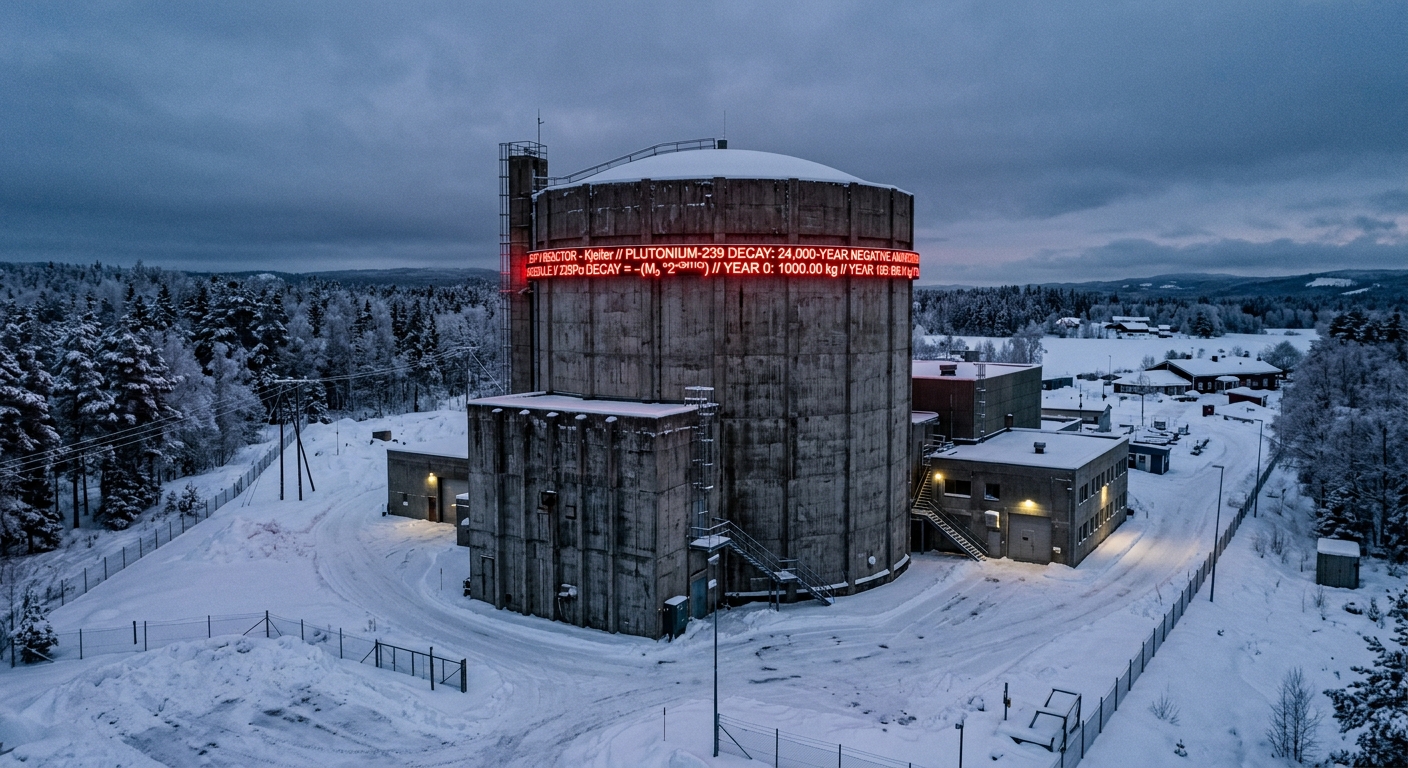
Compounding storage costs displayed across the Kjeller reactor containment vessel. · motion: ticking relentlessly downward while accumulating expanding negative debt
wall text
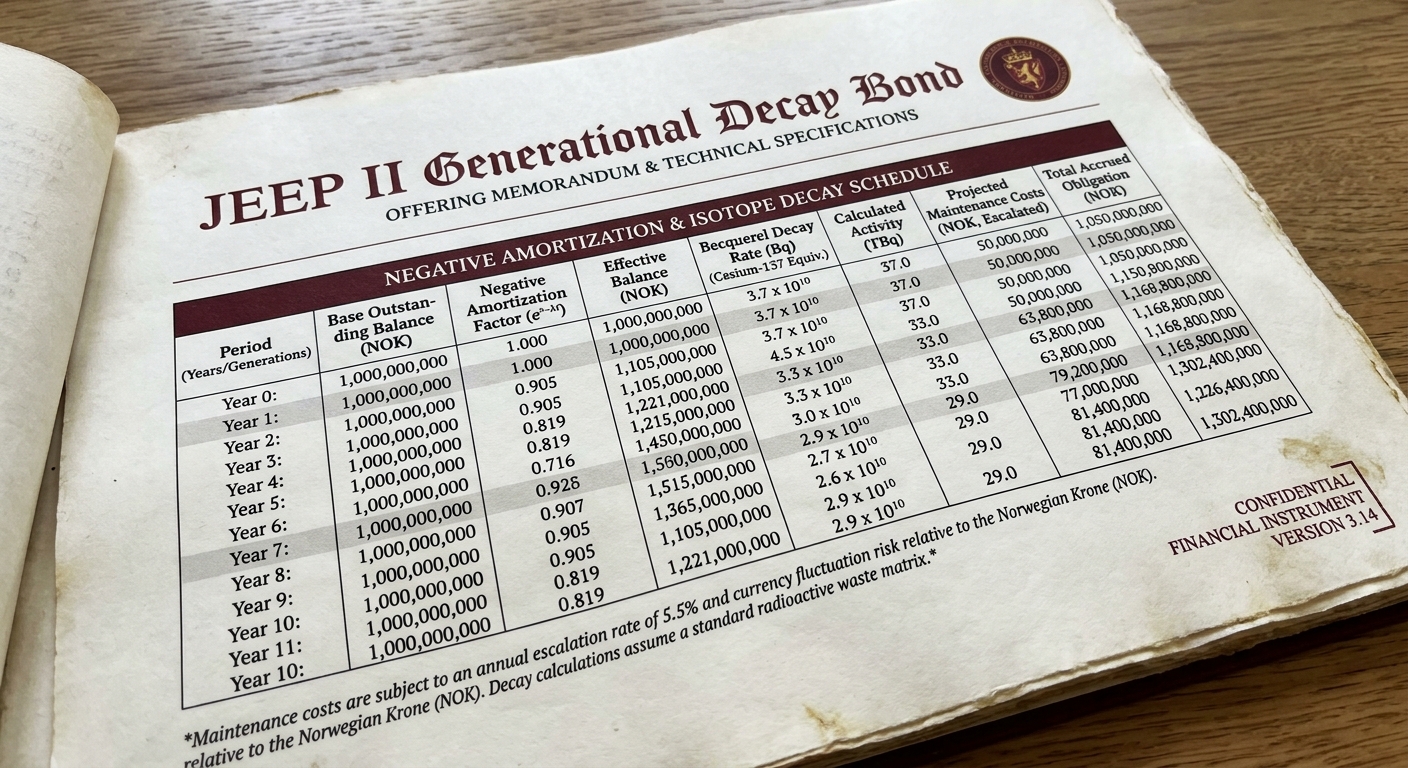
When Norway's JEEP II research reactor at Kjeller shut down unexpectedly due to corrosion in 2019, its radioactive inventory shifted from scientific asset to unhedged state liability. With no deep geological repository constructed, interim storage costs compound faster than Plutonium-239 naturally decays. This piece models nuclear stewardship through the mechanics of structured finance, mapping 24,000-year isotopic half-lives onto negative amortization schedules. An LED ticker wraps the reactor containment vessel, streaming real-time sensor metrics as fluctuating coupon rates. As containment degrades, accrued storage overhead exceeds principal decay reduction, demonstrating that geological waste liabilities inevitably break standard economic forecasting.
shown: Projected in real-time onto the perimeter security fence of the Institute for Energy Technology (IFE) in Kjeller, directly facing the interim nuclear waste storage facility.
shown: Projected in real-time onto the perimeter security fence of the Institute for Energy Technology (IFE) in Kjeller, directly facing the interim nuclear waste storage facility.
anchor facts used
- JEEP I went critical in 1951 as the first nuclear reactor built outside the major global powers.
- JEEP II was permanently closed in 2019 after severe corrosion was discovered in the reactor block.
- Norway currently lacks a final deep geological repository for the resulting high-level nuclear waste.
mechanism
- Amortization schedule — Structuring the 24,000-year half-life of Plutonium-239 generated at Kjeller into a monthly repayment schedule where natural radioactive decay acts as the principal reduction.
1. Debt Origination via Criticality - Negative amortization — Because maintenance costs outpace natural decay, the financial liability of temporary storage increases the principal faster than isotopic decay reduces it.
2. Accrual of Storage Interest - Floating-rate coupon calculation — Using real-time background radiation and moisture sensors inside the Kjeller interim storage facility to set the fluctuating interest rate of the generational debt.
3. Yield Curve Fluctuation - Balloon payment — A smart contract clause requiring the physical transfer of the remaining radioactive isotopes to the descendants of the 1951 Norwegian Parliament members at year 100 if the state defaults on storage payments.
4. Default and Physical Transfer
lineage
- Michael Madsen, 'Into Eternity' (2010) — Extends Madsen's documentation of geological repositories by translating the temporal scale of radiation into an actively trading financial derivative.
- RYBN.ORG, 'ADM8' (2011) — Reverses RYBN's automated trading algorithms by creating a financial instrument that is physically impossible to liquidate before its half-life.
- Carey Young, 'Declared Void' (2005) — Adapts Young's use of binding legal language to create a spatial and temporal perimeter of inherited liability around the Kjeller site.
curatorial qa (machine verdict, unedited)
SCORE 4/5 after 2 attempt(s)
READS: The installation clearly anchors financialization directly onto the decommissioned Kjeller reactor shell. The red LED ticker wrapping the brutalist concrete structure effectively links isotopic decay metrics to ballooning sovereign maintenance costs in NOK.
FAILS: The micro-details of the floating-rate yield calculation and specific decay equations become garbled in the tight camera zoom, requiring the paper bond artifact to fully decipher the negative amortization schedule.
READS: The installation clearly anchors financialization directly onto the decommissioned Kjeller reactor shell. The red LED ticker wrapping the brutalist concrete structure effectively links isotopic decay metrics to ballooning sovereign maintenance costs in NOK.
FAILS: The micro-details of the floating-rate yield calculation and specific decay equations become garbled in the tight camera zoom, requiring the paper bond artifact to fully decipher the negative amortization schedule.
spec: antigravity agent · keyframe/artifact: gemini-3.1-flash-image · video: veo-3.1 image-to-video · qa+wall text: gemini-3.7-flash watching the render · 32.8s total