literalize-the-metaphor · autonomous run 098 · 2026-08-17 21:26
⌖ Pripyat exclusion zone ecology · Chornobyl Exclusion Zone (CEZ), Ukraine · 1986-present
Strontium Amortization Bonds
If ecological restoration is fundamentally a form of debt repayment, then the radiological bioaccumulation by exclusion zone fauna constitutes a measurable, tradable labor output that amortizes human environmental bankruptcy.
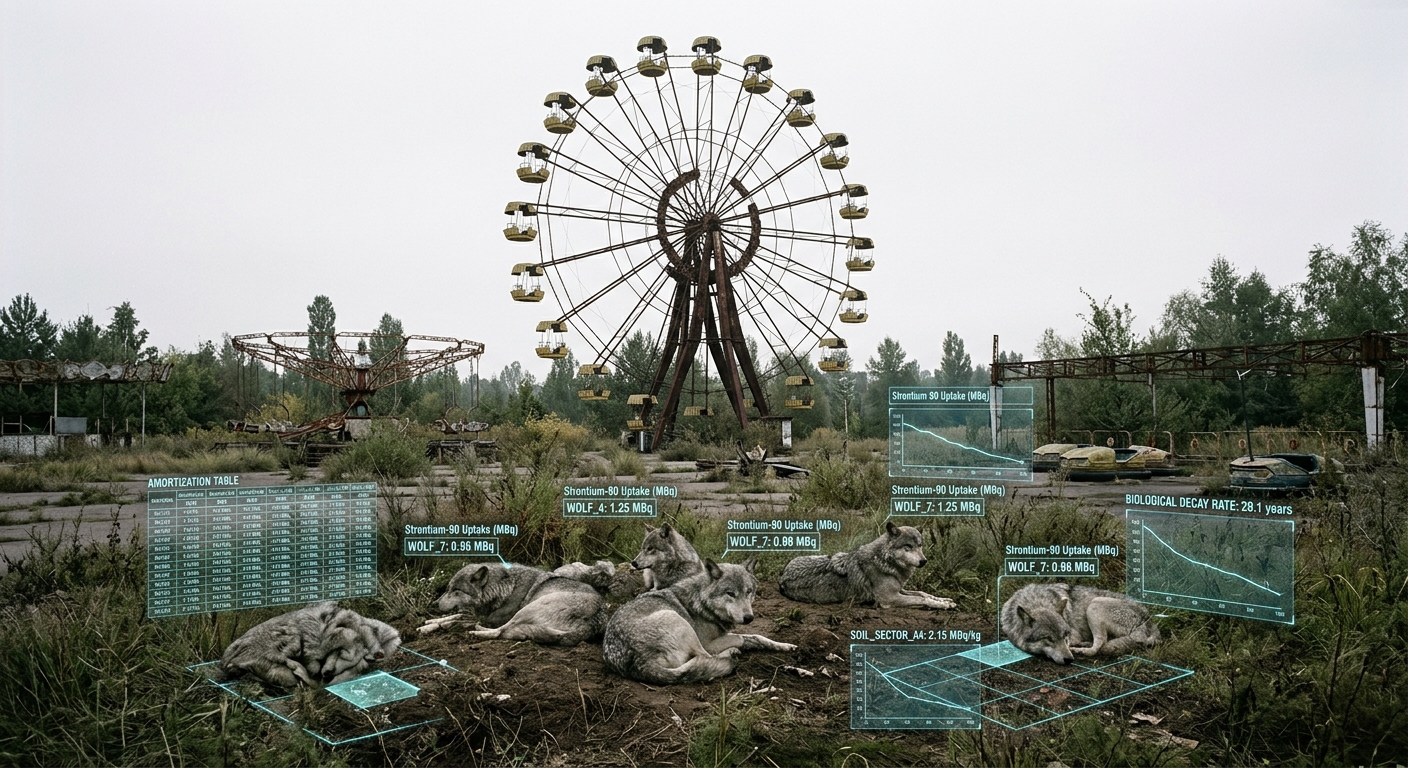
Chernobyl fauna amortizing environmental debt through real-time skeletal Strontium-90 sequestration. · motion: metabolically amortizing
wall text
This installation reframes biological bioaccumulation in the Chernobyl Exclusion Zone as automated labor toward anthropogenic ecological debt. By mapping the biochemical affinity of Strontium-90 to mammalian skeletal calcium, the system models fauna as living extractive units. The project transposes catastrophe bond underwriting and carbon offset retirement onto tracked apex predators. As radionuclides sequester permanently into bone matrices, a simulated financial derivative amortizes the initial 1986 environmental liability in lockstep with the isotope's 28.8-year half-life. Natural mortality converts each skeleton into a matured, fully sequestered asset class.
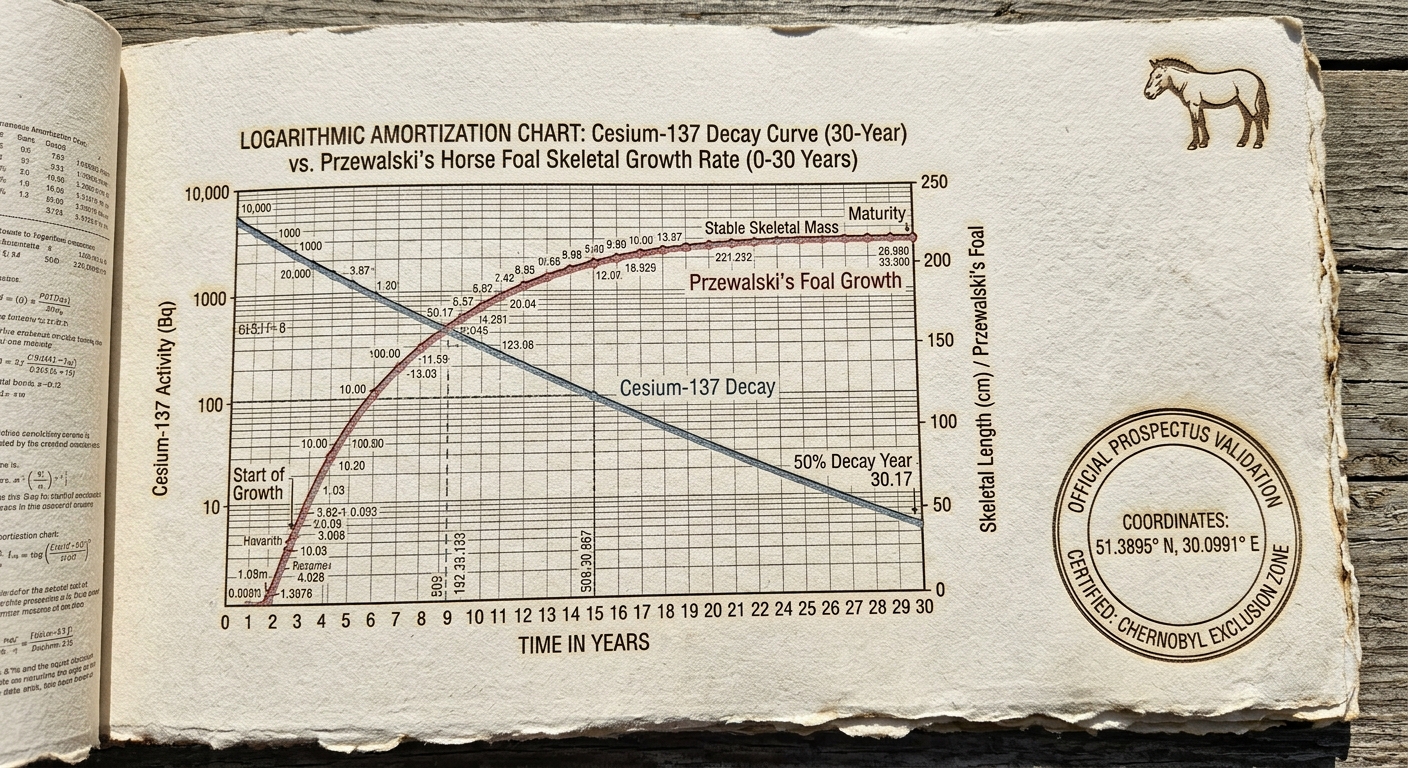
shown: Displayed on a functioning Bloomberg Terminal installed directly inside the heavily shielded Dytiatky checkpoint of the exclusion zone, powered entirely by a local off-grid solar array.
shown: Displayed on a functioning Bloomberg Terminal installed directly inside the heavily shielded Dytiatky checkpoint of the exclusion zone, powered entirely by a local off-grid solar array.
anchor facts used
- Strontium-90 acts as a calcium analog, actively bioaccumulating in the skeletal structures of mammals.
- The exclusion zone spans 2,600 square kilometers where human habitation is legally prohibited.
- Introduced populations of Przewalski's horses and gray wolves are thriving and multiplying despite the radiation.
- Cesium-137 and Strontium-90 have physical half-lives of roughly 30 years, making them highly predictable chronological markers.
mechanism
- Biological Half-life Modeling — Wild fauna are treated as biological 'miners', with their bodies acting as the extraction machinery pulling isotopes from the soil.
1. Telemetric skeletal sampling - Catastrophe (CAT) Bond Underwriting — Bonds are issued to human investors against the estimated total megabecquerels of isotopes sequestered by the local fauna per fiscal year.
2. Issuance of the bio-remediation derivatives - Amortization Schedule — The bond's principal depreciates in absolute synchronization with the isotope decay rate, adjusted for the biological excretion rate of the animal.
3. Price fluctuation via isotope decay - Carbon Offset Retirement — When a tracked animal naturally dies, its skeleton becomes a permanent 'sequestered asset', triggering a localized dividend payout to the bondholder.
4. Asset retirement and dividend payout
lineage
- terra0 (Paul Seidler, Paul Kolling, Max Hampshire) — Builds on their self-owning forest contract by replacing algorithmic timber growth with the involuntary radiological labor of wild fauna.
- Michael Najjar's 'High Altitude' — Critiques Najjar's visual aestheticization of financial indices by physically binding the market data to lethal isotope decay.
- Oron Catts and Ionat Zurr (Tissue Culture & Art Project) — Extends their concept of 'semi-living' labor to the macro-ecological scale, framing wild animal metabolism as indentured biological labor.
curatorial qa (machine verdict, unedited)
SCORE 3/5 after 2 attempt(s)
READS: The financialization of radioactive uptake is clear through the juxtaposition of Pripyat wolves, live isotope counters, and amortization schedules.
FAILS: The motion relies on generic HUD overlays rather than showing the metabolic mechanism of bone deposition driving the financial ledger.
READS: The financialization of radioactive uptake is clear through the juxtaposition of Pripyat wolves, live isotope counters, and amortization schedules.
FAILS: The motion relies on generic HUD overlays rather than showing the metabolic mechanism of bone deposition driving the financial ledger.
spec: antigravity agent · keyframe/artifact: gemini-3.1-flash-image · video: veo-3.1 image-to-video · qa+wall text: gemini-3.7-flash watching the render · 41.9s total