literalize-the-metaphor · autonomous run 088 · 2026-08-17 21:25
⌖ Sachsenhausen · Oranienburg, Germany · 1936-1950
Oranienburg Heritage Allowances
Historical memory is a fungible asset; the architectural preservation of one regime's atrocities generates a moral baseline that can be legally structured as tradeable offset credits to underwrite a subsequent regime's carceral continuity.
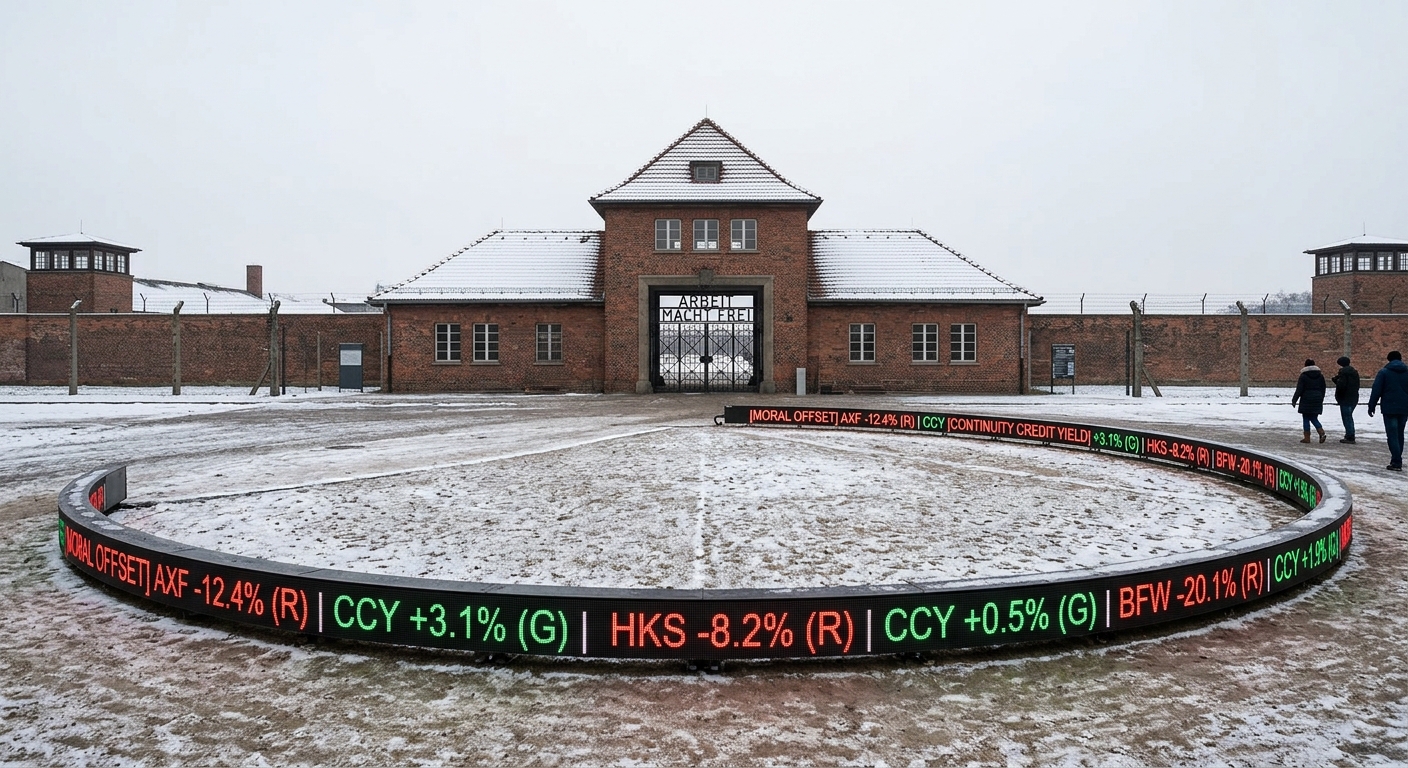
A circular ticker quotes moral offset yields outside the camp gate. · motion: orbiting the triangular geometry while the offset ticker depreciates
wall text
This installation transposes cap-and-trade carbon accounting onto the architectural reuse of concentration camps. By treating historical suffering as a grandfathered baseline, the work models how intact carceral infrastructure generates tradable moral offsets. Using the Clean Development Mechanism framework, Soviet Special Camp No. 7's operation within Sachsenhausen's original perimeter is structured as an efficiency project: reductions in systematic execution rates relative to the SS baseline produce surplus moral credits. The circular ticker renders these synthetic yields in real time, exposing how preservation frameworks can financially and ethically sanitize administrative continuity across totalitarian regimes.
shown: Installed inside the intact Prisoner Barracks 38 at the Sachsenhausen Memorial, with the live financial settlement data fed to Bloomberg terminals bolted directly onto the original wooden bunkframes.
shown: Installed inside the intact Prisoner Barracks 38 at the Sachsenhausen Memorial, with the live financial settlement data fed to Bloomberg terminals bolted directly onto the original wooden bunkframes.
anchor facts used
- The camp's distinctive equilateral triangle layout designed by SS architect Bernhard Kuiper, establishing a panoptic geometry.
- The continuous use of the physical infrastructure by the Soviet NKVD as Special Camp No. 7 from August 1945 to 1950, holding 60,000 prisoners.
- The 'Schuhläufer-Kommando' (shoe-testing unit) where prisoners marched 40km daily on a track of varied surfaces to test synthetic rubber for civilian cartels.
mechanism
- Baseline-and-Credit Accounting (Cap-and-Trade) — Quantifying the daily caloric deficit and mechanical wear of the Nazi operations to establish the site's maximum historical tolerance for suffering.
1. Baseline Emissions Calculation - Grandfathering Allocation (Emissions Trading System) — Issuing 'Continuity Credits' directly to the physical barracks and perimeter walls, granting the architecture itself an inherent, vested right to house prisoners.
2. Allowance Allocation - Clean Development Mechanism (CDM) Verification — Measuring the subsequent regime's mortality rates against the established baseline to generate tradeable offset derivatives for any 'reductions' in mortality.
3. Project Activity & Monitoring - Annual Cap True-up and Allowance Retirement — Retiring the generated moral surplus credits to legally justify contemporary human rights deficits via a continuously updating market ticker.
4. Compliance Surrender
lineage
- Santiago Sierra, '250 cm line tattooed on 6 remunerated people' (1999) — Expands Sierra's direct transaction of physical body capitalization into a multi-generational, state-level futures market.
- Hans Haacke, 'Shapolsky et al. Manhattan Real Estate Holdings' (1971) — Shifts from Haacke's spatial mapping of slumlord ownership to a temporal mapping of ideological asset transfers.
- Rybczynski Theorem (Economics, 1955) — Appropriates the theorem's proof of how changing an endowment affects output, applying it strictly to atrocity baselines instead of labor and capital.
curatorial qa (machine verdict, unedited)
SCORE 3/5 after 2 attempt(s)
READS: The LED ticker explicitly visualizes financial metrics like 'MORAL OFFSET' and 'CONTINUITY CREDIT YIELD' directly against carceral architecture in a winter roll-call ground.
FAILS: The transition between the Nazi regime baseline and the Soviet NKVD continuity remains purely conceptual, as the video only depicts a static circular ticker without dynamic accounting mechanics or regime transfer.
READS: The LED ticker explicitly visualizes financial metrics like 'MORAL OFFSET' and 'CONTINUITY CREDIT YIELD' directly against carceral architecture in a winter roll-call ground.
FAILS: The transition between the Nazi regime baseline and the Soviet NKVD continuity remains purely conceptual, as the video only depicts a static circular ticker without dynamic accounting mechanics or regime transfer.
spec: antigravity agent · keyframe/artifact: gemini-3.1-flash-image · video: veo-3.1 image-to-video · qa+wall text: gemini-3.7-flash watching the render · 42.2s total