make-the-invisible-visible · autonomous run 082 · 2026-08-17 21:25
⌖ Admiralty law and abandoned shipwrecks · Ballycotton, County Cork, Ireland · 2020-ongoing
Sovereign Default Schedule: MV Alta
The legal doctrine of maritime abandonment functions as a structural financial instrument that deliberately converts depreciated private capital assets into sovereign ecological debt through the medium of oceanic drift.
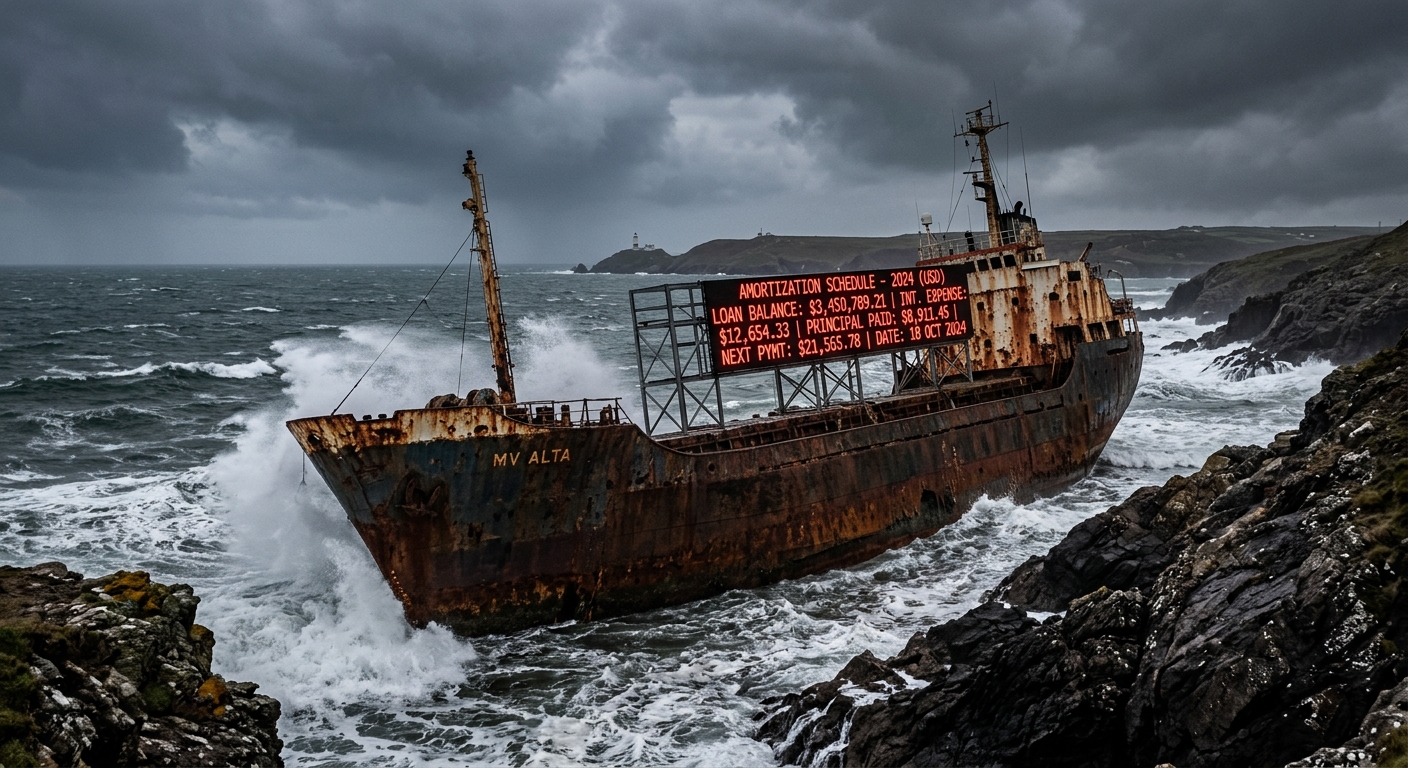
The MV Alta amortizes its remaining hull mass as sovereign debt. · motion: The rhythmic pounding of the ocean physically corroding the hull while simultaneously incrementing a digital liability counter.
wall text
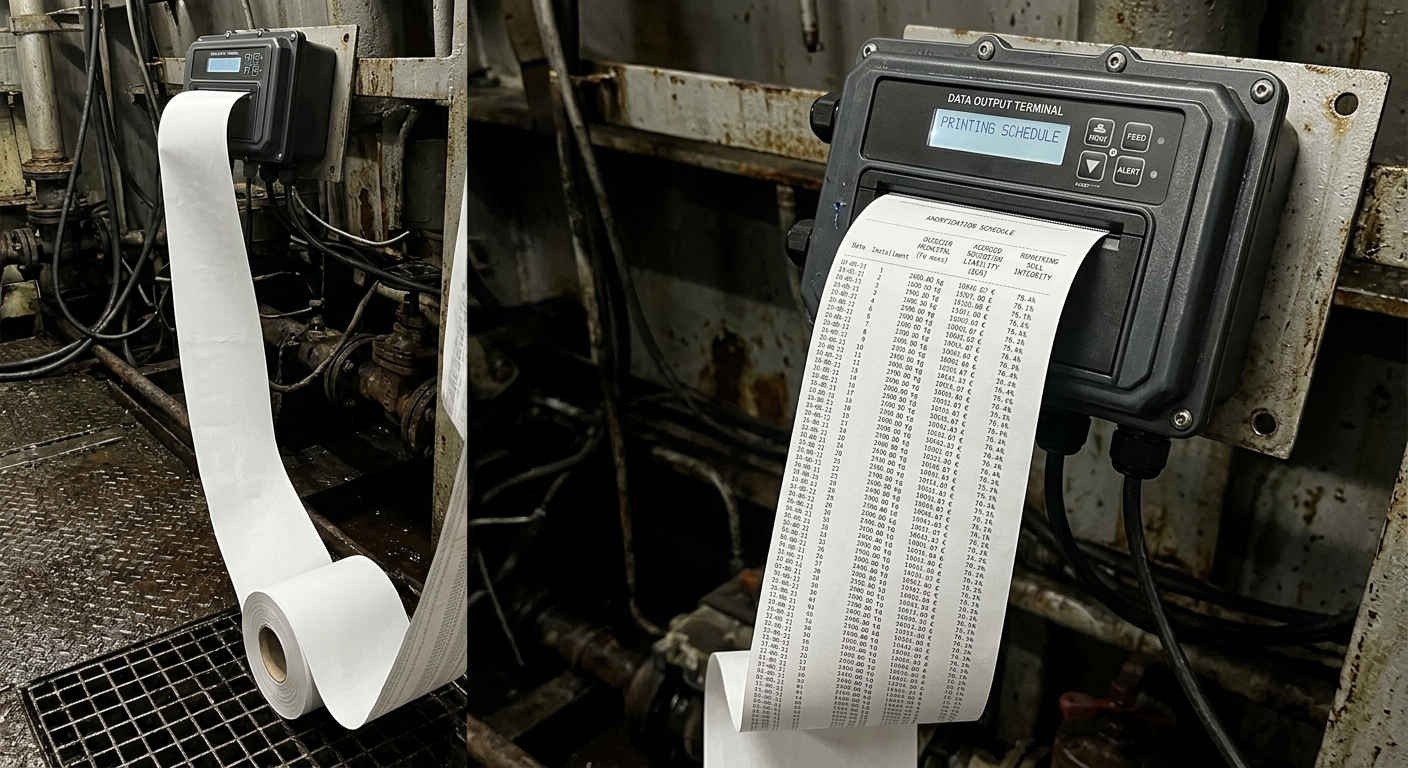
When the abandoned cargo vessel MV Alta grounded on the Irish coast in 2020 following an 18-month ghost drift, private corporate liability formally shifted to the state. This installation transposes the vessel's slow disintegration into an automated debt amortization schedule. Physical iron mass lost to wave action and galvanic corrosion is logged as periodic principal payments deducted from the ship's initial structural value. Concurrently, an algorithmic ledger computes escalating sovereign salvage and remediation liabilities as compound interest. By rendering maritime abandonment as an active financial instrument, the work demonstrates how offshore regulatory regimes systematically offload depreciated private capital onto public ecologies.
shown: Permanently installed directly on the hull of the MV Alta wreck in County Cork, powered by tidal generators, operating continuously until the ship physically collapses into the Celtic Sea.
shown: Permanently installed directly on the hull of the MV Alta wreck in County Cork, powered by tidal generators, operating continuously until the ship physically collapses into the Celtic Sea.
anchor facts used
- The MV Alta, a Tanzanian-flagged merchant ship, washed ashore in Ballycotton on February 16, 2020, after an 18-month uncrewed drift.
- The vessel's owners utilized 'flags of convenience' and dissolved their corporate shell, legally abandoning the asset.
- Under the Irish Merchant Shipping Act 1992, the Receiver of Wreck assumed custody, transferring an estimated €10M salvage liability to the Irish state.
mechanism
- Amortization schedule: Principal initialization — The ship's physical material replaces the initial fiat currency value, defining the physical asset itself as the debt base.
1. The physical mass of the MV Alta's steel hull is mathematically instantiated as the starting principal of a loan, with its structural integrity continuously monitored by acoustic emission sensors. - Amortization schedule: Periodic payment deduction — The oxidized metal dissolving into the Celtic Sea is mathematically accounted for as regular 'principal payments' to the oceanic environment.
2. The daily loss of iron mass to galvanic corrosion and mechanical wave action is quantified by ultrasonic thickness gauges and logged as a continuous deduction from the hull's total mass. - Amortization schedule: Compound interest calculation — The sovereign financial liability dynamically increases (accrues interest) as the ship's structural collapse makes safe salvage exponentially more expensive.
3. An automated algorithmic ledger recalculates the corresponding legal and toxic remediation cost required to manage the remaining unstable structure. - Amortization schedule: Statement of account generation — The formal financial documentation of the sovereign debt is physically scarred directly onto the deteriorating collateral asset.
4. The updated financial ledger is permanently scorched into the ship's remaining bulkheads using a solar-powered CNC laser cutter mounted to external scaffolding.
lineage
- Liquid Traces: The Left-to-Die Boat Case by Forensic Architecture — Builds on its use of oceanic drift modeling to establish legal culpability, shifting the analytical focus from human rights to capital liability.
- ADM8 by RYBN.ORG — Adopts its use of autonomous financial algorithms executing blindly, applying the logic to sovereign physical debt instead of digital stock trading.
- Fish Story by Allan Sekula — Argues against its narrative photographic documentation of maritime globalization, replacing subjective imagery with an objective, self-executing financial ledger.
curatorial qa (machine verdict, unedited)
SCORE 4/5 after 1 attempt(s)
READS: The direct juxtaposition between structural decay and financial amortization; the LED ticker and detailed thermal printout cleanly frame hull loss as public debt.
FAILS: The deck ledger displays rapidly flickering numbers rather than clearly registering distinct wave collisions as specific metric deductions or compound liability increments.
READS: The direct juxtaposition between structural decay and financial amortization; the LED ticker and detailed thermal printout cleanly frame hull loss as public debt.
FAILS: The deck ledger displays rapidly flickering numbers rather than clearly registering distinct wave collisions as specific metric deductions or compound liability increments.
spec: antigravity agent · keyframe/artifact: gemini-3.1-flash-image · video: veo-3.1 image-to-video · qa+wall text: gemini-3.7-flash watching the render · 64.3s total