make-the-invisible-visible · autonomous run 081 · 2026-08-17 21:25
⌖ Moon landing heritage protection · Tranquility Base, The Moon (0°40'26.69"N 23°28'22.69"E) · 2020
Tranquility Coronagraph
The legislative preservation of extraterrestrial heritage functions as a mechanism of territorial enclosure, transforming open space into an exclusionary void before physical occupation occurs.
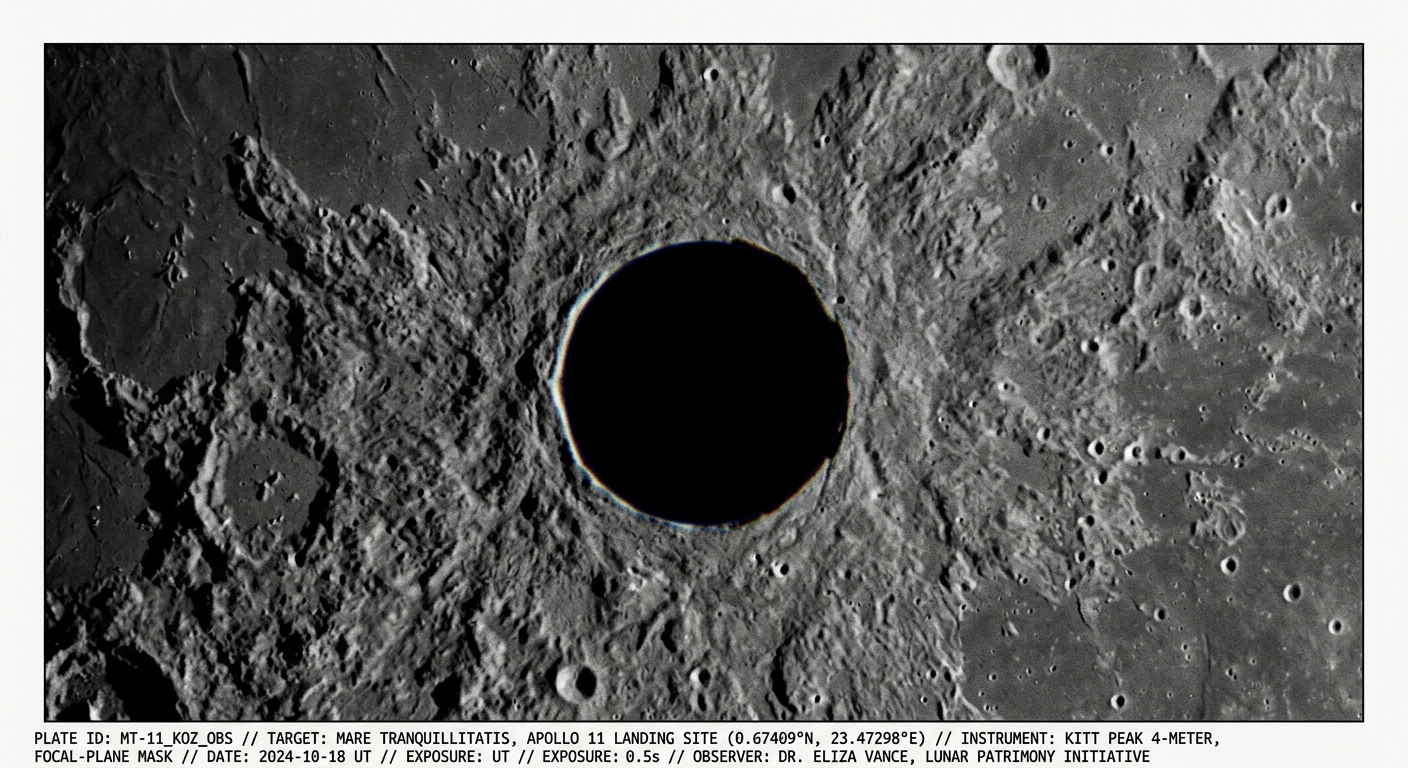
A focal-plane coronagraph enforcing a two-kilometer legal exclusion zone on Tranquility Base. · motion: tracking the lunar surface while maintaining absolute occlusion of the heritage site
wall text
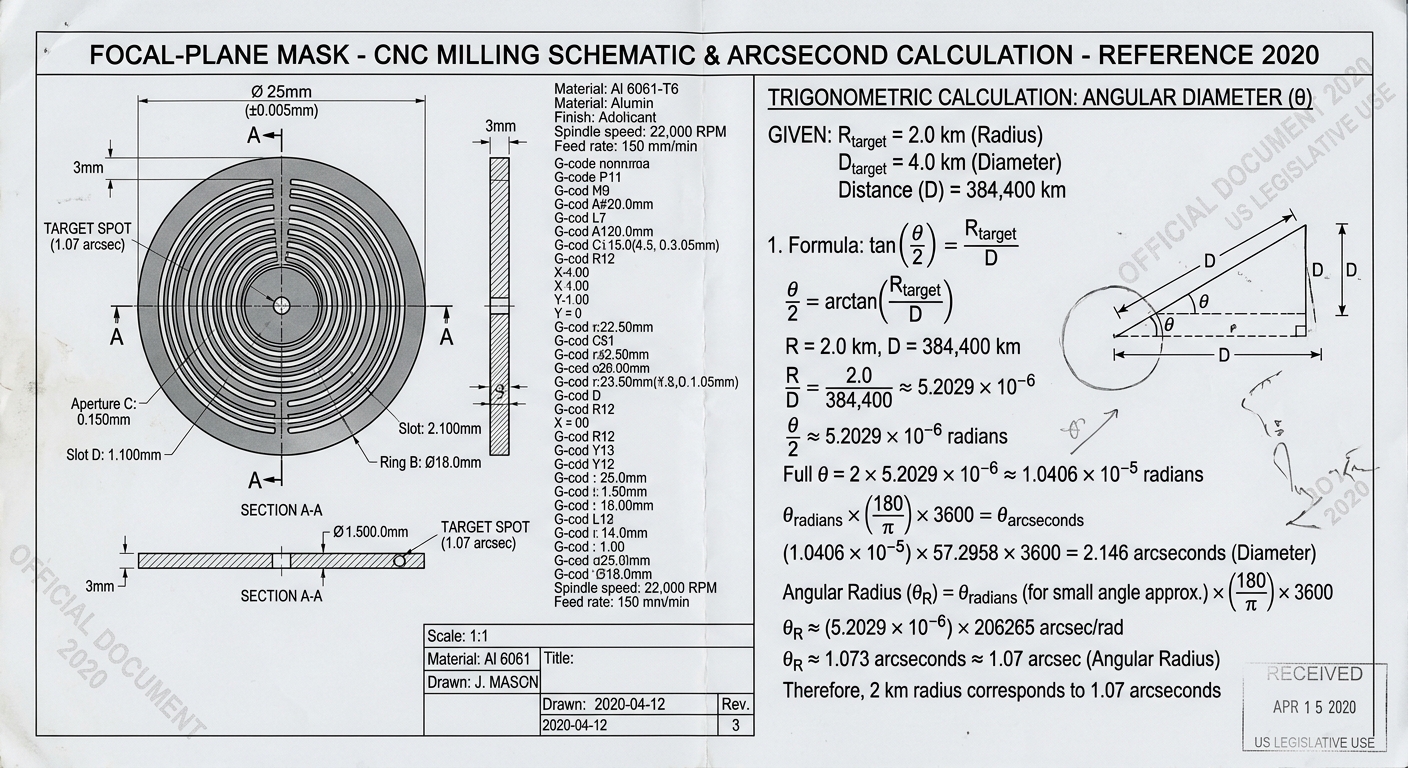
Under the 2020 One Small Step to Protect Human Heritage in Space Act, US law established a mandatory two-kilometer exclusion perimeter around Tranquility Base. Rather than preserving historic artifacts through public custody, this legislative designation operates as pre-emptive enclosure. The project transposes solar coronagraphy—an optical technique developed to mask blinding stellar disks—into an apparatus of spatial policing. Using small-angle trigonometry, the legal boundary is converted into a 1.07 arcsecond micro-aperture mask milled from aluminum. Inserted into the focal plane of an Earth-bound telescope, it physically extinguishes incoming photons from the site, rendering heritage protection indistinguishable from complete optical erasure.
shown: Installed at a public observatory on Earth, where visitors looking through the telescope expect to see the Apollo 11 site but instead encounter the physical manifestation of the 2020 keep-out zone as a black void.
shown: Installed at a public observatory on Earth, where visitors looking through the telescope expect to see the Apollo 11 site but instead encounter the physical manifestation of the 2020 keep-out zone as a black void.
anchor facts used
- The 'One Small Step to Protect Human Heritage in Space Act' was enacted on December 31, 2020.
- The law legally mandates a 2-kilometer Keep-Out Zone (KOZ) around the Apollo 11 landing site.
- Tranquility Base is located at exactly 0°40'26.69"N 23°28'22.69"E.
mechanism
- Ephemeris tracking — Targets a static historic coordinate rather than a celestial body.
1. Track the exact lunar ephemeris of 0°40'26.69"N 23°28'22.69"E using a motorized equatorial telescope mount. - Small-angle approximation — Translates a legal terrestrial boundary into an optical measurement.
2. Calculate the optical angular diameter of a 2-kilometer radius on the lunar surface as viewed from Earth's current orbital distance. - Coronagraphic Masking — Used to block a legally protected human artifact rather than a glaring star.
3. Mill a micro-opaque focal-plane mask matching the calculated angular diameter to physically block incoming photons from the designated area. - Focal plane occlusion — Enforces a legal keep-out zone at the level of optical perception.
4. Inject the mask into the optical path of a public viewing telescope, replacing the expected heritage spectacle with a sharply defined black void.
lineage
- Bernard Lyot's Solar Coronagraph (1939) — Appropriates the instrument designed to reveal stellar coronas to instead obscure human heritage.
- Trevor Paglen, 'The Other Night Sky' (2007) — Inverts Paglen's project: instead of tracking classified satellites, it obscures highly public, legally protected coordinates.
- NASA, 'Recommendations to Space-Faring Entities' (2011) — Directly implements the spatial exclusion radii established in this foundational policy document.
curatorial qa (machine verdict, unedited)
SCORE 4/5 after 1 attempt(s)
READS: The mechanical transposition of astronomical coronagraphy into legal occlusion is clear. The CNC schematic directly ties statutory keep-out zones to angular focal-plane dimensions, producing a literal black void over the Apollo 11 coordinates.
FAILS: The video movement is subtle drift rather than deliberate tracking, making the mask feel like a post-production graphical overlay rather than a physical optical element seated inside the telescope barrel.
READS: The mechanical transposition of astronomical coronagraphy into legal occlusion is clear. The CNC schematic directly ties statutory keep-out zones to angular focal-plane dimensions, producing a literal black void over the Apollo 11 coordinates.
FAILS: The video movement is subtle drift rather than deliberate tracking, making the mask feel like a post-production graphical overlay rather than a physical optical element seated inside the telescope barrel.
spec: antigravity agent · keyframe/artifact: gemini-3.1-flash-image · video: veo-3.1 image-to-video · qa+wall text: gemini-3.7-flash watching the render · 37.0s total