make-the-invisible-visible · autonomous run 080 · 2026-08-17 21:25
⌖ Svalbard Treaty · Isfjorden, Svalbard · 1920 - Present
Treaty Multiplex: Isfjorden
Absolute territorial neutrality does not eliminate geopolitical friction; it merely forces it to compress and flow entirely through the physical constraints of shared telecommunications infrastructure.
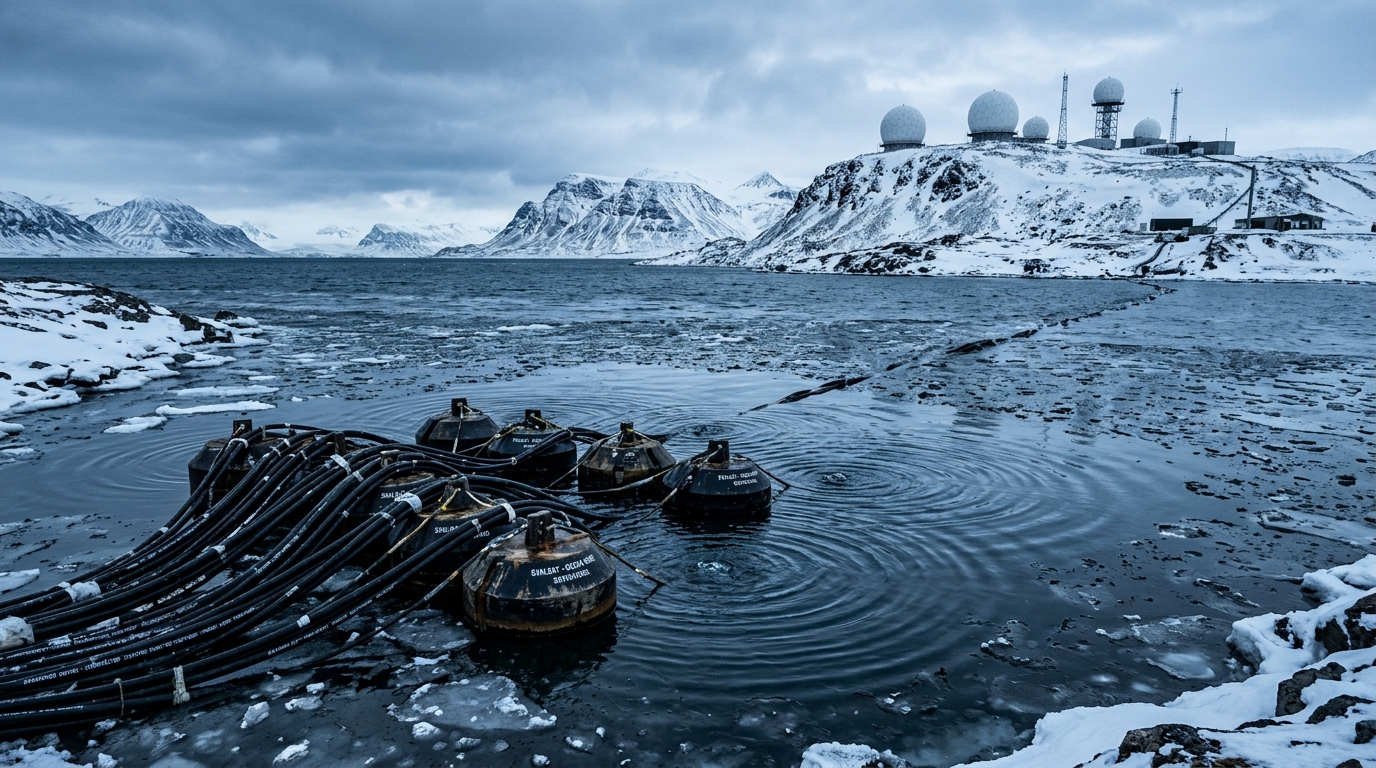
Subsea optical data streams converted into acoustic surface interference in Isfjorden. · motion: demultiplexing the sovereign optical signal into physical acoustic interference
wall text
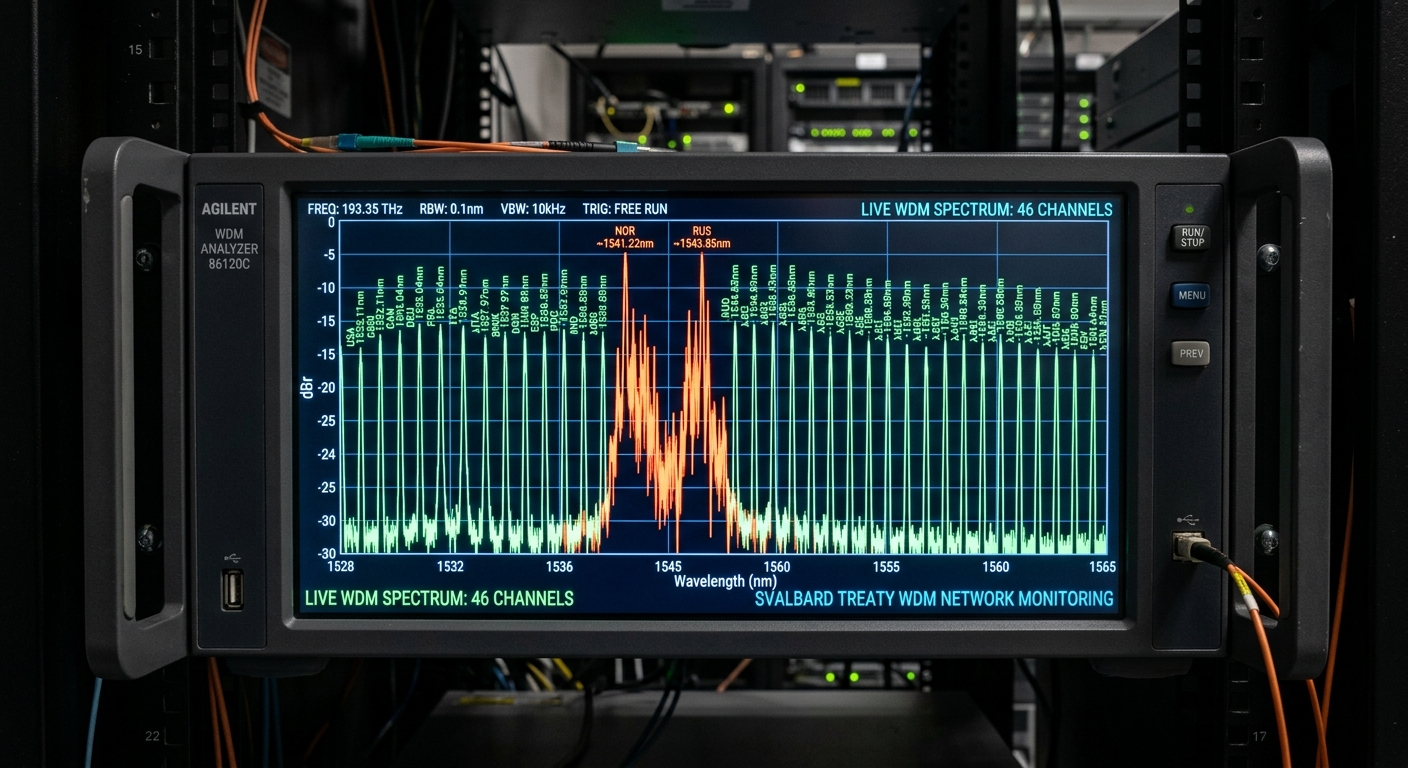
Under the 1920 Svalbard Treaty, 46 signatory nations retain equal commercial rights over the demilitarized archipelago, a legal neutrality sustained today through a single shared fiber-optic umbilical. This installation taps the SvalSat egress line using wavelength-division multiplexing (WDM) to isolate each signatory's data stream onto dedicated optical channels. Rather than routing packets to switches, each optical wavelength directly drives a submerged piezoelectric transducer in Isfjorden. The legal fiction of sovereign equality becomes physical turbulence: high-bandwidth nations generate violent localized cavitation, while low-traffic signatories produce faint standing ripples, rendering diplomatic friction as hydroacoustic interference.
shown: Installed permanently at the physical point where the Svalbard Undersea Cable System makes landfall in Longyearbyen, visible from the shore.
shown: Installed permanently at the physical point where the Svalbard Undersea Cable System makes landfall in Longyearbyen, visible from the shore.
anchor facts used
- Article 3 of the February 9, 1920 treaty grants absolute equal commercial access and entry to all 46 signatory nations.
- Article 9 strictly prohibits the establishment of any naval bases or fortifications, making it a demilitarized zone.
- The Svalbard Undersea Cable System connects the Svalbard Satellite Station (SvalSat) on Platåberget to mainland Norway, handling massive global earth observation data.
mechanism
- Wavelength-Division Multiplexing (WDM) — A custom optical multiplexer intercepts the raw fiber-optic egress from SvalSat, combining the earth observation data streams downloaded by the 46 different signatory nations into a single shared optical medium.
1. Interception and Multiplexing - Optical Demultiplexing — The combined optical signal is passed through a diffraction grating, splitting the data flow exactly into 46 distinct optical wavelengths, each mapped rigidly to a specific signatory nation's data traffic.
2. Sovereign Separation - Photonic-to-Acoustic Transduction — Each separated optical wavelength drives a dedicated high-voltage piezoelectric transducer submerged just below the waterline, converting the real-time bitrate of that nation's data flow into low-frequency acoustic vibrations.
3. Materialization of Traffic - Constructive and Destructive Interference — The 46 distinct acoustic waves physically collide in the fjord water, creating a standing wave pattern on the surface where data spikes from competing nations literally cancel out or amplify each other as physical ripples.
4. Frictional Mapping
lineage
- Trevor Paglen, 'Symbology' (2006) — Builds on Paglen's method of making classified sovereign operations visible, but shifts the focus from military visuality to civilian optical network infrastructure.
- Susan Schuppli, 'Material Witness' (2020) — Extends her framework of matter recording geopolitical events, taking it from historical trace into the real-time fluid dynamics of a physical waterway.
- Ryoji Ikeda, 'spectra' (2001-) — Argues against his pure, mathematically pristine sonic aesthetics by deliberately grounding the acoustic translation in messy, contested, and highly unequal treaty data.
curatorial qa (machine verdict, unedited)
SCORE 3/5 after 2 attempt(s)
READS: Subsea cable infrastructure in Arctic terrain, submerged transducers producing surface agitation, and WDM spectral analysis mapping national data channels.
FAILS: The direct transduction mechanism from 46 distinct optical wavelengths to individual acoustic frequencies looks like generic water bubbling rather than structured acoustic interference patterns.
READS: Subsea cable infrastructure in Arctic terrain, submerged transducers producing surface agitation, and WDM spectral analysis mapping national data channels.
FAILS: The direct transduction mechanism from 46 distinct optical wavelengths to individual acoustic frequencies looks like generic water bubbling rather than structured acoustic interference patterns.
spec: antigravity agent · keyframe/artifact: gemini-3.1-flash-image · video: veo-3.1 image-to-video · qa+wall text: gemini-3.7-flash watching the render · 40.5s total