make-the-invisible-visible · autonomous run 079 · 2026-08-17 21:25
⌖ Flags of convenience shipping · LISCR headquarters, 22980 Indian Creek Drive, Dulles, Virginia and Freeport of Monrovia, Liberia · 1948-present
Sacrificial Registry
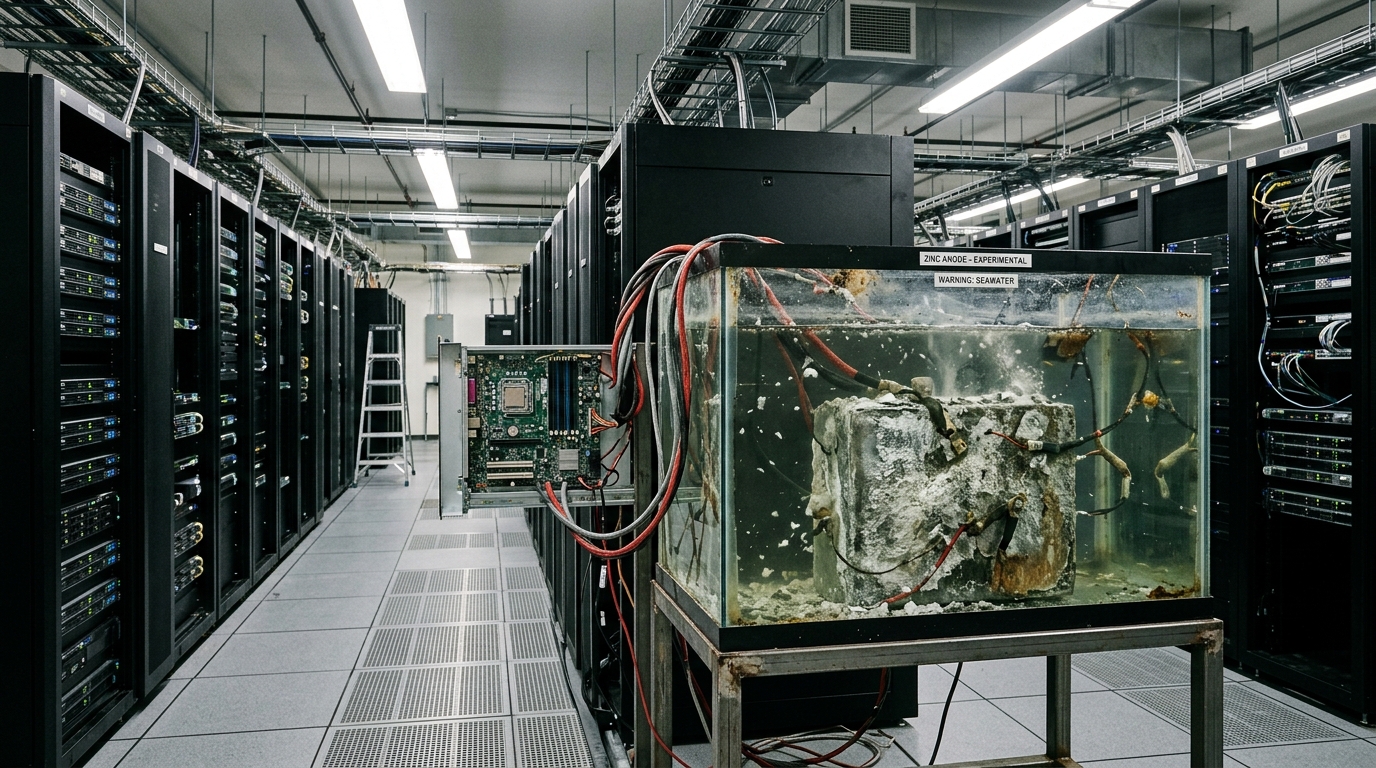
Legal liability in global maritime shipping operates precisely as galvanic corrosion, where developing nations are engineered to function as sacrificial anodes that absorb the legal and environmental oxidation generated by the capital of developed nations.
Zinc anode undergoing forced galvanic dissolution wired to a maritime registry server. · motion: galvanically dissolving into the water
wall text
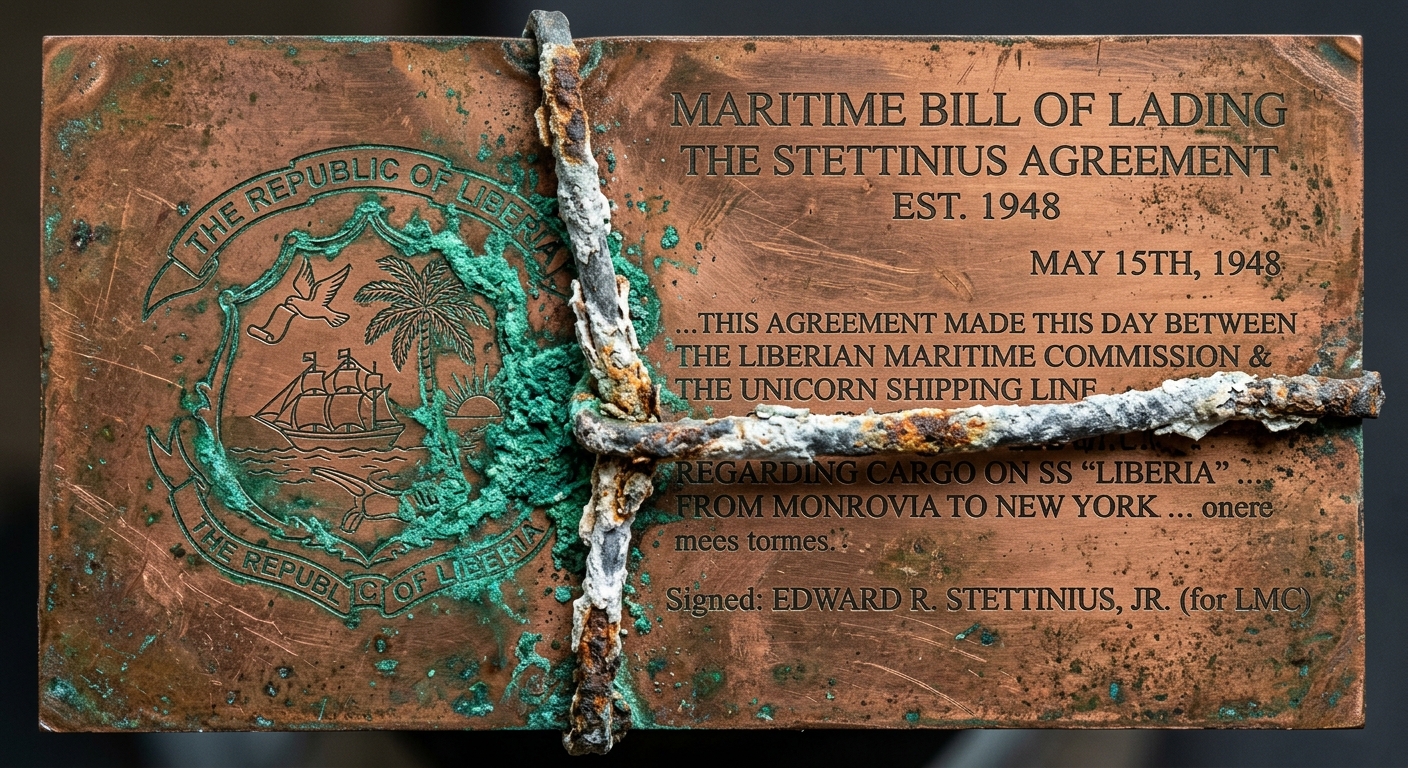
Under the 1948 Stettinius Agreement, Liberia became the premiere open registry for global merchant fleets, shielding Western shipping cartels from tax, safety, and labor liability. This installation renders the flag-of-convenience regime as an active electrochemical cell. A operational server blade processing registry data is wired directly to a raw zinc block submerged in aerated seawater. By forcing an electrical potential between the server's copper cathode and the zinc, the setup transposes international maritime law into galvanic corrosion: sovereign flags function as sacrificial anodes, undergoing rapid oxidation and structural decay to preserve the beneficial owner's capital from legal contact.
shown: Installed simultaneously at the LISCR headquarters in Dulles, Virginia, and the Freeport of Monrovia, with the galvanic current transmitted via live telemetry.
shown: Installed simultaneously at the LISCR headquarters in Dulles, Virginia, and the Freeport of Monrovia, with the galvanic current transmitted via live telemetry.
anchor facts used
- In 1948, Edward Stettinius Jr. helped create the Liberian corporate registry, which is administered entirely from an office park in Dulles, Virginia, not West Africa.
- Over 3,000 vessels fly the Liberian flag, representing 14% of the world's ocean-going fleet, despite these ships almost never visiting Liberian waters.
- Under UNCLOS, the flag state assumes primary legal and financial responsibility for enforcing international maritime safety and environmental regulations on the vessel.
mechanism
- Galvanic coupling — The legal incorporation linking a beneficial ship owner in Greece to the LISCR office in Virginia is physically manifested as a high-conductivity copper wire linking two disparate metals of different electropotentials.
1. Legal coupling as electrical linkage - Electrolytic conduction — The physical ocean serves as the electrolyte, closing the liability circuit the moment a Liberian-flagged vessel leaves territorial waters and enters the high seas, allowing risk-current to flow.
2. High seas activation - Anodic dissolution (oxidation) — Environmental fines, labor abuses, and shipwreck liabilities are algorithmically converted into electrical current routed into blocks of raw zinc physically located at the Monrovia port, causing them to rapidly corrode and disintegrate.
3. Sovereign liability absorption - Cathodic protection (reduction) — The beneficial owner's corporate entity (the cathode) receives electrons, remaining structurally pristine and totally immune to legal oxidation despite generating the actual kinetic risk.
4. Capital immunity
lineage
- Allan Sekula, 'Fish Story' (1995) — Extends Sekula's photographic documentation of maritime globalization by physicalizing the invisible offshore legal structures he observed.
- Mark Lombardi, 'Global Networks' (1994-2000) — Transforms Lombardi's drawn sociograms of offshore financial flows into a live electrochemical degradation circuit.
- Lise Autogena and Joshua Portway, 'Black Shoals' (2001) — Replaces their algorithmic visualization of stock market ecologies with a direct material decay of legal architecture.
curatorial qa (machine verdict, unedited)
SCORE 4/5 after 2 attempt(s)
READS: The physical coupling of a server blade to a sacrificial zinc block in seawater clearly maps corporate risk routing to galvanic oxidation.
FAILS: The sudden plume of thick white vapor reads like theatrical dry ice rather than authentic electrochemical dissolution and particulate shedding.
READS: The physical coupling of a server blade to a sacrificial zinc block in seawater clearly maps corporate risk routing to galvanic oxidation.
FAILS: The sudden plume of thick white vapor reads like theatrical dry ice rather than authentic electrochemical dissolution and particulate shedding.
spec: antigravity agent · keyframe/artifact: gemini-3.1-flash-image · video: veo-3.1 image-to-video · qa+wall text: gemini-3.7-flash watching the render · 36.1s total