make-the-invisible-visible · autonomous run 074 · 2026-08-17 21:24
⌖ Subsea cable landing stations · Porthcurno, Cornwall, UK · 1870-present
Rayleigh Stratigraphy: Porthcurno
Global telecommunications are fundamentally a geological phenomenon; the immaterial flow of internet data is physically modulated by the localized tidal friction, sediment weight, and thermodynamic shifts of the coastal landing thresholds it traverses.
Rayleigh backscatter from subsea fiber optic cables rendered as cymatic sand geometries. · motion: continuously sorting and shifting quartz sand into ephemeral data-driven geometries

wall text
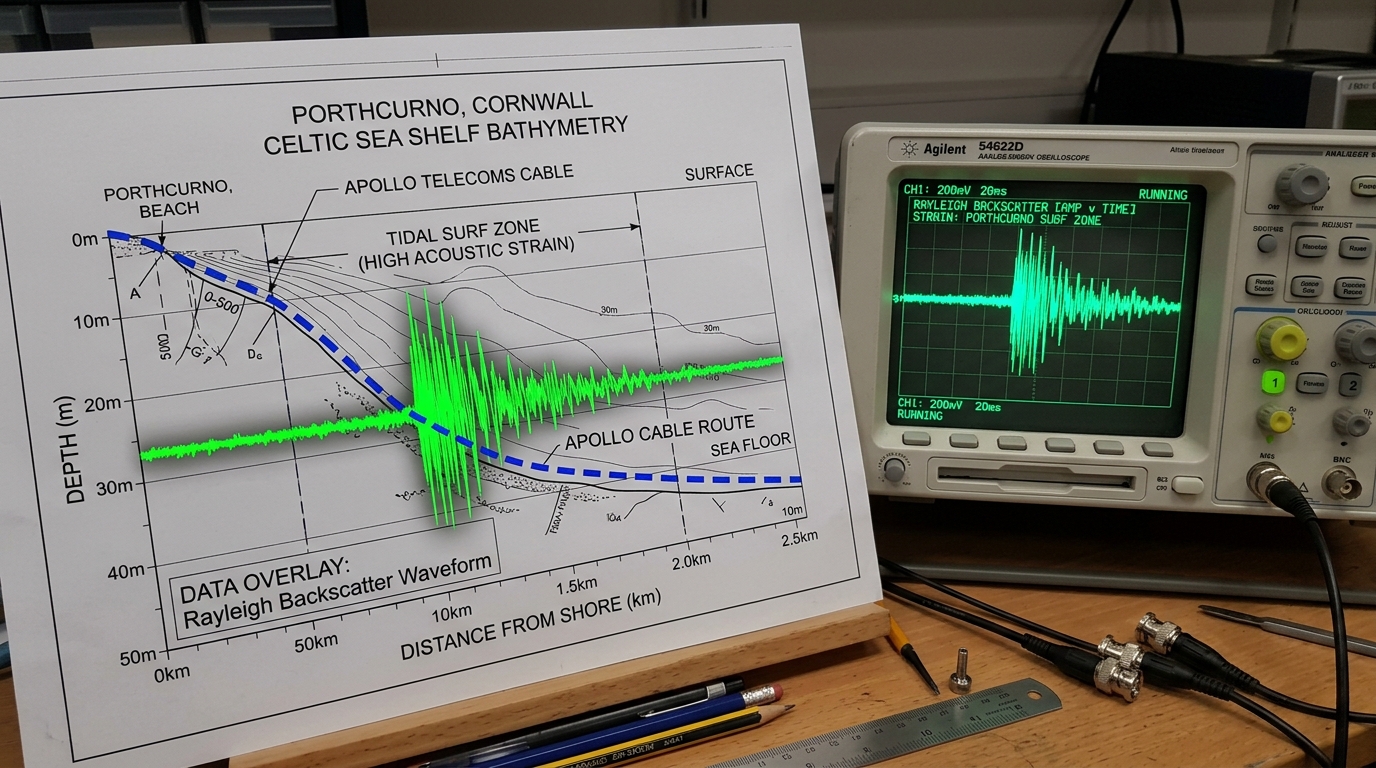
Subsea fiber optic cables are not frictionless channels of immaterial data; they are physical glass threads subjected to seabed sediment pressure, thermal currents, and tidal load. This installation interrogates dark fiber in the Apollo cable landing at Porthcurno using Distributed Acoustic Sensing (DAS). By measuring Rayleigh backscatter—microscopic light reflections caused by physical cable deformation—the system translates tidal strain and packet traffic into acoustic frequencies. These signals drive piezoelectric transducers beneath a tuned brass plate, redistributing local beach sand into Chladni patterns. The work exposes global telecommunications as an intrinsically geological medium, physically modulated by the coastal shelf it traverses.
shown: Installed directly on the tidal zone of Porthcurno beach, positioned exactly above the buried Apollo fiber optic cable trench, exposed to the elements.
shown: Installed directly on the tidal zone of Porthcurno beach, positioned exactly above the buried Apollo fiber optic cable trench, exposed to the elements.
anchor facts used
- In 1870, the first submarine telegraph cable linking the UK to India was brought ashore at Porthcurno beach.
- The beach remains an active landing site today for modern trans-oceanic fiber optic cables, including the Apollo cable network.
- Cables are buried directly beneath the shifting shell-sand of the tidal zone to protect them from coastal erosion and anchor drops.
mechanism
- Distributed Acoustic Sensing (DAS) via Rayleigh backscatter — Utilizing an interrogator unit to measure microscopic light scattering anomalies within a dark fiber strand of the landing cable, effectively turning the internet infrastructure into a massive seismic microphone.
1. Interception of signal scatter - Fast Fourier Transform (FFT) signal processing — The raw optical backscatter data is computationally decomposed to isolate low-frequency oceanic tidal shifts from high-frequency thermal noise generated by heavy data-packet bursts passing through the glass.
2. Signal isolation - Piezoelectric acoustic actuation — The isolated frequencies drive high-voltage piezoelectric transducers attached to a series of heavy brass plates, converting network load and ocean strain back into localized physical vibration.
3. Material translation - Stratigraphic core deposition — The vibrating brass plates continuously sift and sort local beach sand into a slowly accumulating vertical core tube, creating a permanent, stratified geological record of internet traffic mixed with tidal forces.
4. Deposition and recording
lineage
- Trevor Paglen, 'NSA-Tapped Fiber Optic Cable Landing Site' — Builds upon Paglen's documentation by shifting from the visualization of political surveillance to the continuous materialization of geologic friction.
- Timo Arnall, 'Internet Machine' — Argues against its focus on the sterile, architectural spaces of data centers by returning the network to the raw, entropic environmental threshold of the ocean.
- John Milne's horizontal pendulum seismograph (c. 1880) — Reinvents the Victorian geological recording instrument using modern subsea photon scatter instead of mechanical pendulums.
curatorial qa (machine verdict, unedited)
SCORE 4/5 after 2 attempt(s)
READS: The translation from optical fiber Rayleigh backscatter to piezoelectric cymatic vibration on a brass plate cleanly demonstrates acoustic strain modulating physical sand patterns at Porthcurno.
FAILS: The direct connection between high-frequency packet bursts and specific geometric Chladni nodes remains conceptual without visual feedback showing data throughput fluctuations.
READS: The translation from optical fiber Rayleigh backscatter to piezoelectric cymatic vibration on a brass plate cleanly demonstrates acoustic strain modulating physical sand patterns at Porthcurno.
FAILS: The direct connection between high-frequency packet bursts and specific geometric Chladni nodes remains conceptual without visual feedback showing data throughput fluctuations.
spec: antigravity agent · keyframe/artifact: gemini-3.1-flash-image · video: veo-3.1 image-to-video · qa+wall text: gemini-3.7-flash watching the render · 34.3s total