make-the-invisible-visible · autonomous run 073 · 2026-08-17 21:24
⌖ Equinix data centers in decommissioned bunkers · Frankfurt, Germany · 1980s (Bunker Construction) / Present (Data Node)
Psychrometric Exchange [FR4]
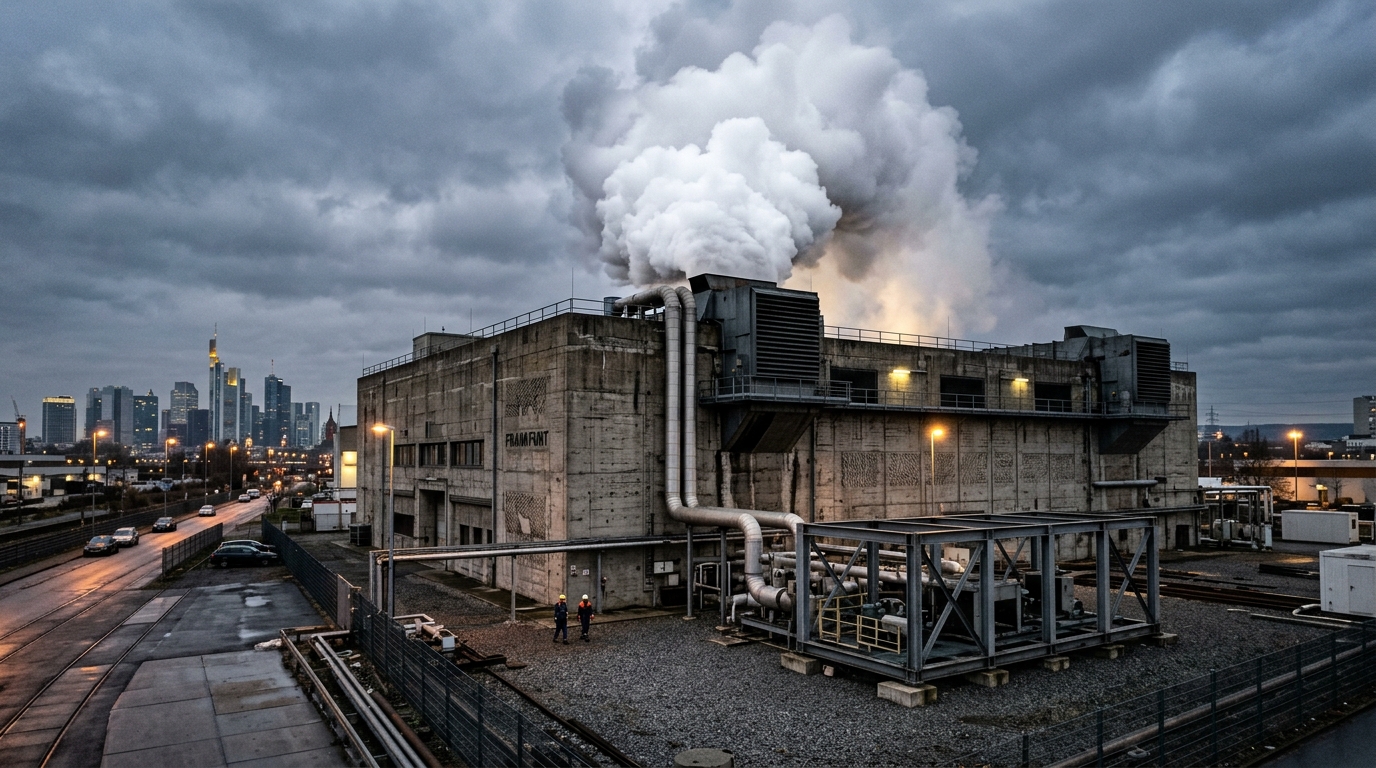
The architectural posture of the Cold War has inverted: a bunker engineered to protect human bodies from external nuclear heat now functions exclusively to contain and vent the continuous internal thermal radiation of the global digital economy.
Bunker condenser venting heat generated by DE-CIX data traffic into the atmosphere. · motion: billowing upward with thermodynamic turbulence
wall text
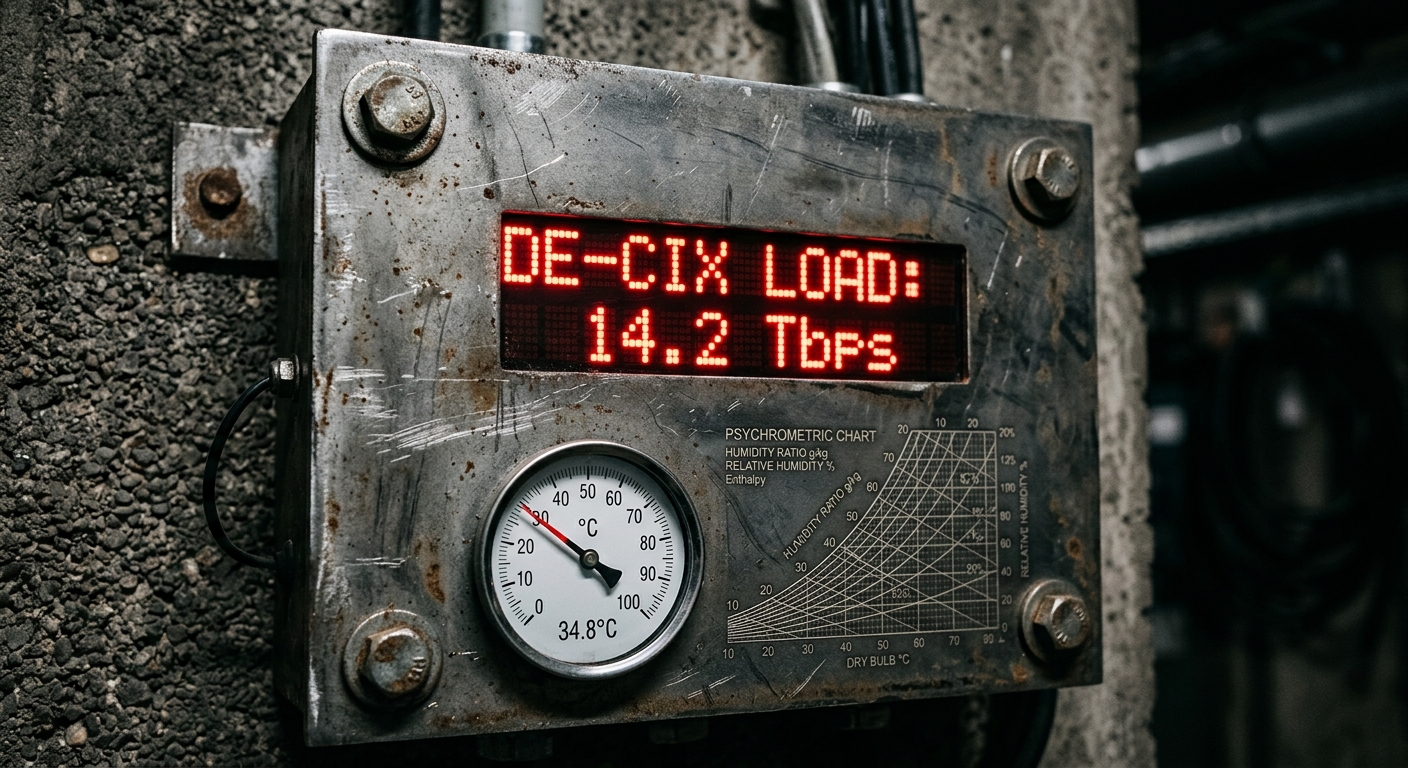
Originally constructed to withstand external nuclear blasts, this bunker in Frankfurt has been retrofitted to manage an inverted thermal threat: the waste heat of global data flows. Interfacing directly with the adjacent DE-CIX internet exchange, the installation polls network throughput via SNMP and computes real-time Joule heating generated across server clusters. As traffic surges past 14 terabits per second, sensible heat from the 35°C secondary chilled water loop is diverted into exterior condenser arrays, venting dense vapor into the atmosphere against the financial skyline. The work renders intangible algorithmic transactions as raw thermodynamic friction, exposing the physical footprint of digital networks.
shown: Installed as a permanent, weather-dependent land art intervention directly mounted over the external ventilation shafts of the Equinix facility in Frankfurt.
shown: Installed as a permanent, weather-dependent land art intervention directly mounted over the external ventilation shafts of the Equinix facility in Frankfurt.
anchor facts used
- Equinix FR4 operates directly adjacent to the DE-CIX infrastructure, the world's highest peak-traffic internet exchange.
- The decommissioned bunkers feature 2-meter thick reinforced concrete walls originally designed to withstand external thermal radiation from nuclear blasts.
- High-density server racks generate up to 15 kW of heat per rack, requiring continuous secondary chilled water loops to prevent hardware failure.
- Waste heat from Equinix facilities in Frankfurt is actively diverted into local district heating grids (Abwärmenutzung) via plate heat exchangers.
mechanism
- Simple Network Management Protocol (SNMP) polling — Data traffic telemetry is repurposed from a network management tool into the primary fuel variable for a thermodynamic control system.
1. Real-time capture of data traffic peaks at the DE-CIX Frankfurt node via secure network interfaces. - Power Usage Effectiveness (PUE) calculation and Joule heating computation — Intangible information flow is mathematically reduced to its unavoidable physical byproduct: waste heat expressed in continuous kilowatts.
2. Algorithmic translation of gigabits-per-second (Gbps) into exact thermal equivalents using the facility's baseline efficiency metrics. - Sensible heat transfer via counter-flow plate heat exchangers — The physical containment of the bunker is deliberately breached to externalize the thermal mass of algorithmic trading and cloud storage.
3. Diversion of the 35°C return water from the bunker's secondary cooling loop into a bespoke exterior condenser array. - Psychrometric saturation and dew point manipulation — The abstract digital 'cloud' is rendered as a literal, weather-making physical cloud of steam hovering directly over the militarized concrete.
4. Rapid vaporization of ambient atmospheric moisture above the bunker exhaust using the extracted heat, creating localized fog.
lineage
- Julian Oliver's 'Harvest' — Extends Oliver's physicalization of invisible computational processes by shifting from wind energy harvesting to thermodynamic waste externalization.
- Richard Box's 'Field' — Shares the strategy of making infrastructural energy visible in the landscape, substituting fluorescent light induction with psychrometric phase changes.
- Paul N. Edwards' 'A Vast Machine' — Inverts Edwards' theoretical framework of weather as a computational infrastructure to demonstrate computation as a literal climate-generating force.
curatorial qa (machine verdict, unedited)
SCORE 4/5 after 1 attempt(s)
READS: The brutalist bunker venting massive steam against the Frankfurt skyline clearly links physical containment with industrial thermodynamic exhaust. The telemetry unit directly bridges network throughput with cooling metrics.
FAILS: The video alone resembles a standard industrial boiler or power facility; the direct causal coupling between network packet spikes and steam volume relies heavily on the gauge artifact.
READS: The brutalist bunker venting massive steam against the Frankfurt skyline clearly links physical containment with industrial thermodynamic exhaust. The telemetry unit directly bridges network throughput with cooling metrics.
FAILS: The video alone resembles a standard industrial boiler or power facility; the direct causal coupling between network packet spikes and steam volume relies heavily on the gauge artifact.
spec: antigravity agent · keyframe/artifact: gemini-3.1-flash-image · video: veo-3.1 image-to-video · qa+wall text: gemini-3.7-flash watching the render · 39.4s total