make-the-invisible-visible · autonomous run 072 · 2026-08-17 21:24
⌖ Chunnel migrant crossings · Coquelles, Pas-de-Calais, France to Folkestone, Kent, UK · 2015-ongoing
Rayleigh Backscatter / 50.45km
State border security systems generate vast amounts of high-fidelity infrastructural noise; the presence of unauthorized biological bodies can be mathematically isolated from this kinetic energy as a structural acoustic signature.
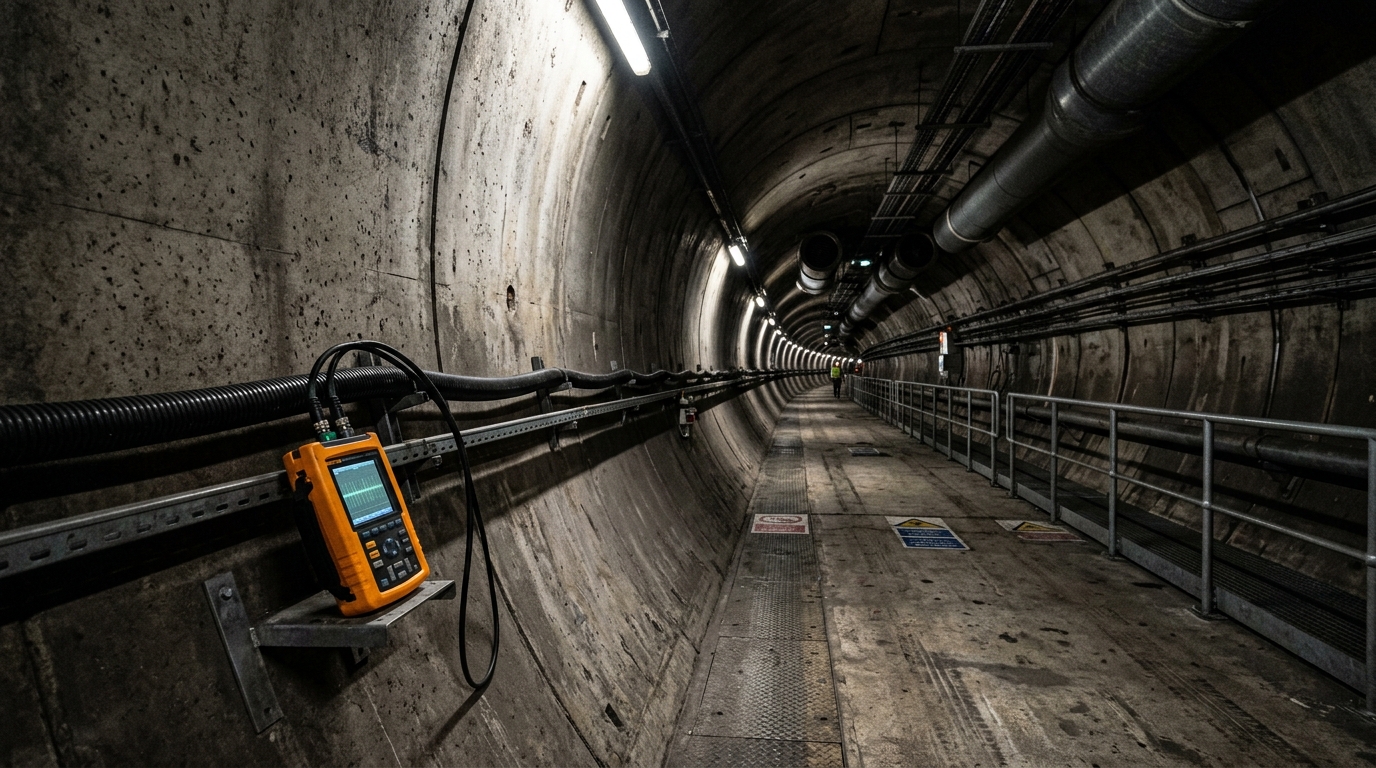
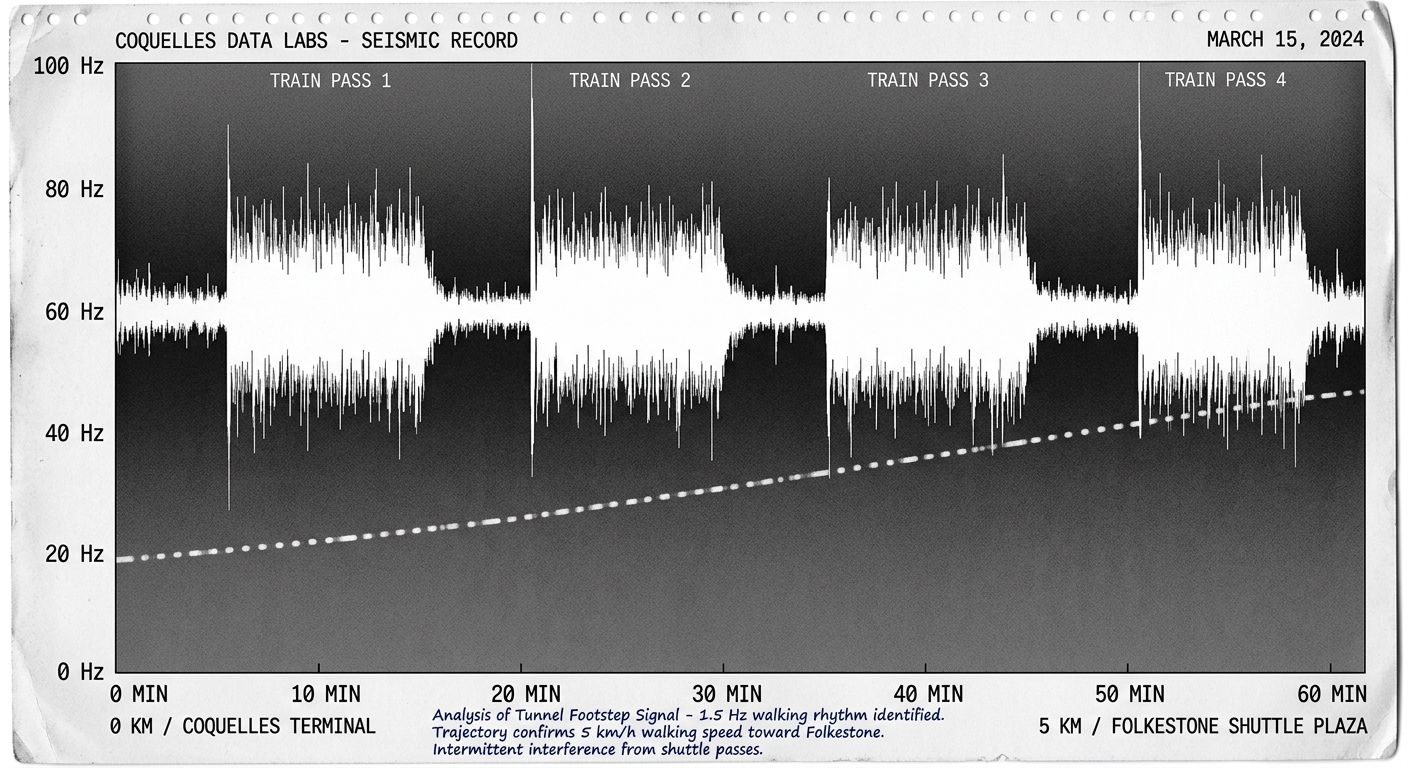
Optical interrogator tracking subterranean footsteps beneath 160 km/h train passes. · motion: rhythmic, isolated vibration rattling heavy steel
wall text
The Channel Tunnel generates massive kinetic noise that masks covert crossings. This installation repurposes telecommunication infrastructure through Distributed Acoustic Sensing (DAS) and Optical Time-Domain Reflectometry (OTDR). By injecting continuous laser pulses down dark fiber-optic cables lining the service tunnel, Rayleigh backscatter measures localized silica strain caused by micro-vibrations. Fast Fourier Transform (FFT) filtering separates low-frequency 1.5 Hz footfall cadences from the broad-spectrum roar of 160 km/h shuttle trains, converting concrete transport corridors into continuous subterranean listening arrays that mathematically isolate unauthorized human movement.
shown: Installed in an abandoned logistics warehouse directly abutting the A16 motorway in Calais, less than a mile from the Eurotunnel terminal perimeter.
shown: Installed in an abandoned logistics warehouse directly abutting the A16 motorway in Calais, less than a mile from the Eurotunnel terminal perimeter.
anchor facts used
- The Channel Tunnel is 50.45 km long, featuring a central service tunnel flanked by two rail tunnels.
- In July 2015, over 2,000 incursions into the Eurotunnel terminal at Coquelles occurred in a single night.
- Eurotunnel Shuttle trains travel at 160 km/h, creating massive aerodynamic and structural vibration.
- The perimeter is defended by 29 km of fencing, including 4-meter-high National Barrier Asset panels.
mechanism
- Distributed Acoustic Sensing (DAS) via Rayleigh backscatter — Repurposes standard telecommunications architecture as a 50km continuous subterranean microphone array to capture micro-vibrations.
1. Inject continuous interrogation laser pulses into an unused dark fiber-optic cable running along the concrete walls of the service tunnel to measure photon scattering. - Optical Time-Domain Reflectometry (OTDR) — Measures localized strain on the silica fiber to pinpoint exactly where pedestrian bodies are located in the total darkness.
2. Calculate the time delay of backscattered light to map acoustic events to precise longitudinal coordinates along the length of the fiber. - Fast Fourier Transform (FFT) signal isolation — Extracts the fragile, slow-moving biological signal from the overwhelming kinetic energy of industrial transport.
3. Apply spectral low-pass filtering to separate the 1-2 Hz frequency of human footfalls from the broad-spectrum structural noise. - Electromechanical transduction — Converts intercepted subterranean biometric data into violent, localized shaking of physical border architecture in the exhibition space.
4. Route isolated 1-2 Hz pedestrian signals to industrial pneumatic actuators physically attached to freestanding segments of high-security fencing.
lineage
- Susan Schuppli, 'Nature Represents Itself' (2018) — Extends her thesis on material witness by using the tunnel's own silica infrastructure to testify to hidden migration.
- Lawrence Abu Hamdan, 'Saydnaya (the missing 19db)' (2017) — Applies acoustic forensics and threshold analysis to vast subterranean infrastructural scales rather than enclosed carceral spaces.
- OptaSense distributed acoustic sensing (DAS) pipeline technology — Subverts commercial pipeline intrusion-detection algorithms to identify human vulnerability instead of protecting corporate assets.
curatorial qa (machine verdict, unedited)
SCORE 3/5 after 2 attempt(s)
READS: The service tunnel context, high-speed train passage generating kinetic turbulence, and the seismic chart artifact showing footfall extraction against train interference.
FAILS: The floating neon waveform superimposed on the tunnel wall appears as generic AR motion graphics rather than physical Distributed Acoustic Sensing or fiber-optic interrogation.
READS: The service tunnel context, high-speed train passage generating kinetic turbulence, and the seismic chart artifact showing footfall extraction against train interference.
FAILS: The floating neon waveform superimposed on the tunnel wall appears as generic AR motion graphics rather than physical Distributed Acoustic Sensing or fiber-optic interrogation.
spec: antigravity agent · keyframe/artifact: gemini-3.1-flash-image · video: veo-3.1 image-to-video · qa+wall text: gemini-3.7-flash watching the render · 37.7s total