make-the-invisible-visible · autonomous run 070 · 2026-08-17 21:24
⌖ Windrush scandal · Tilbury Docks, Essex and Lunar House, Croydon, UK · 1948-2018
Mark-and-Sweep: Tilbury to Croydon
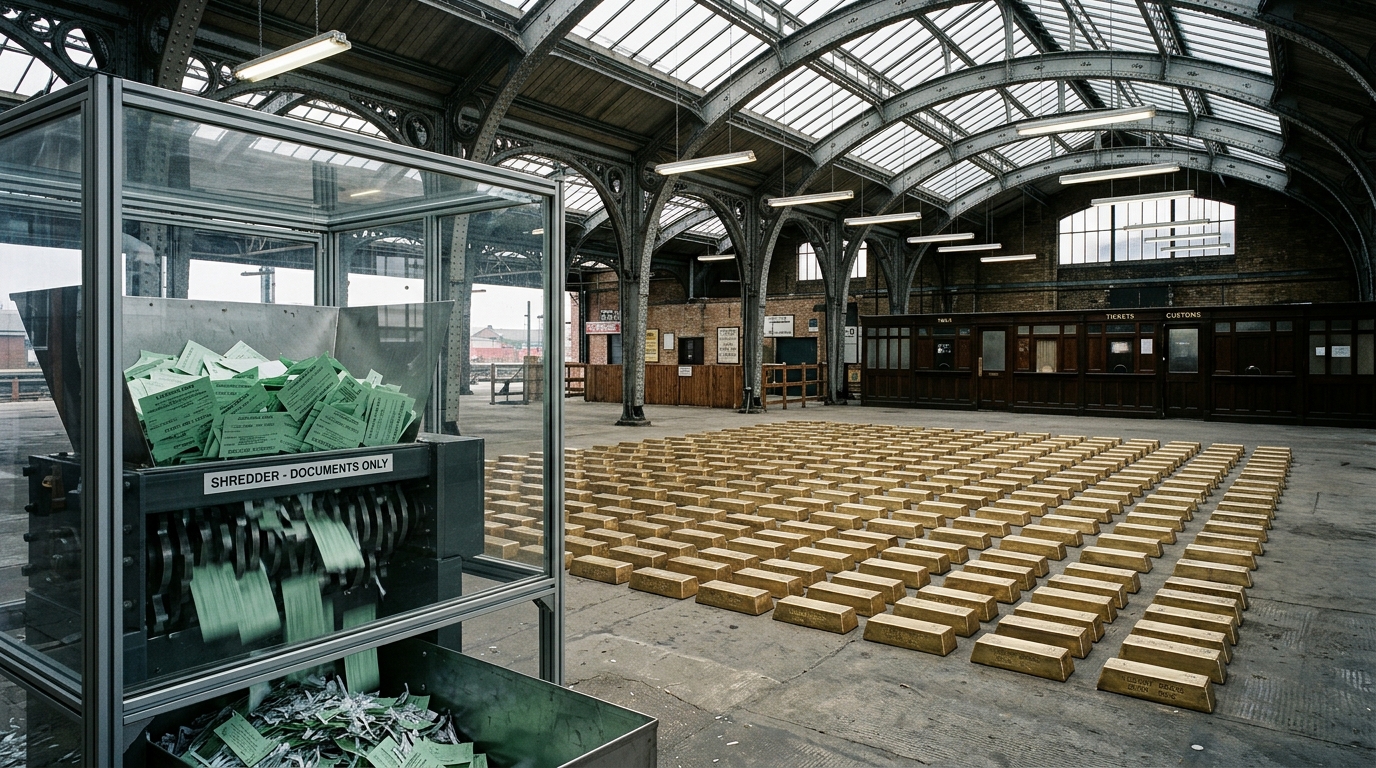
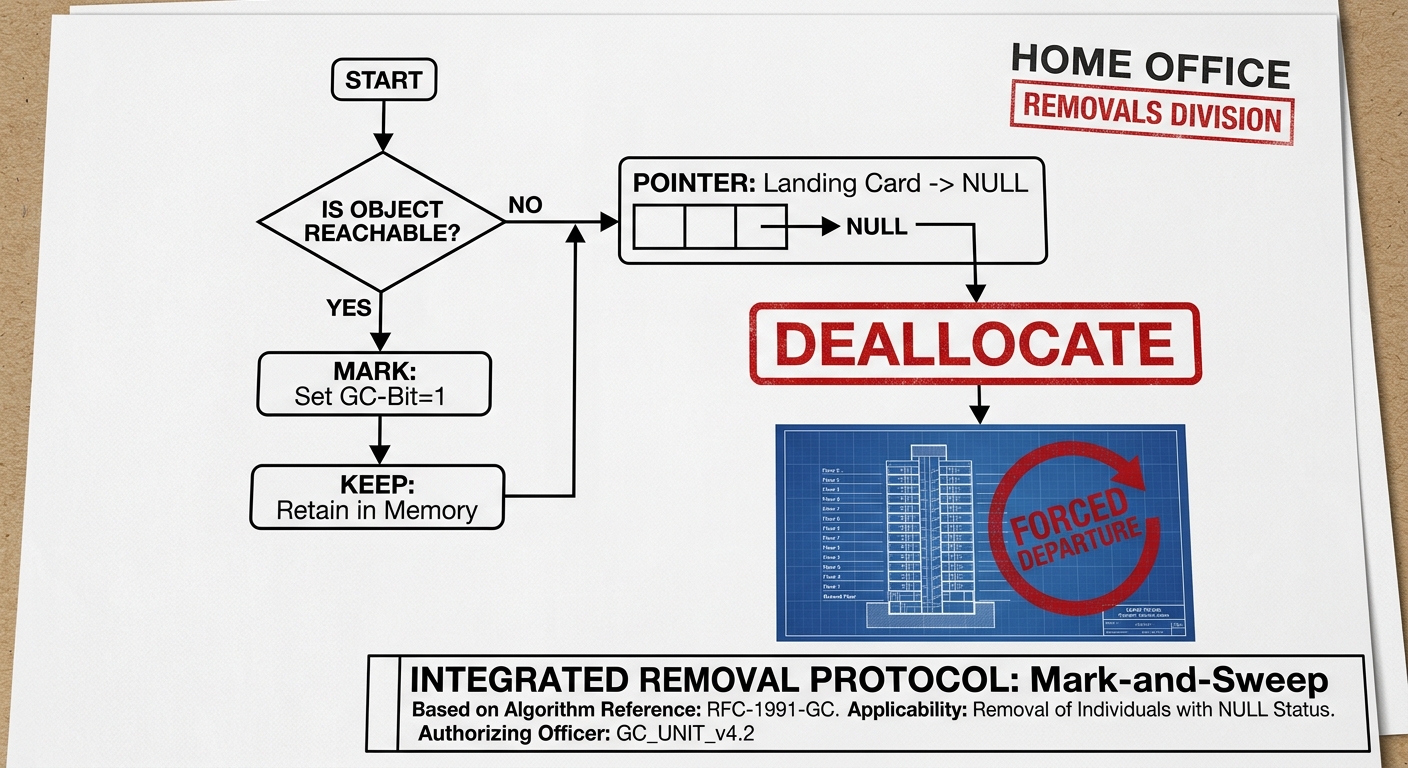
Bureaucratic erasure functions identically to algorithmic garbage collection: once the administrative 'root pointer' (the landing card) is severed, the state automatically designates physically integrated human beings as reclaimable space, nullifying decades of physical presence.
Garbage collector executing sweep phase on dereferenced physical presence. · motion: systematically scanning, un-marking, and ejecting un-referenced physical mass
wall text
In computing, mark-and-sweep garbage collection scans memory roots: objects lacking active pointers are flagged as unreachable and cleared. In 2010, the UK Border Agency destroyed thousands of paper landing cards recording arrivals from the Caribbean. Without these administrative root pointers, decades of physical presence were nullified under 'Hostile Environment' policies. This installation stages the computational equivalence. A glass-enclosed shredder steadily destroys punch-card records; unable to trace reference pointers back to the register, an automated gantry systematically scans the floor grid, treats the 802 dense brass ingots as dead allocation, and sweeps them onto an outbound conveyor belt for disposal.
shown: Installed within the original 1930s Riverside Railway Baggage Hall at Tilbury Docks, exactly where the passengers first disembarked.
shown: Installed within the original 1930s Riverside Railway Baggage Hall at Tilbury Docks, exactly where the passengers first disembarked.
anchor facts used
- HMT Empire Windrush brought 802 Caribbean passengers to Tilbury Docks on 22 June 1948.
- In 2010, the Home Office destroyed thousands of physical landing cards, erasing the only proof of arrival.
- The 2012 'Hostile Environment' policy required continuous documentary proof to maintain legal status, shifting the burden to citizens.
mechanism
- Memory Allocation — 802 heavy brass ingots are physically placed into the exhibition space, tracked via paper punch-cards mathematically bound to each ingot, acting as pointers.
1. Allocation - Pointer Severance — A mechanized industrial shredder digests the paper punch-cards at a steady, algorithmic rate, permanently severing the informational link to the brass ingots.
2. Dereferencing - Mark-and-Sweep Trace — An optical gantry scans the grid of ingots; without the corresponding intact paper 'root pointer', the physical ingot fails the algorithm's 'mark' phase despite its visible mass.
3. Reachability Analysis - Garbage Collection (Memory Reclamation) — An automated robotic arm physically ejects the 'unmarked' brass ingots from the grid onto a conveyor belt leading to an opaque shipping container.
4. Deallocation
lineage
- Hans Haacke, Shapolsky et al. Manhattan Real Estate Holdings, a Real-Time Social System, as of May 1, 1971 — Builds on Haacke's static mapping of real estate flows by moving into the automated algorithmic execution of human displacement.
- Forensic Architecture, Left-to-Die Boat — Extends the forensic reconstruction of state violence by transposing the state's passive administrative violence into a real-time, predictive mechanical simulation.
- John McCarthy, Recursive Functions of Symbolic Expressions and Their Computation by Machine, Part I (1960) — Takes McCarthy's foundational paper introducing mark-and-sweep garbage collection and transposes its memory management logic directly onto state immigration enforcement protocols.
curatorial qa (machine verdict, unedited)
SCORE 4/5 after 1 attempt(s)
READS: The shredder destroying green cards cleanly synchronizes with the overhead gantry and robotic arm systematically lifting brass ingots from the grid to the conveyor.
FAILS: The computational 'scan and mark' phase is implicit; optical sensors or targeting lasers scanning the unreferenced ingots before pickup would clarify reachability failure.
READS: The shredder destroying green cards cleanly synchronizes with the overhead gantry and robotic arm systematically lifting brass ingots from the grid to the conveyor.
FAILS: The computational 'scan and mark' phase is implicit; optical sensors or targeting lasers scanning the unreferenced ingots before pickup would clarify reachability failure.
spec: antigravity agent · keyframe/artifact: gemini-3.1-flash-image · video: veo-3.1 image-to-video · qa+wall text: gemini-3.7-flash watching the render · 43.1s total