make-the-invisible-visible · autonomous run 068 · 2026-08-17 21:24
⌖ Lampedusa · Pelagie Islands, Sicily, Italy · 2010s-present
Tail Drop / Molo Favaloro
The European border regime does not function as a humanitarian framework, but strictly as a Leaky Bucket traffic-shaping algorithm, converting human geographic displacement into raw stochastic network congestion that is buffered, throttled, and ultimately dropped when hardware limits are breached.
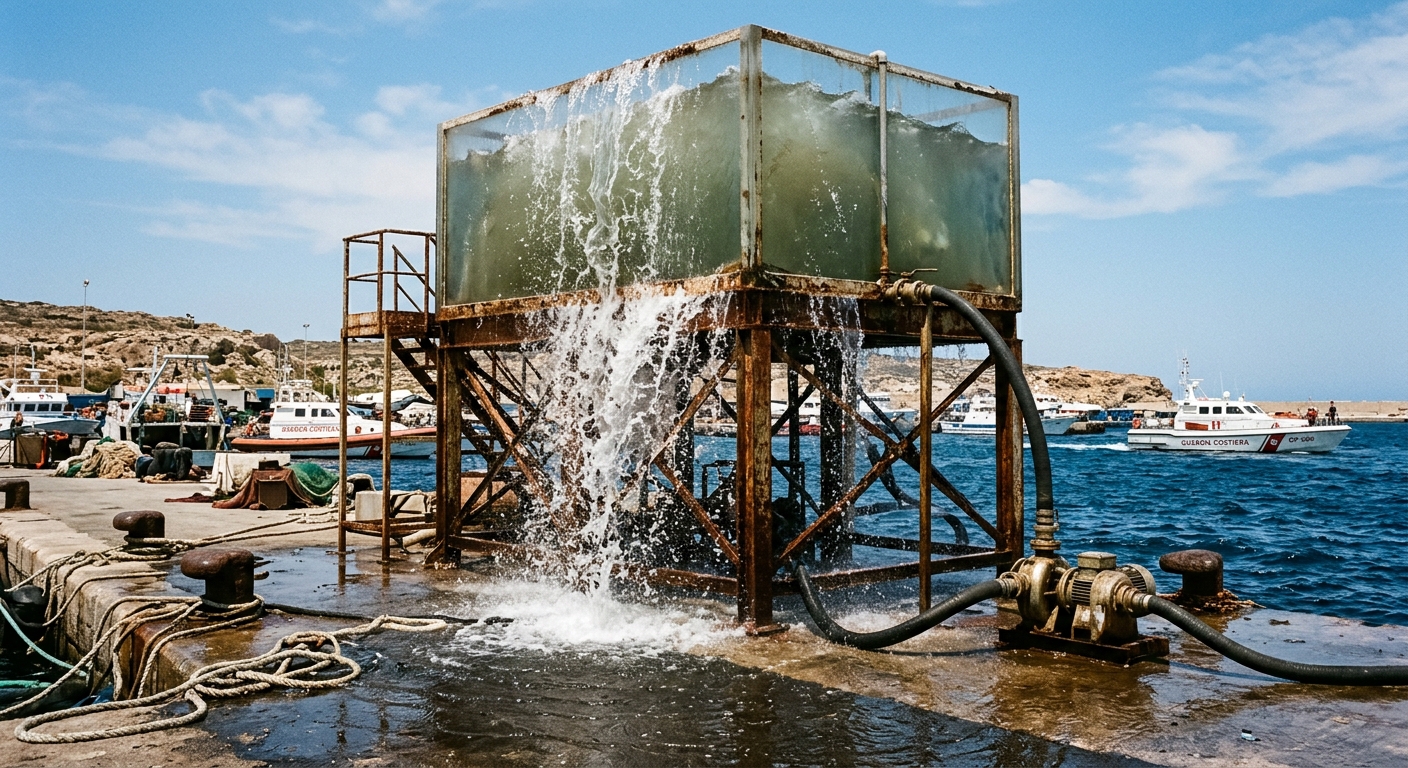
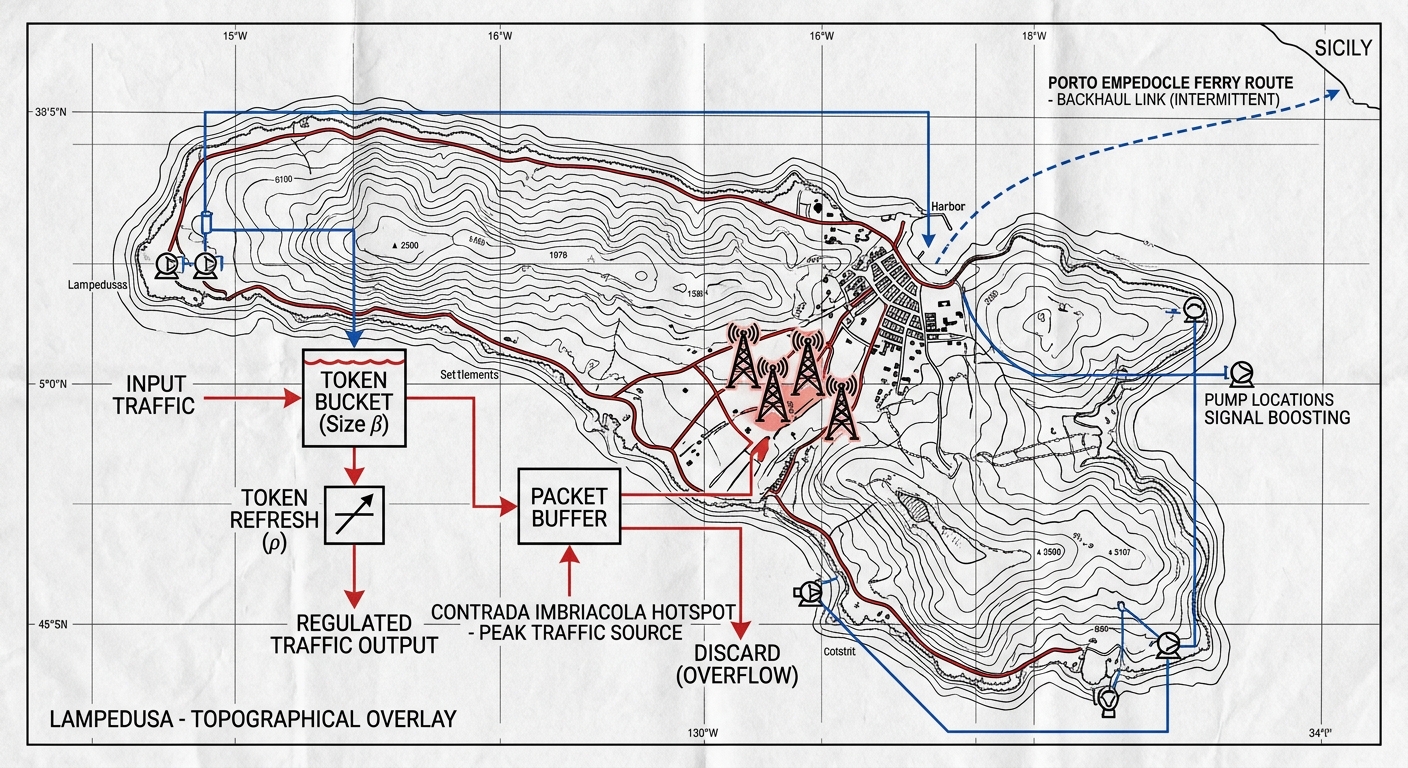
Seawater buffer overflow modeling queue saturation at the Lampedusa border hotspot. · motion: violently overtopping its algorithmic container
wall text
Set on Lampedusa's pier, this kinetic installation materializes the EU border regime as a leaky bucket traffic-shaping algorithm. Industrial pumps pull seawater directly from the harbor at volumes scaled to stochastic migrant arrivals at Molo Favaloro. The water enters a rigid, transparent tank holding exactly 389 liters—the legal capacity of the island's Contrada Imbriacola hotspot. A motorized valve trickles liquid out at the fixed rate of mainland ferry transfers. When arrivals spike, the queue breaches its buffer limit, triggering violent tail-drop overflow onto the concrete dock. The piece translates geographic displacement into network congestion, revealing administrative buffering and migrant detention as pure bandwidth management.
shown: Installed directly on the concrete expanse of Molo Favaloro in Lampedusa as an unsanctioned, parasitic hydraulic infrastructure during the peak summer crossing season.
shown: Installed directly on the concrete expanse of Molo Favaloro in Lampedusa as an unsanctioned, parasitic hydraulic infrastructure during the peak summer crossing season.
anchor facts used
- Contrada Imbriacola hotspot's official designed capacity of 389 persons.
- The Siremar commercial ferry serving as the primary constant transfer mechanism to Porto Empedocle.
- Molo Favaloro serving as the primary disembarkation pier for incoming boats.
- The September 2023 event where over 7,000 arrivals overwhelmed the island's infrastructure in a 48-hour window.
mechanism
- Packet arrival in a stochastic network model — AIS (Automatic Identification System) and VHF distress signals trigger industrial pumps to extract seawater directly onto the pier at a volume mathematically scaled to real-time disembarkation counts.
1. Ingress / Stochastic Burst Simulation - Data buffering in a finite memory queue — The pumped seawater enters an elevated, transparent industrial holding tank with a strict, unalterable volumetric limit of exactly 389 liters.
2. Buffering / Finite Queue Capacity - Token Bucket / Leaky Bucket constant egress rate — A motorized valve drains the holding tank at a rigid, unchangeable trickle, regardless of the inflow volume.
3. Throttling / Constant Leak Rate - Tail drop packet loss during network congestion — When the 389-liter tank exceeds capacity, raw seawater cascades directly over the top, aggressively flooding the concrete pier and creating a physical slip-hazard for border authorities.
4. Tail Drop / System Overflow
lineage
- Hans Haacke, 'Condensation Cube' (1965) — Expands Haacke's closed-system thermodynamics into an open-system geopolitical data-physicalization.
- Forensic Architecture, 'Liquid Traces: The Left-to-Die Boat' (2014) — Whereas Liquid Traces maps the ocean as a sensorium of state violence, this piece renders the bureaucratic processing of that violence as a physical flood.
- James Bridle, 'Seamless Transitions' (2015) — Shifts Bridle's visualization of invisible deportation infrastructure from pristine digital rendering to aggressive, space-claiming hydraulic reality.
curatorial qa (machine verdict, unedited)
SCORE 4/5 after 2 attempt(s)
READS: The mechanical metaphor lands clearly: seawater violently overflows the elevated rectangular buffer on the Lampedusa pier, driven by industrial pumps while the network diagram maps human movement directly to queue management.
FAILS: The constant-rate egress trickle is visually masked by the overwhelming violent spill, making the throttling mechanism less legible than the overflow drop.
READS: The mechanical metaphor lands clearly: seawater violently overflows the elevated rectangular buffer on the Lampedusa pier, driven by industrial pumps while the network diagram maps human movement directly to queue management.
FAILS: The constant-rate egress trickle is visually masked by the overwhelming violent spill, making the throttling mechanism less legible than the overflow drop.
spec: antigravity agent · keyframe/artifact: gemini-3.1-flash-image · video: veo-3.1 image-to-video · qa+wall text: gemini-3.7-flash watching the render · 60.3s total