make-the-invisible-visible · autonomous run 066 · 2026-08-17 21:24
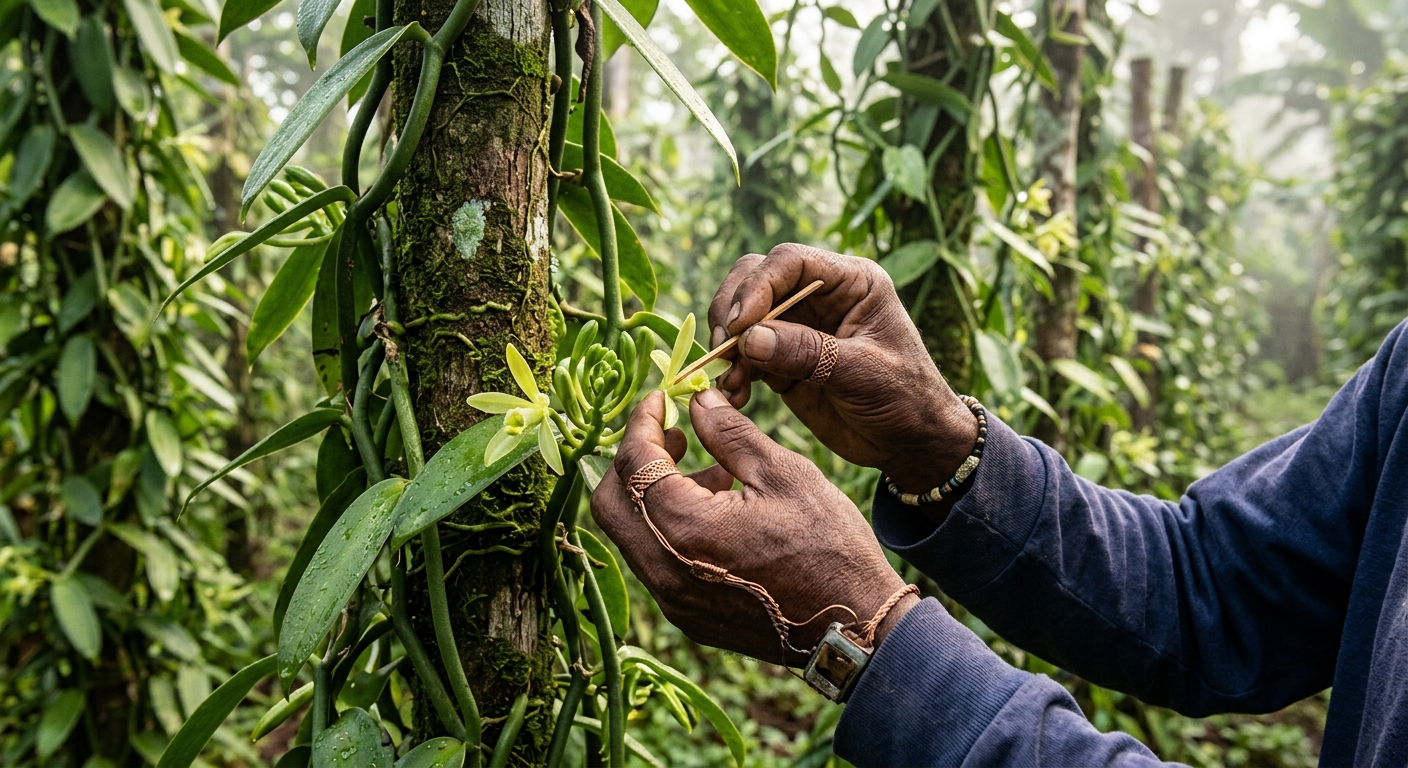
⌖ Vanilla pollination by hand · Sava Region, Madagascar · 1841-present
Albius Teleoperation Loop: Force-Feedback Commodity
The global flavor economy relies entirely on the unmechanizable, micro-kinematic labor of human hands in the Global South acting as biological prosthetics for a displaced ecosystem.
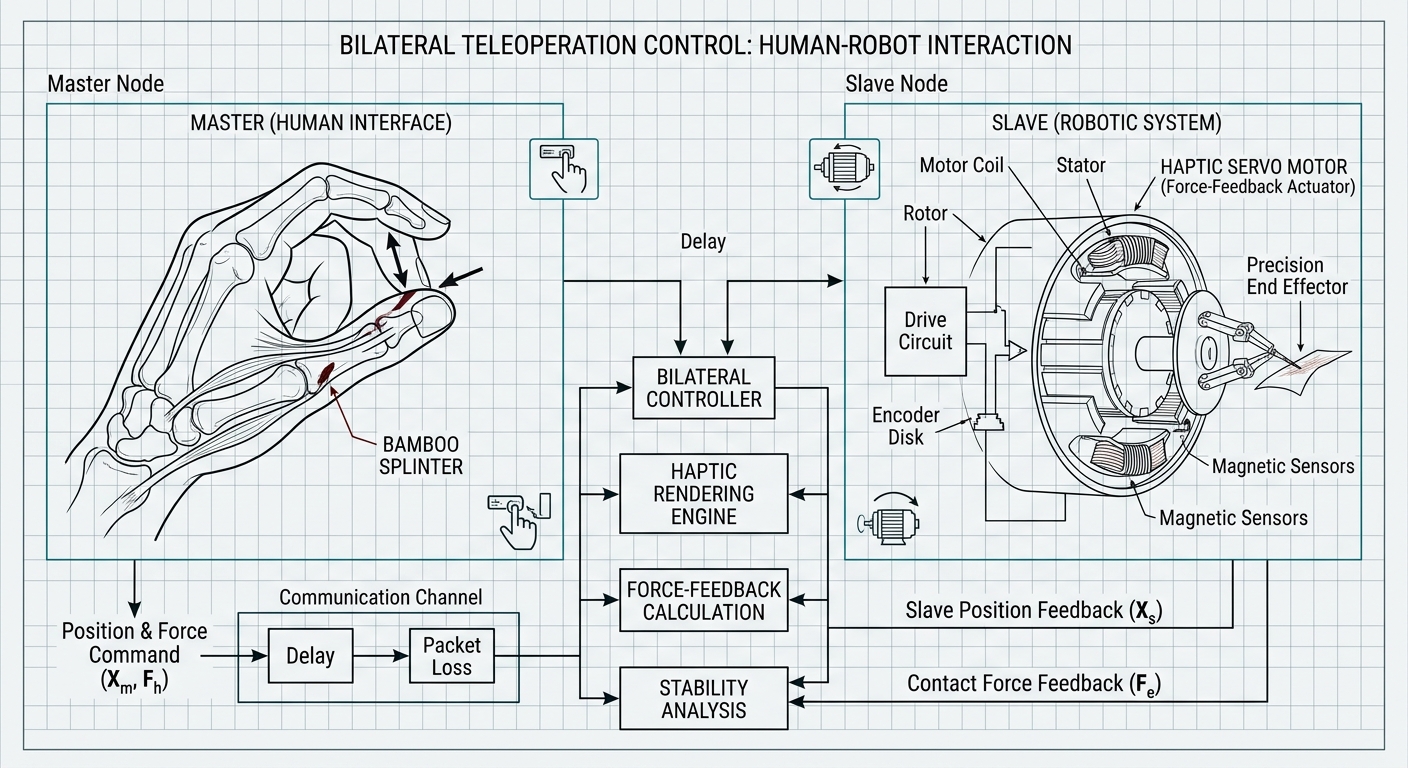
A robotic end-effector mirrors manual vanilla pollination gestures via haptic telemetry. · motion: micro-kinematic force translation
wall text
Every natural vanilla bean requires manual pollination, an intricate micro-kinematic gesture invented by Edmond Albius in 1841 to replace extinct native pollinators. This installation instruments Malagasy farmers with micro-IMU telemetry rings that capture pitch, roll, yaw, and contact force as they manipulate the rostellum with bamboo needles. Across the network, a bilateral teleoperation system mirrors these vectors in real time through high-torque haptic servo motors driving a mechanical end-effector. By transposing agrarian manual dexterity directly into remote physical actuation and cryptographic telemetry, the work diagrams global flavor supply chains as biological prosthetics, revealing the industrial dependence on manual gestures that remain entirely unmechanizable.
shown: Simultaneously installed as a live data-feed projection at the Antalaha vanilla market in Madagascar and as a kinetic force-feedback sculpture at the Euronext Paris commodity exchange.
shown: Simultaneously installed as a live data-feed projection at the Antalaha vanilla market in Madagascar and as a kinetic force-feedback sculpture at the Euronext Paris commodity exchange.
anchor facts used
- In 1841 on Réunion, an enslaved 12-year-old named Edmond Albius invented the technique of hand-pollinating vanilla using a stick and thumb.
- The natural pollinator, the Melipona bee, is geographically restricted to Central America, preventing natural pollination elsewhere.
- Today, Madagascar's Sava Region produces the vast majority of the world's vanilla, requiring manual pollination for every single pod.
mechanism
- Inertial Measurement Unit (IMU) kinematic tracking — Micro-IMU rings worn on the thumbs of Malagasy farmers capture the exact pitch, roll, and yaw vectors of the pollination gesture in real-time.
1. Sensor Deployment - Asynchronous UDP telemetry streaming — The vector data of each individual flower's pollination is time-stamped, geotagged via GPS, and transmitted via satellite uplink from the Sava region.
2. Signal Transmission - Bilateral haptic force-feedback actuation — A kinetic sculpture in a commodities exchange uses servo motors to recreate the exact force, resistance, and spatial trajectory of each remote pollination event.
3. Physical Actuation - Proof-of-Work (PoW) cryptographic hashing — The unique, non-repeatable kinematic signature of each human thumb motion serves as the cryptographic hash that mints the provenance certificate for that specific vanilla pod.
4. Value Instantiation
lineage
- Telegarden (Ken Goldberg, 1995) — Builds on its tele-robotic interaction by reversing the flow: transmitting rural agricultural labor data into an urban industrial display.
- Symmetry Breaking in Haptic Teleoperation (Passenberg et al., 2010) — Recontextualizes haptic asymmetry not as a robotic control problem, but as a visceral representation of the global economic disparity between producer and consumer.
- London Metal Exchange (LME) Ring trading — Argues against the abstract pricing of commodities by injecting the literal, physical force-feedback of the agricultural worker directly into the trading floor environment.
curatorial qa (machine verdict, unedited)
SCORE 4/5 after 2 attempt(s)
READS: Direct kinematic mirroring between the farmer's thumb-mounted IMU gestures and the robotic gripper's synchronized physical actuation.
FAILS: The cryptographic provenance hashing mechanism is entirely absent from the video, remaining purely conceptual in the text.
READS: Direct kinematic mirroring between the farmer's thumb-mounted IMU gestures and the robotic gripper's synchronized physical actuation.
FAILS: The cryptographic provenance hashing mechanism is entirely absent from the video, remaining purely conceptual in the text.
spec: antigravity agent · keyframe/artifact: gemini-3.1-flash-image · video: veo-3.1 image-to-video · qa+wall text: gemini-3.7-flash watching the render · 39.4s total