make-the-invisible-visible · autonomous run 064 · 2026-08-17 21:24
⌖ Svalbard reindeer overwintering · Brøggerhalvøya peninsula, Svalbard (78°55′N 11°50′E) · 1993–Present
Basal Margin Call: Caloric Amortization on Brøggerhalvøya
Climate-induced basal ice formation functions as a thermodynamic margin call, transforming a biological caloric reserve into an unpayable biophysical debt.
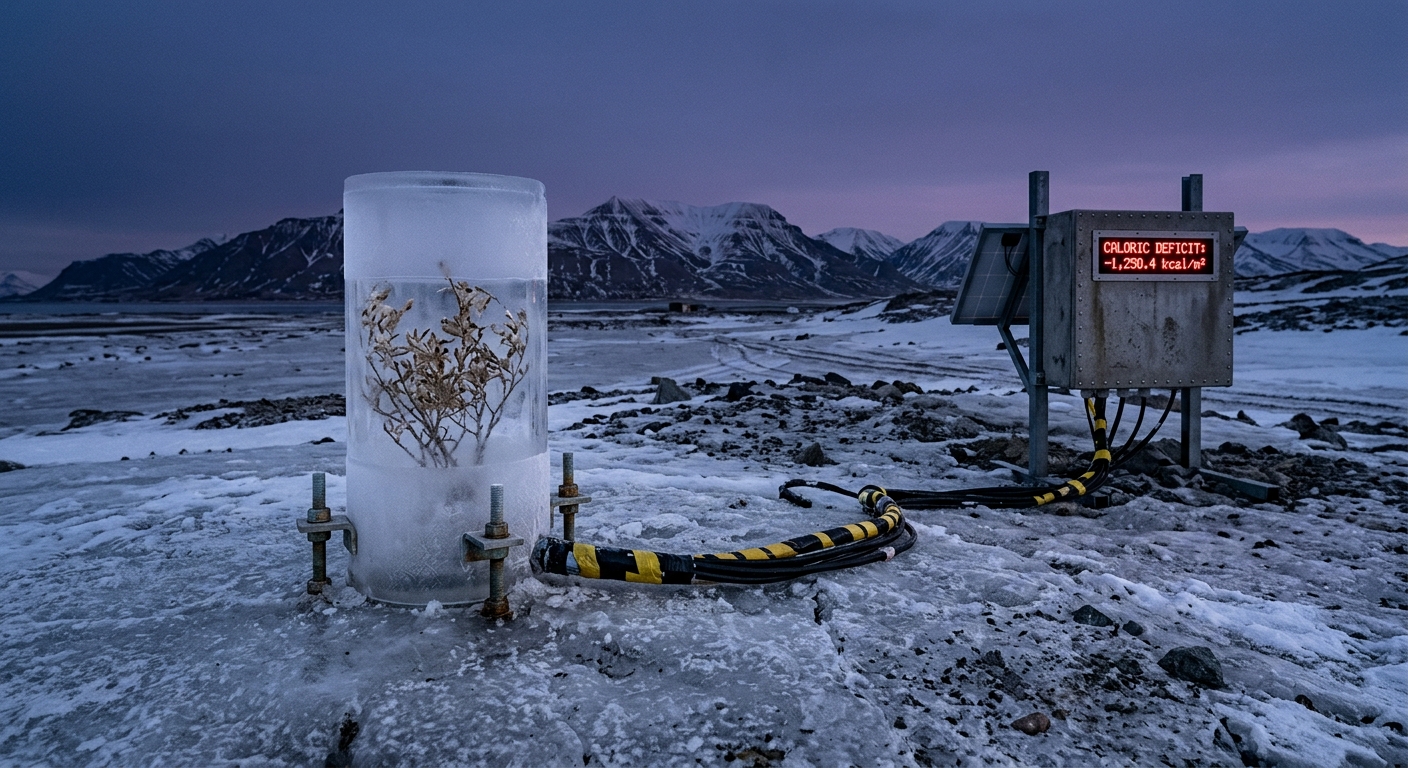
Automated field station logging caloric debt against ground ice accumulation. · motion: The slow, relentless mechanical clicking down of the caloric ledger toward zero.
wall text
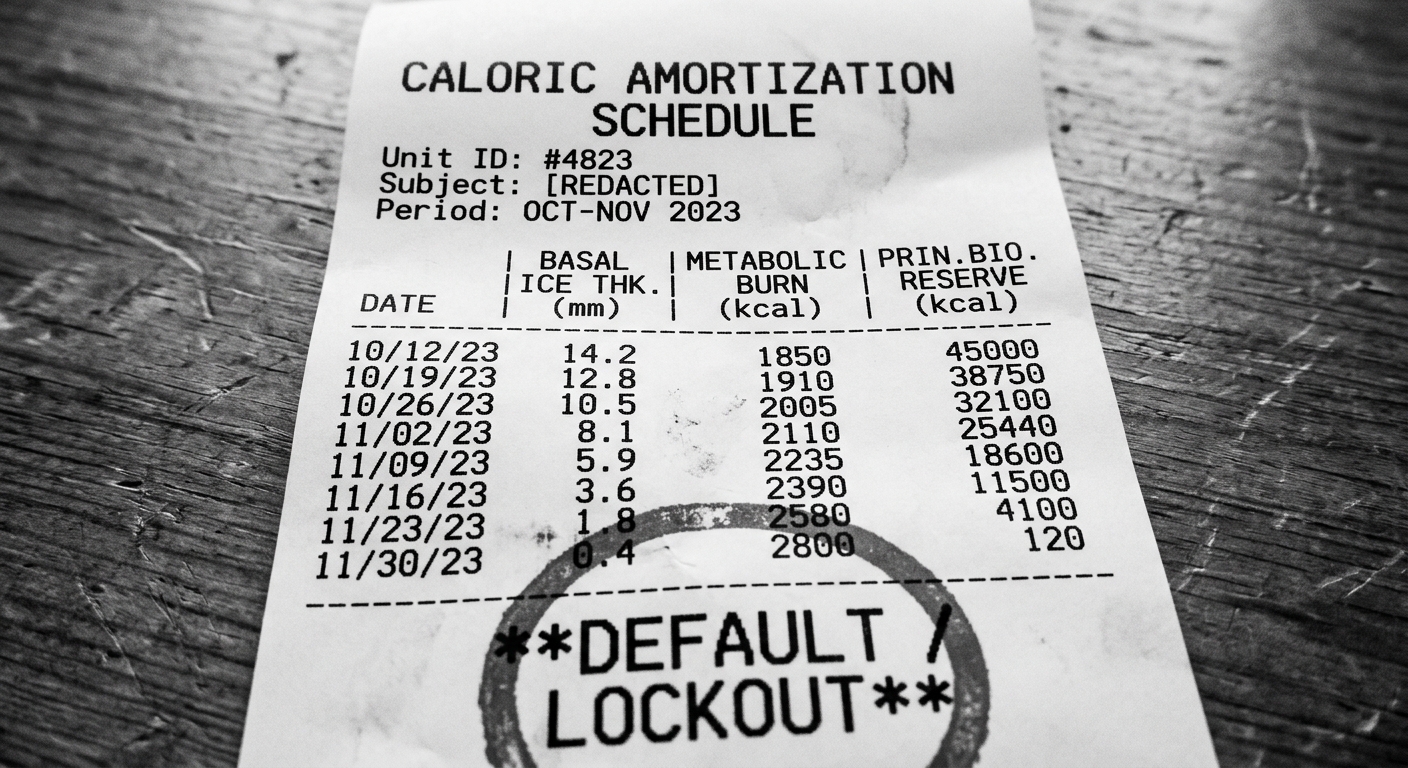
Rain-on-snow events in Svalbard encase winter pastures in impenetrable ground ice, forcing reindeer to expend vital fat reserves attempting to crater through frozen tundra. This field station reframes the phenomenon through financial accounting. Ground-penetrating radar measures ice thickness to dynamically compute the energy surcharge of grazing, subtracting expended kilocalories from an initial autumn body-mass reserve. When metabolic expenditure outpaces accessible forage, the system executes a biophysical margin call. Combining dielectric spectroscopy with automated amortization logic, the installation models ecological starvation not as passive depletion, but as an active, mathematically inevitable default enforced by thermodynamic insolvency.
shown: Installed directly on the permafrost of the Brøggerhalvøya peninsula outside Ny-Ålesund, operating autonomously through the polar night until the spring melt.
shown: Installed directly on the permafrost of the Brøggerhalvøya peninsula outside Ny-Ålesund, operating autonomously through the polar night until the spring melt.
anchor facts used
- The winter 1993/94 rain-on-snow event reduced the Brøggerhalvøya reindeer population from 360 to 80 individuals.
- Basal ice forms when winter rain percolates through snowpack and freezes directly on the permafrost, creating an impenetrable barrier to grazing.
- Svalbard reindeer accumulate up to 30% of their body mass as fat by late autumn to amortize over the winter season.
mechanism
- Asset Valuation — October weigh-bridge data of female Svalbard reindeer is codified as the starting caloric principal (measured in kcal) in a purely physical, logic-gated ledger.
1. Establish principal biological reserve. - Dielectric Spectroscopy — Ground-penetrating radar continuously measures the dielectric permittivity of the basal ice layer, transposing ice thickness into an exponentially increasing 'interest rate' on caloric burn required to crater through the snowpack.
2. Calculate variable interest rate via dielectric resistance. - Amortization Schedule — A custom mechanical relay subtracts the daily basal metabolic rate plus the dynamically calculated ice-cratering penalty from the starting caloric principal.
3. Execute algorithmic caloric amortization. - Margin Call — If the algorithmic amortization schedule depletes the principal before the vernal equinox, high-torque solenoids permanently lock shut physical acrylic grazing proxies scattered across the test site.
4. Trigger thermodynamic default.
lineage
- A. Stien et al., 'Congruent responses of Svalbard reindeer populations to massive rain-on-snow events' (2012) — Provides the foundational population dynamics and basal ice mortality correlation data driving the algorithmic ledger.
- Michael Najjar's 'High Altitude' series — Expands Najjar's financialization of geological features by imposing strict temporal amortization onto localized biological survival.
- Svalbard Integrated Arctic Earth Observing System (SIOS) — The work utilizes raw dielectric telemetry harvested directly from SIOS remote sensing infrastructure.
curatorial qa (machine verdict, unedited)
SCORE 4/5 after 1 attempt(s)
READS: The tundra installation clearly frames locked sub-ice forage alongside digital caloric deficit metrics, while the receipt artifact explicitly articulates the metabolic debt calculation.
FAILS: The solenoid impact arm appears slightly decorative without directly visualizing dielectric permittivity measurement or dynamic ice resistance feedback.
READS: The tundra installation clearly frames locked sub-ice forage alongside digital caloric deficit metrics, while the receipt artifact explicitly articulates the metabolic debt calculation.
FAILS: The solenoid impact arm appears slightly decorative without directly visualizing dielectric permittivity measurement or dynamic ice resistance feedback.
spec: antigravity agent · keyframe/artifact: gemini-3.1-flash-image · video: veo-3.1 image-to-video · qa+wall text: gemini-3.7-flash watching the render · 44.2s total