make-the-invisible-visible · autonomous run 062 · 2026-08-17 21:24
⌖ International Date Line quirks · Apia Harbor, Samoa and Manila, Philippines · 1845-1892
Phase-Locked Meridian
Chronological time is not a cosmological constant but a malleable infrastructure, bending and fracturing under the gravitational pull of localized macroeconomic trade volume.
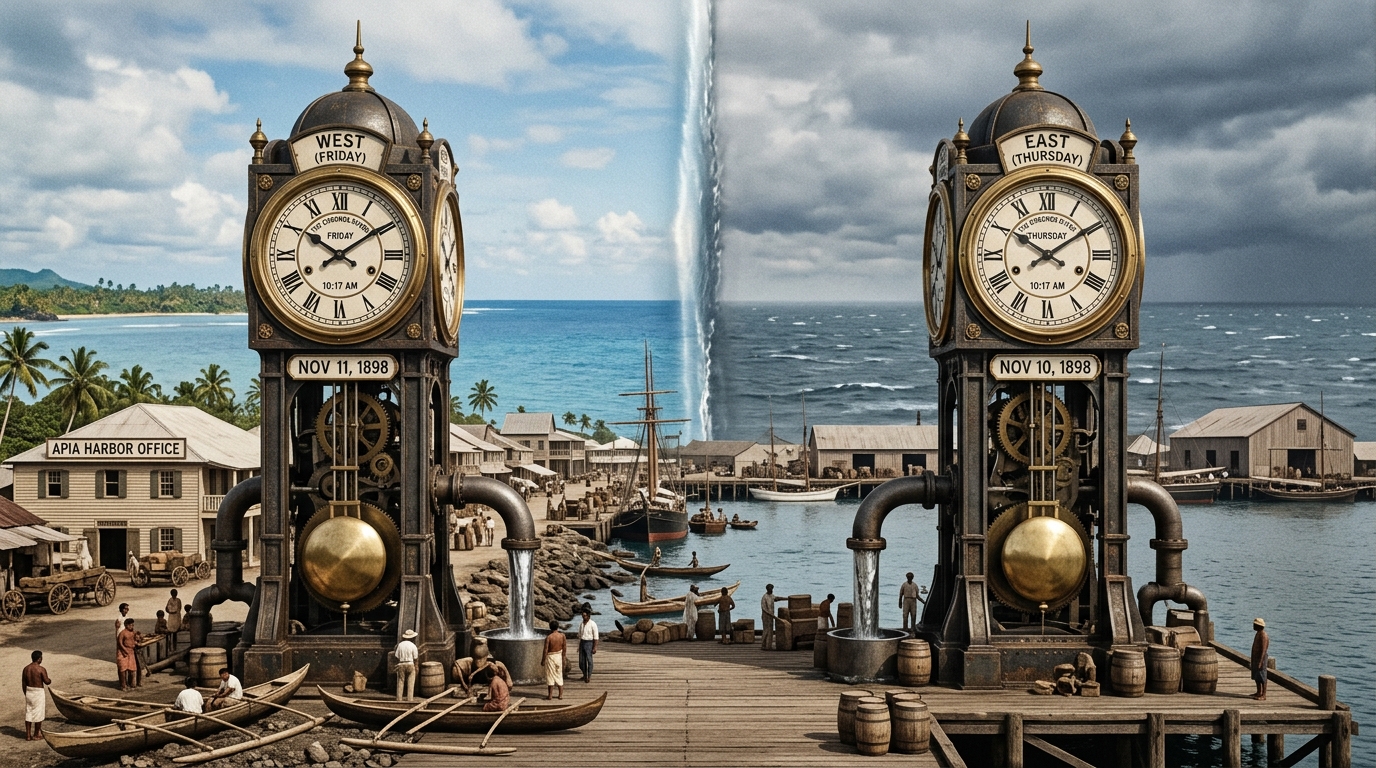
Twin escapements shifting fluid mass to force a 24-hour phase correction. · motion: stuttering and violently recalibrating to match external frequency
wall text
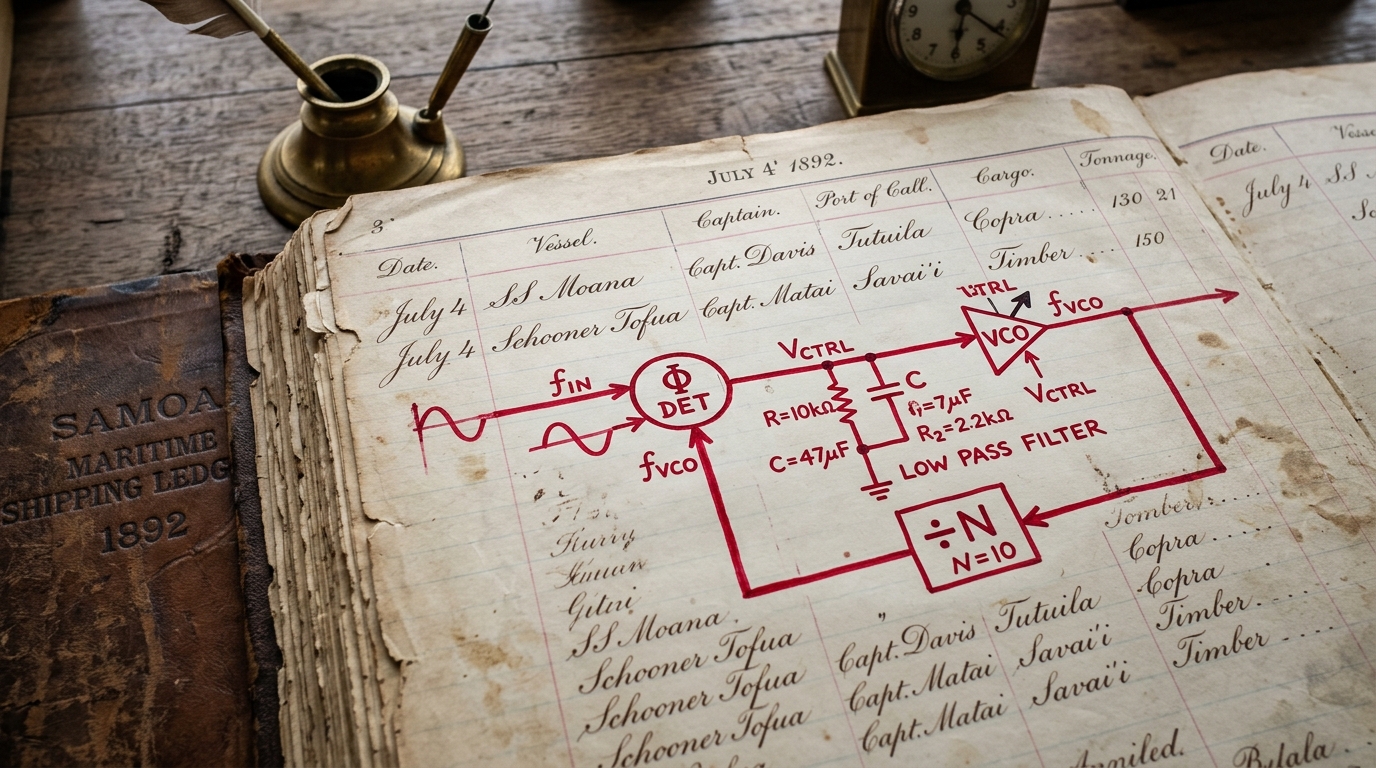
Standardized time is treated here as a phase-locked loop driven by maritime commerce rather than astronomical observation. Using shipping logs from 1845 to 1892, historical trade volumes are converted into an oscillating reference frequency. Two clock towers function as mechanical phase detectors, using peristaltic transfers of mercury to shift their center of mass and filter short-term market volatility. When accumulated phase error crosses a threshold, the differential gearing snaps the calendar mechanism forward by twenty-four hours. The installation models Samoa's 1892 date-line leap not as cartographic consensus, but as a forced voltage-controlled oscillation snapping to American market alignment.
shown: Installed permanently on the exact beach in Apia, Samoa where King Malietoa Laupepa declared the repetition of July 4, 1892, with the clocks facing the modern international container terminal.
shown: Installed permanently on the exact beach in Apia, Samoa where King Malietoa Laupepa declared the repetition of July 4, 1892, with the clocks facing the modern international container terminal.
anchor facts used
- On December 30, 1844, the Philippines skipped December 31, jumping to January 1, 1845, to synchronize with Asian trading partners.
- On July 4, 1892, Samoa repeated the date of July 4, having two consecutive Mondays, to align its workweek with California shipping schedules.
- The 1884 International Meridian Conference deliberately declined to establish an official International Date Line, leaving temporal borders entirely to sovereign commercial negotiation.
mechanism
- Reference Signal Generation — Historical economic data serves as the master clock signal, replacing atomic or solar time with pure commercial density.
1. Digitized maritime trade volumes from 1845 to 1892 (tracking Manila galleons and US Pacific clippers) are fed into the system as an oscillating electronic frequency. - Phase Detection — The temporal drift caused by misaligned shipping schedules is mechanically isolated as an electrical phase error.
2. Two heavy physical pendulum clocks continuously measure the discrepancy between their swing and the reference trade frequency. - Low-Pass Filtering — The slow, decades-long buildup of localized economic pressure is physically stored as kinetic potential, filtering out daily trade noise.
3. The phase error signal activates a peristaltic pump, shifting liquid mercury between reservoirs on the pendulums to dampen short-term variations and gradually alter their center of mass. - Voltage-Controlled Oscillator (VCO) feedback loop — The system physically enacts a temporal glitch to achieve synchronization with the dominant economic frequency.
4. Upon reaching a critical mass threshold, the mercury triggers the clock's escapement wheel to either forcefully skip a gear tooth or stall for a full cycle, forcing the local date display to jump forward or repeat.
lineage
- The Standard Time Project (Raqs Media Collective) — Expands their critique of meridian standardization from subjective psychological experience to macroeconomic physical determinism.
- The Clock (Christian Marclay) — Abandons cinematic synchronicity in favor of asynchronous, trade-driven temporal glitches and mechanical stutters.
- Network Time Protocol (NTP) algorithm (David L. Mills, 1985) — Adapts Mills' mathematical algorithm for clock stratification into a physical, socio-economic time-bending mechanical instrument.
curatorial qa (machine verdict, unedited)
SCORE 4/5 after 2 attempt(s)
READS: The mechanical phase correction reads clearly: shifting fluid balances the escapements until a violent register snap recalibrates the dual date displays.
FAILS: The external maritime trade data driving the electronic reference signal is absent from the render, relying entirely on the ledger artifact.
READS: The mechanical phase correction reads clearly: shifting fluid balances the escapements until a violent register snap recalibrates the dual date displays.
FAILS: The external maritime trade data driving the electronic reference signal is absent from the render, relying entirely on the ledger artifact.
spec: antigravity agent · keyframe/artifact: gemini-3.1-flash-image · video: veo-3.1 image-to-video · qa+wall text: gemini-3.7-flash watching the render · 35.3s total