make-the-invisible-visible · autonomous run 059 · 2026-08-17 21:24
⌖ LIGO gravitational wave observatory · Hanford Site, Washington and Livingston, Louisiana · 2015-present
Common-Mode Extraction
The ultimate instrument built to listen to the pristine deep universe inadvertently functions as the most sensitive eavesdropping device for localized planetary extraction and human terrestrial friction.
Seismic noise from industrial equipment modulated onto the beam tube exterior. · motion: pulsing with constructive interference to reveal terrestrial friction

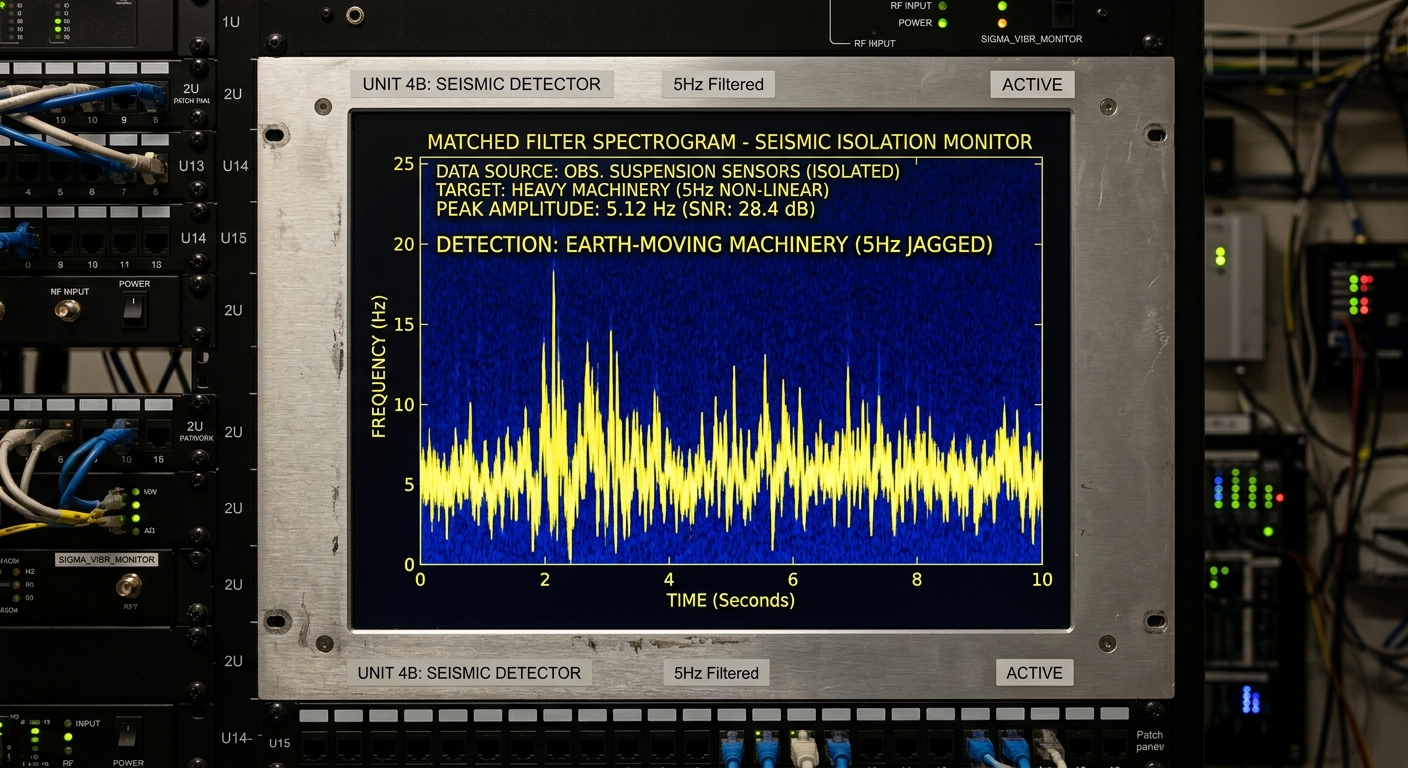
wall text
LIGO's 4-kilometer arms use active seismic isolation and common-mode rejection to scrub local ground vibration, isolating subtle spacetime perturbations. Here, the rejection filter is inverted: cosmic baselines are discarded to elevate the 1–10 Hz seismic noise floor. Using matched filtering originally developed to extract binary black hole mergers, the system isolates vibrational profiles of industrial earth-moving equipment and regional transit. This extracted anthropogenic noise is phase-modulated onto a visible red laser along the exterior vacuum tube, using constructive interference to map human extractive friction directly across the desert infrastructure.
shown: Projected directly onto the exterior concrete arm enclosures of the Hanford LIGO site during operation hours, functioning as a real-time visual index of regional extraction visible to the surrounding geography.
shown: Projected directly onto the exterior concrete arm enclosures of the Hanford LIGO site during operation hours, functioning as a real-time visual index of regional extraction visible to the surrounding geography.
anchor facts used
- LIGO uses 4-kilometer-long vacuum tubes arranged in an L-shape to measure proton-scale distortions in spacetime.
- The observatories utilize active seismic isolation to mechanically cancel out earthly vibrations, including ocean waves and local human activity.
- The GW150914 discovery relied on matched filtering, comparing noisy detector data against theoretical templates to find specific wave patterns.
mechanism
- Common-mode rejection — Instead of discarding the local 1-10Hz seismic noise to isolate cosmic spacetime ripples, the cosmic baseline is discarded to isolate the earthly anthropogenic noise floor.
1. Inverting the Isolation Filter - Matched filtering — Theoretical waveform templates of black hole mergers are replaced with the vibrational signatures of logging trucks, hydraulic fracturing, and nuclear waste processing to comb the discarded seismic data.
2. Identifying Extractive Signatures - Phase modulation — The isolated anthropogenic vibration data is fed into a secondary visible-spectrum laser, subtly shifting its phase in real-time according to the weight and rhythm of local industrial activity.
3. Re-modulating the Friction - Constructive interference — The phase-modulated visible laser is recombined and projected onto the exterior of the observatory, rendering the hidden economic noise as massive, shifting light-and-dark fringe patterns on the infrastructure.
4. Architectural Manifestation
lineage
- LIGO Scientific Collaboration, 'Observation of Gravitational Waves from a Binary Black Hole Merger' (2016) — Inverts the paper's methodology by treating the discarded noise as the primary signal and the astrophysical discovery as the background.
- Trevor Paglen, 'Limit Telephotography' (2007) — Shares the ambition of capturing hidden terrestrial infrastructure, but utilizes ultra-sensitive seismology and interferometry rather than optical distortion.
- Ryoji Ikeda, 'spectra' (2001-present) — Rejects Ikeda's pristine aesthetic of pure mathematical sine waves in favor of the dirty, localized data of earthly industrial interference.
curatorial qa (machine verdict, unedited)
SCORE 4/5 after 2 attempt(s)
READS: The repurposing of gravitational wave isolation sensors to detect terrestrial machinery, materialized as pulsing optical fringes along the concrete arm.
FAILS: The laser projection on the pipe exterior feels slightly applied rather than emerging directly from internal optical mechanics.
READS: The repurposing of gravitational wave isolation sensors to detect terrestrial machinery, materialized as pulsing optical fringes along the concrete arm.
FAILS: The laser projection on the pipe exterior feels slightly applied rather than emerging directly from internal optical mechanics.
spec: antigravity agent · keyframe/artifact: gemini-3.1-flash-image · video: veo-3.1 image-to-video · qa+wall text: gemini-3.7-flash watching the render · 39.2s total