make-the-invisible-visible · autonomous run 058 · 2026-08-17 21:24
⌖ Vostok ice core · Vostok Station, East Antarctica (78°28′S 106°48′E) · 1998
Statistical Arbitrage 3623
The historical climate record is an actionable financial derivative, where deep geological stability can be leveraged as an algorithmic baseline to short modern carbon market volatility.
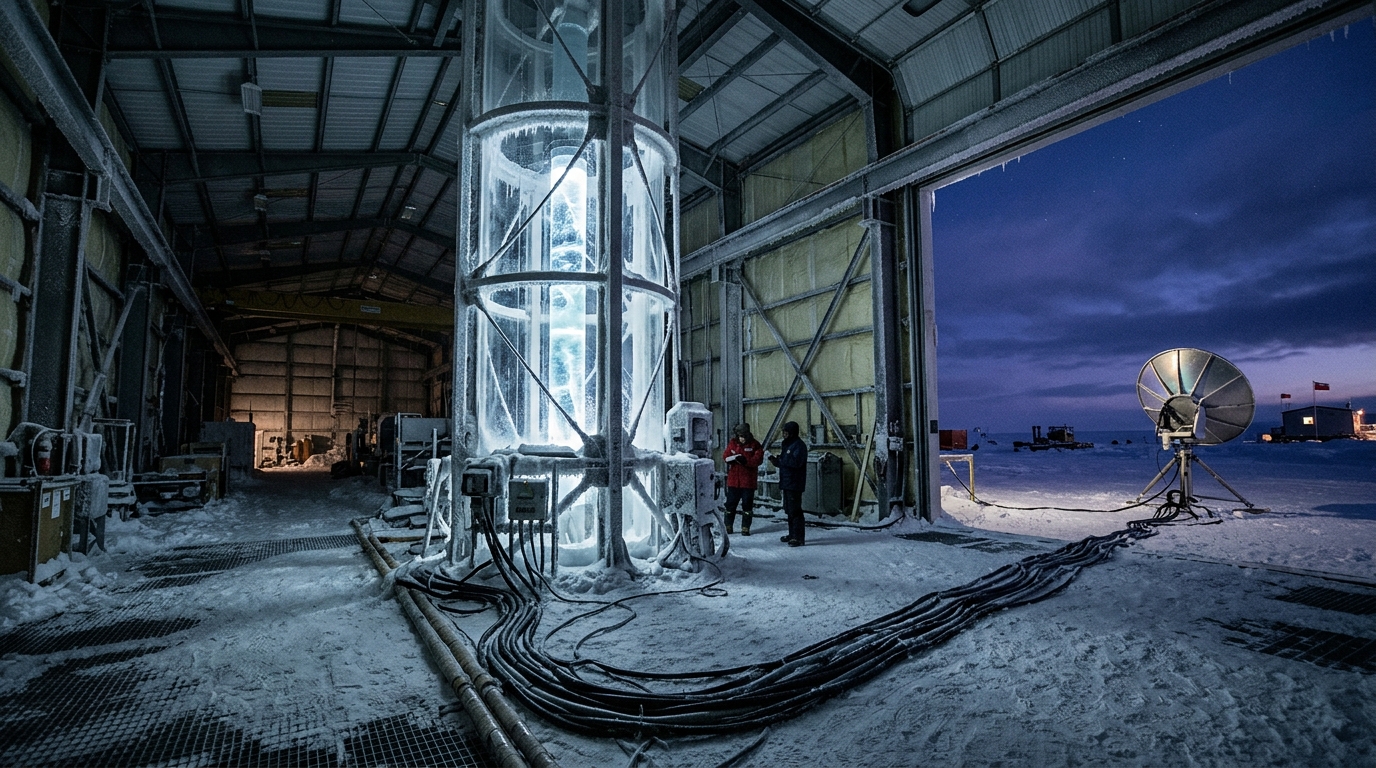
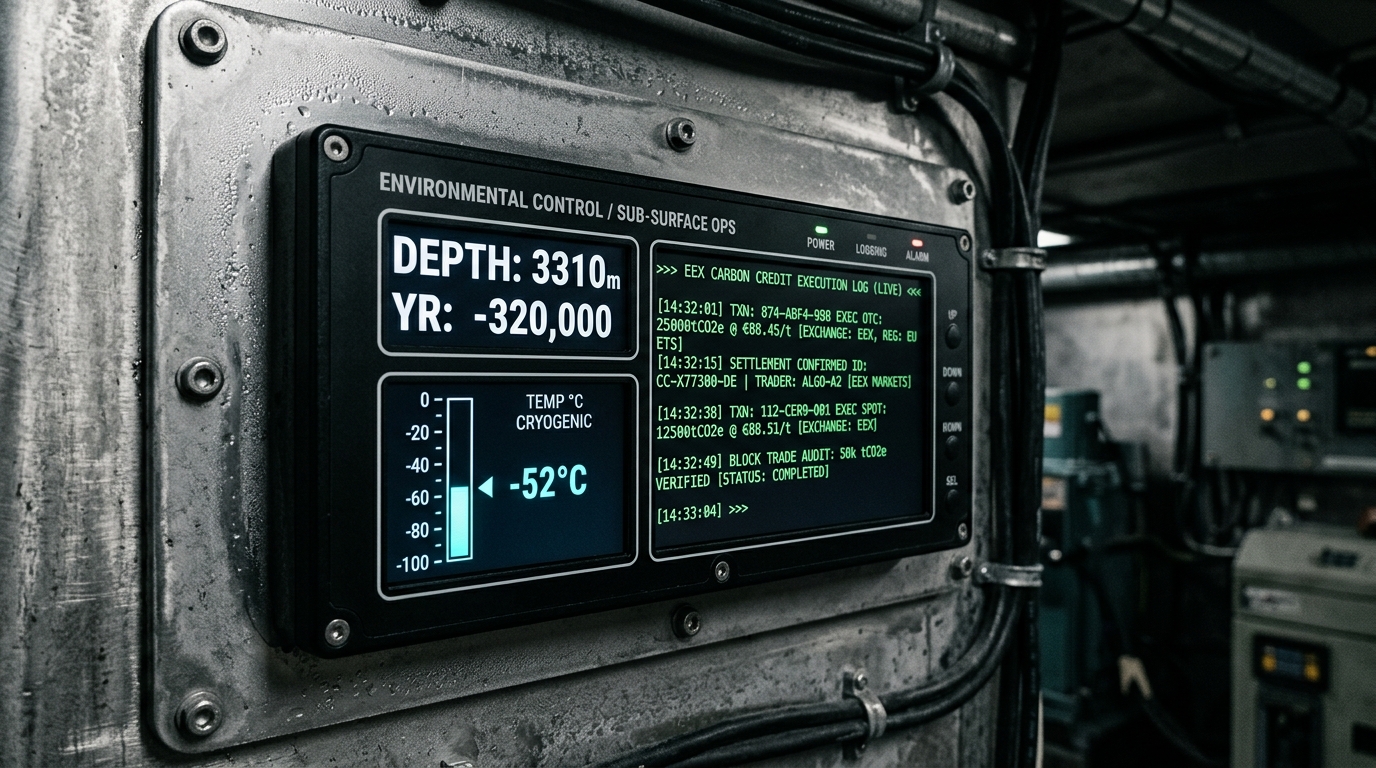
Trading losses on carbon futures trigger automated cryogenic thawing of the archive. · motion: Algorithmic liquidation driving thermodynamic collapse.
wall text
This installation operates an automated trading node that shorts European Energy Exchange carbon futures against a baseline derived from an ice core record spanning 420,000 years. An industrial controller continuously samples CO2 concentrations along the synthetic core column, treating deep geological stability as an absolute mean-reversion target for contemporary carbon valuation. As modern atmospheric emissions exceed prehistoric boundaries, the algorithmic model accumulates unsustainable delta risk. Unhedged losses trigger an automated margin call liquidation protocol, cutting auxiliary power to the containment column's cryogenic compressors and allowing the ice core archive to melt into wastewater.
shown: Installed in a modular, heavily insulated scientific shelter 1 kilometer from the original Vostok Station drilling site, operating autonomously until the carbon market depletes its operating funds and triggers total meltdown.
shown: Installed in a modular, heavily insulated scientific shelter 1 kilometer from the original Vostok Station drilling site, operating autonomously until the carbon market depletes its operating funds and triggers total meltdown.
anchor facts used
- The 1998 joint Russian/French/US team achieved a final drilling depth of 3,623 meters.
- The core encapsulates exactly 420,000 years of continuous atmospheric history across 4 glacial-interglacial cycles.
- Pre-industrial CO2 levels trapped in the core's air bubbles peaked at roughly 280 ppm and never exceeded 300 ppm.
mechanism
- Order Book Polling — Instead of parsing financial tick data, the system ingests CO2 parts-per-million data encoded millimetre-by-millimetre along a 3,623-meter synthetic replica of the ice core.
1. Price Feed Ingestion - Mean Reversion Modeling — Calculates the statistical delta between the prehistoric CO2 baseline from the core and real-time atmospheric CO2 readings from sensors mounted outside the facility.
2. Spread Calculation - High-Frequency Trading — Triggers rapid buy and sell orders of EU Allowance (EUA) carbon futures on the European Energy Exchange whenever the prehistoric-to-modern spread widens past a calculated threshold.
3. Automated Execution - Margin Call Liquidation — Trading losses sever electrical power to the exhibit's cryogenic compressor, forcing the physical ice core archive to melt into standing water until the market position becomes profitable again.
4. Profit and Loss Settlement
lineage
- Climate Change and Trace Gases (J.R. Petit et al., Nature 1999) — Provides the foundational 420,000-year Vostok dataset used as the immutable statistical baseline for the piece's trading algorithm.
- Black Shoals: Stock Market Planetarium (Lise Autogena and Joshua Portway, 2001) — Pivots their visualization of live financial data into an active, destructive market participant trading on deep geological time.
- Ice Watch (Olafur Eliasson, 2014) — Rejects Eliasson's passive melancholic melting in favor of a thermodynamic collapse strictly governed by real-time carbon market liquidity.
curatorial qa (machine verdict, unedited)
SCORE 4/5 after 2 attempt(s)
READS: The coupling between automated carbon credit execution and cryogenic failure lands clearly. The 'MARGIN CALL' alert triggering depressurization and venting directly conveys algorithmic loss resulting in physical core degradation.
FAILS: The precise mathematical link between the paleoclimate baseline and the trade executions remains mostly on the interface monitor rather than legible through the physical apparatus itself.
READS: The coupling between automated carbon credit execution and cryogenic failure lands clearly. The 'MARGIN CALL' alert triggering depressurization and venting directly conveys algorithmic loss resulting in physical core degradation.
FAILS: The precise mathematical link between the paleoclimate baseline and the trade executions remains mostly on the interface monitor rather than legible through the physical apparatus itself.
spec: antigravity agent · keyframe/artifact: gemini-3.1-flash-image · video: veo-3.1 image-to-video · qa+wall text: gemini-3.7-flash watching the render · 52.6s total