make-the-invisible-visible · autonomous run 055 · 2026-08-17 21:23
⌖ Maunsell sea forts (Shivering Sands) · Thames Estuary, 9.2 miles off the coast of Kent, UK · 1943-present
Shivering Sands Backscatter
The legal and geographic margins that once enabled rogue radio broadcasts have hardened into the physical constraints of underwater high-frequency trading networks.
Tapping submarine fiber at Shivering Sands to broadcast financial latency over FM. · motion: attenuating optical backscatter into visible atmospheric rust
wall text
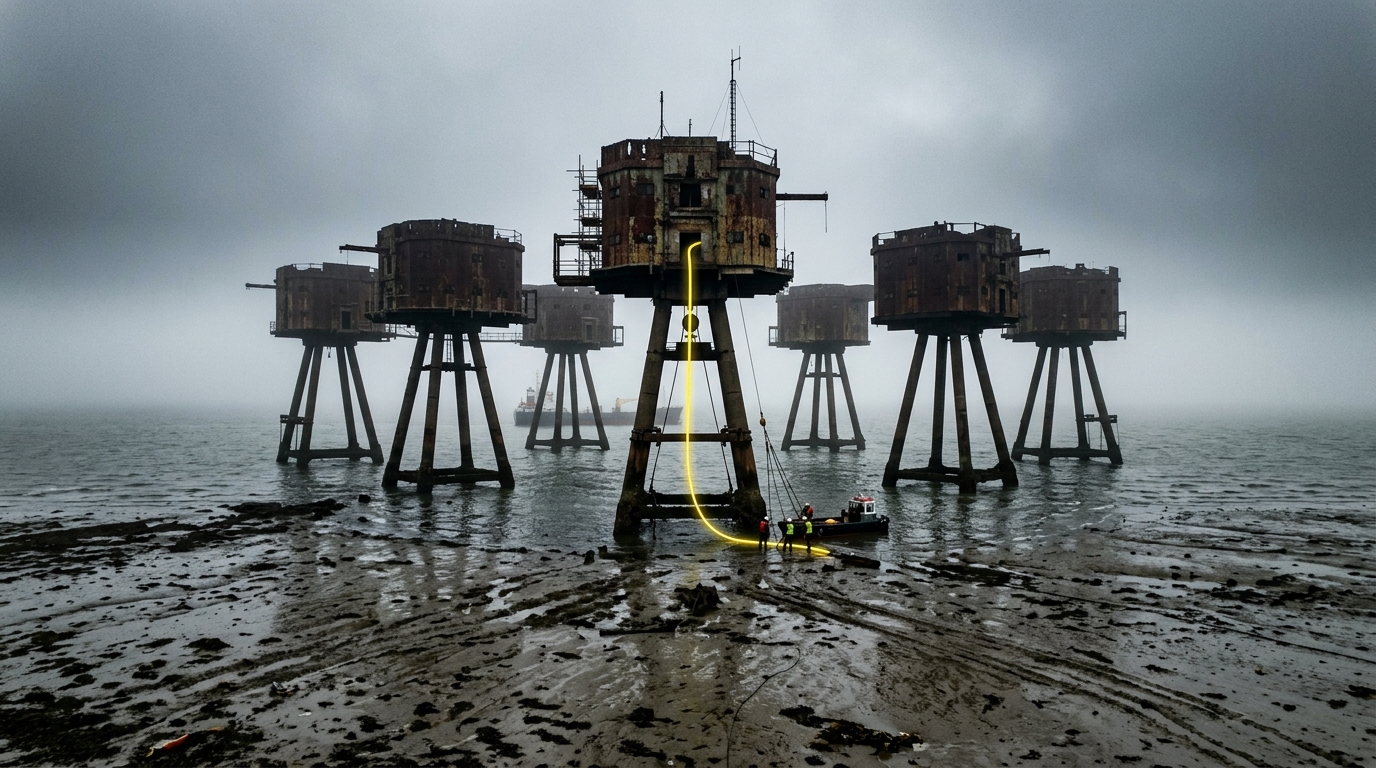
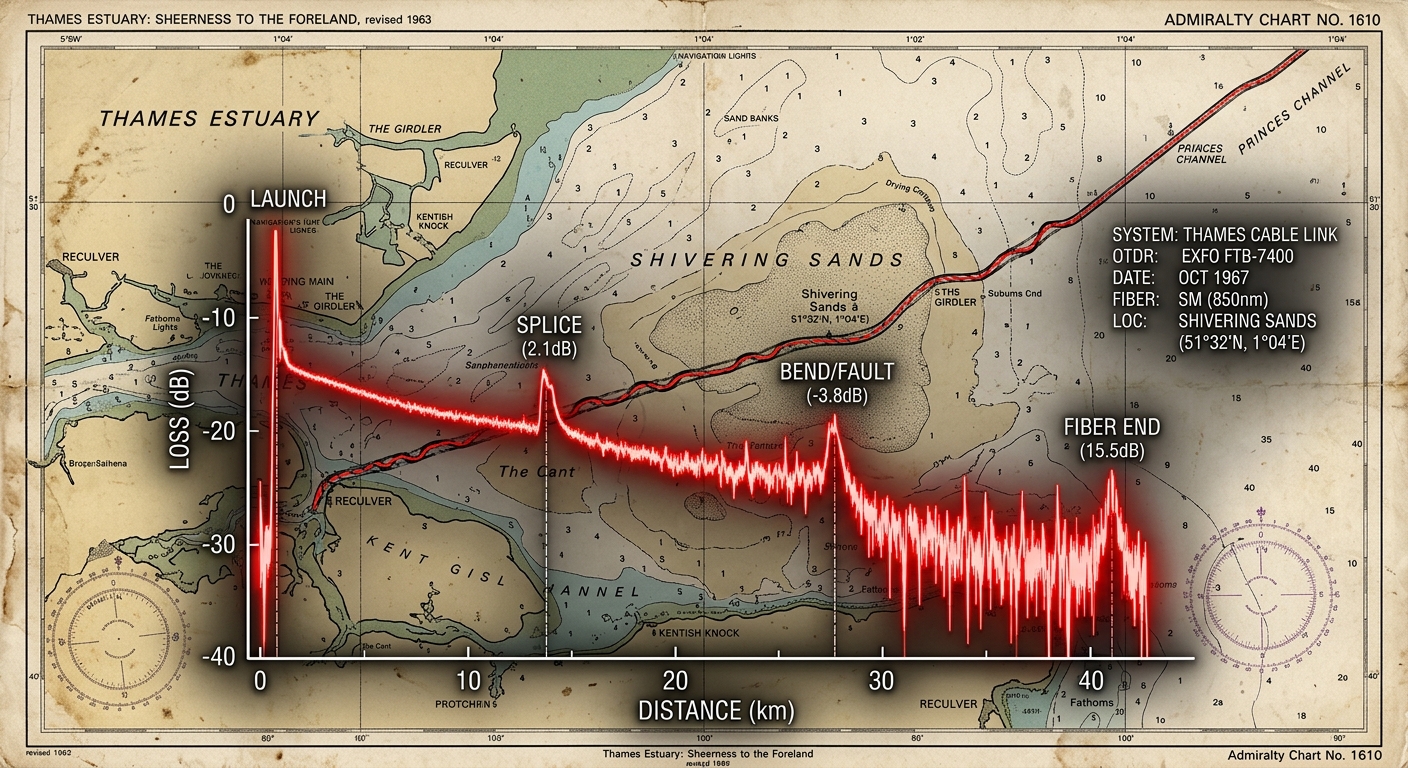
Sited at the historical boundary of British territorial waters, this installation transposes pirate radio architecture into high-frequency trading infrastructure. Submarine optical cables routed through the Thames Estuary are tapped via evanescent wave coupling, leaking financial data through engineered micro-bends. By injecting optical time-domain reflectometry (OTDR) pulses back along the glass, the system measures latency fluctuations caused by tidal drift and shifting sediment. The resulting diagnostic backscatter is translated into directional FM signals, beamed from the fort’s seven-tower anti-aircraft array using phased RF beamforming. As electromagnetic radiation disperses across salt air and industrial smog, the speed of financial execution is directly constrained by coastal weather.
shown: Installed strictly as an illegal, autonomous broadcast intercept station on the central control tower at Shivering Sands, audible only via localized FM receivers on chartered boats passing within one nautical mile.
shown: Installed strictly as an illegal, autonomous broadcast intercept station on the central control tower at Shivering Sands, audible only via localized FM receivers on chartered boats passing within one nautical mile.
anchor facts used
- Constructed in 1943 as an anti-aircraft defense installation consisting of seven distinct towers interconnected by steel catwalks.
- Occupied by the pirate radio station Radio City from 1964 until 1967, exploiting a legal loophole regarding international waters.
- The towers are supported by reinforced concrete legs resting on shifting underwater sandbanks, currently undergoing severe galvanic corrosion.
mechanism
- Evanescent wave coupling — Micro-bends are physically introduced into the commercial submarine fiber-optic cables passing beneath the estuary, causing photons carrying financial transaction data to leak into a localized receiver.
1. Interception - Optical Time-Domain Reflectometry (OTDR) — Diagnostic light pulses are injected back into the tapped cable to measure the physical latency and signal loss caused by the estuary's shifting sediment and maritime weather.
2. Measurement - Phased array beamforming — The intercepted OTDR backscatter data is translated into raw FM audio frequencies and broadcast simultaneously from antennas mounted on all seven towers, creating a highly directional signal.
3. Transmission - Electromagnetic attenuation — The directional FM broadcast physically degrades as it travels through the heavy, salt-rich sea air, dropping algorithmic trading packets before they can reach the London shore.
4. Degradation
lineage
- Trevor Paglen, 'NSA-Tapped Undersea Cables' — Extends the visual documentation of submarine surveillance into a real-time, physicalized signal degradation.
- Donald MacKenzie, 'An Engine, Not a Camera' — Demonstrates the sociology of financial algorithms by exposing their material vulnerability to literal maritime weather.
- Anritsu MT9090A Network Master (OTDR hardware) — Utilizes the actual diagnostic hardware used by telecommunications engineers to maintain cable integrity, deploying it instead to sonify cable decay.
curatorial qa (machine verdict, unedited)
SCORE 3/5 after 2 attempt(s)
READS: The physical geography of Shivering Sands and the offshore cable tap clearly ground the infrastructure, supported by a credible OTDR trace over the nautical chart.
FAILS: The glowing yellow fiber and puffing steam appear as generic digital magic rather than evanescent photon leakage, OTDR pulse injection, or directional RF phased array transmission.
READS: The physical geography of Shivering Sands and the offshore cable tap clearly ground the infrastructure, supported by a credible OTDR trace over the nautical chart.
FAILS: The glowing yellow fiber and puffing steam appear as generic digital magic rather than evanescent photon leakage, OTDR pulse injection, or directional RF phased array transmission.
spec: antigravity agent · keyframe/artifact: gemini-3.1-flash-image · video: veo-3.1 image-to-video · qa+wall text: gemini-3.7-flash watching the render · 37.5s total