make-the-invisible-visible · autonomous run 054 · 2026-08-17 21:23
⌖ Soviet bus stops · Taraz, Kazakhstan · 1970s-1980s
Acoustic Emission of a Utopian Periphery
The idiosyncratic architectural freedom permitted at the edges of the Soviet empire inadvertently created a network of brutalist acoustic resonators, which now make the slow, invisible collapse of 20th-century infrastructure audibly palpable through material decay.
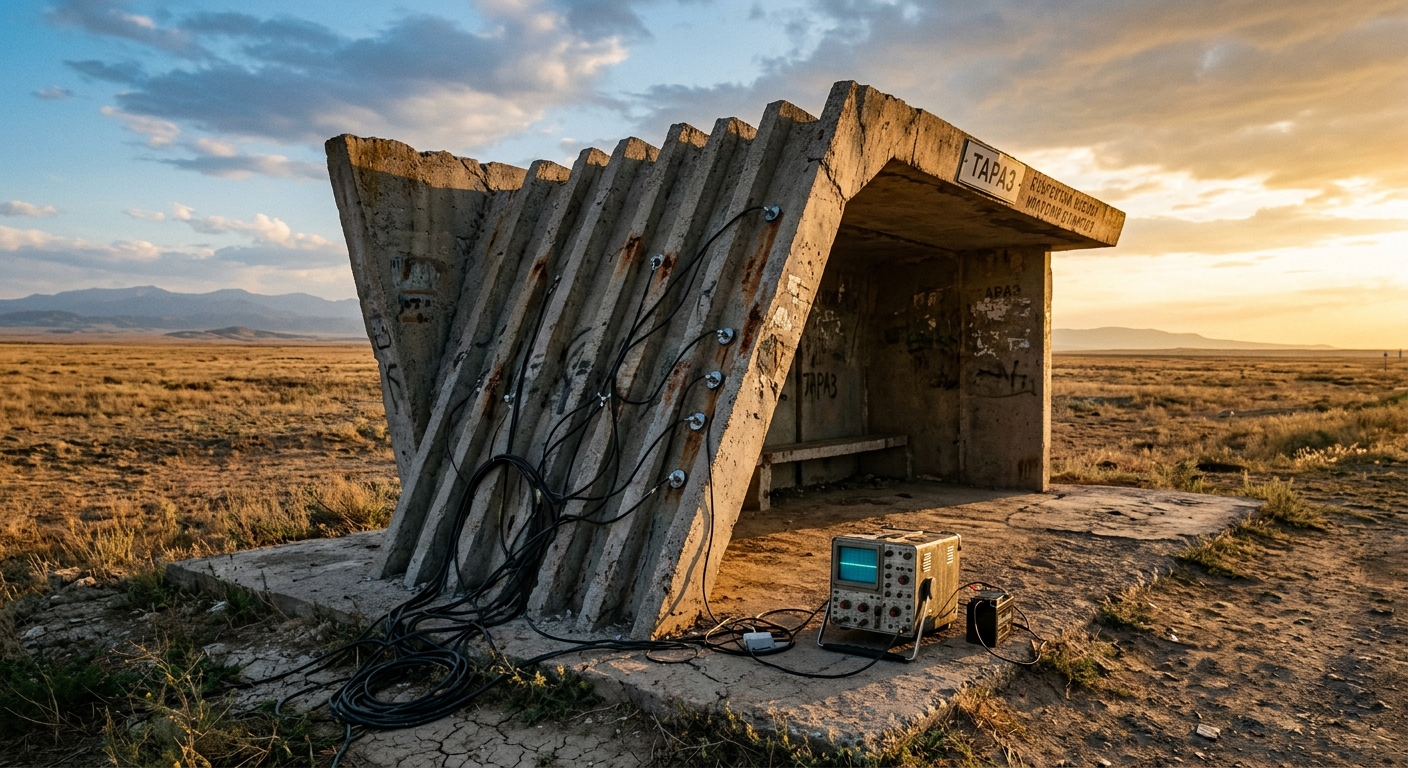
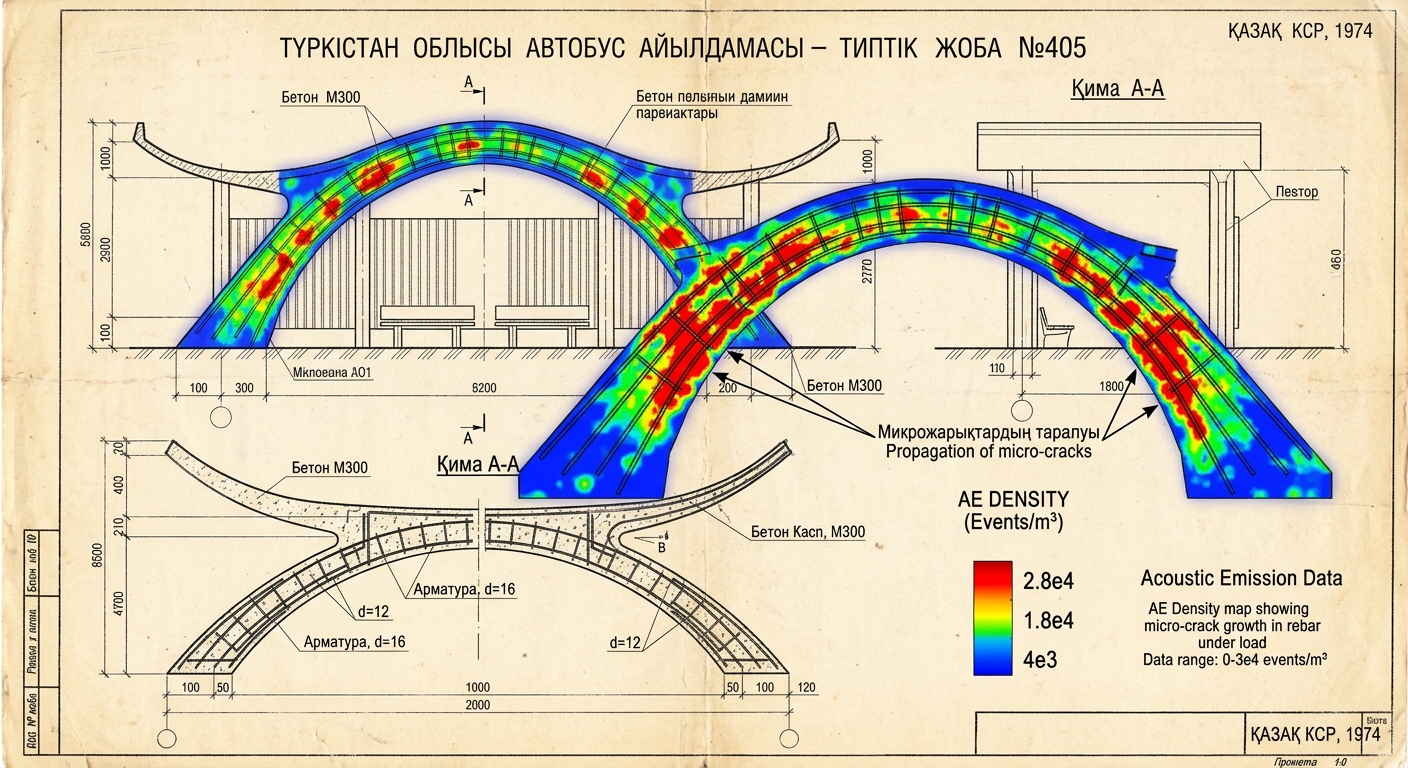
Acoustic emission monitoring of micro-crack propagation in a 1970s Kazakh bus shelter. · motion: fine dust vibrating off the concrete surface in sync with structural resonance
wall text
Across the former Soviet periphery, regional bus shelters bypassed centralized design mandates, resulting in experimental reinforced concrete forms. Decades of extreme thermal cycling in the Kazakh steppe now drive continuous micro-fissuring and rebar delamination. By mounting piezoelectric transducers directly to the load-bearing ribs, this installation performs continuous Acoustic Emission (AE) testing. Micro-seismic fracture events within the ferroconcrete are captured via envelope demodulation and mapped to an analog oscilloscope. The internal degradation of late-Soviet infrastructure becomes an audible and visual transducer, translating imperceptible structural decay into physical vibration and low-frequency resonance.
shown: Installed permanently on-site at the Taraz bus stop, functioning autonomously via solar power until the structure eventually collapses.
shown: Installed permanently on-site at the Taraz bus stop, functioning autonomously via solar power until the structure eventually collapses.
anchor facts used
- Soviet bus stops were largely exempt from central architectural planning norms, allowing local artists to build highly idiosyncratic, non-standard brutalist structures.
- Many stops, such as the wave-like concrete shelter near Taraz, were built using heavily reinforced ferroconcrete (zhelezobeton).
- Decades of extreme thermal cycling on the Central Asian steppe have caused systemic carbonation, moisture ingress, and micro-cracking in the unmaintained concrete.
mechanism
- Acoustic Emission (AE) Testing — Harvesting the microscopic ultrasonic sounds of concrete cracking and rebar corrosion as a continuous generative audio source.
1. High-frequency piezoelectric transducers are affixed directly to the load-bearing concrete ribs of the bus shelter to continuously record transient elastic waves generated by the sudden release of energy within the material. - Time Difference of Arrival (TDOA) Localization — Mapping the invisible topography of decay within the artist's eccentric, non-standard geometry to trigger spatialized audio panning.
2. The arrival times of these micro-seismic events are measured across the sensor array, calculating the exact spatial coordinates of the internal material failure. - Envelope Demodulation — Translating the imperceptible structural failure into a low, audible rumble that corresponds dynamically to the rate of material degradation.
3. The raw, high-frequency ultrasonic waveforms of the micro-cracks are mathematically extracted and shifted down into the human auditory range in real-time. - Acoustic Impedance Matching — Turning the entire bus stop into a physical, monolithic speaker cone that hums with the sound of its own structural death.
4. The downconverted signals are broadcast via surface-exciter transducers back into the structure, coupling the sound waves perfectly with the dense material of the shelter walls.
lineage
- Christopher Herwig, 'Soviet Bus Stops' (2015) — Provides the geographical taxonomy and architectural history of these structures, which this work physically reinterprets as a deployed sensor network.
- Jacob Kirkegaard, '4 Rooms' (2006) — Captures the ambient resonance of abandoned spaces in Chernobyl, whereas this piece actively sonifies real-time, ongoing material degradation.
- Susan Schuppli, 'Material Witness' (2020) — Shares the premise that physical matter records environmental and political violence, here applied to the slow infrastructural violence of post-Soviet neglect.
curatorial qa (machine verdict, unedited)
SCORE 3/5 after 2 attempt(s)
READS: Piezoelectric sensors wired along the brutalist concrete ribs and real-time waveform display capturing material stress.
FAILS: The direct acoustic translation between internal micro-cracking and external resonance feels illustrative rather than causally demonstrated.
READS: Piezoelectric sensors wired along the brutalist concrete ribs and real-time waveform display capturing material stress.
FAILS: The direct acoustic translation between internal micro-cracking and external resonance feels illustrative rather than causally demonstrated.
spec: antigravity agent · keyframe/artifact: gemini-3.1-flash-image · video: veo-3.1 image-to-video · qa+wall text: gemini-3.7-flash watching the render · 33.2s total