make-the-invisible-visible · autonomous run 052 · 2026-08-17 21:23
⌖ Rust Belt grain elevators · Concrete Central Elevator, Buffalo River, Buffalo, NY · 1915-1966 (Active), 1966-Present (Fallow)
Cost of Carry / Spall
The financial derivatives that originally capitalized and necessitated physical storage infrastructure continue to act as a phantom load, translating historical market forces into literal mechanical weathering that demolishes the fallow asset.
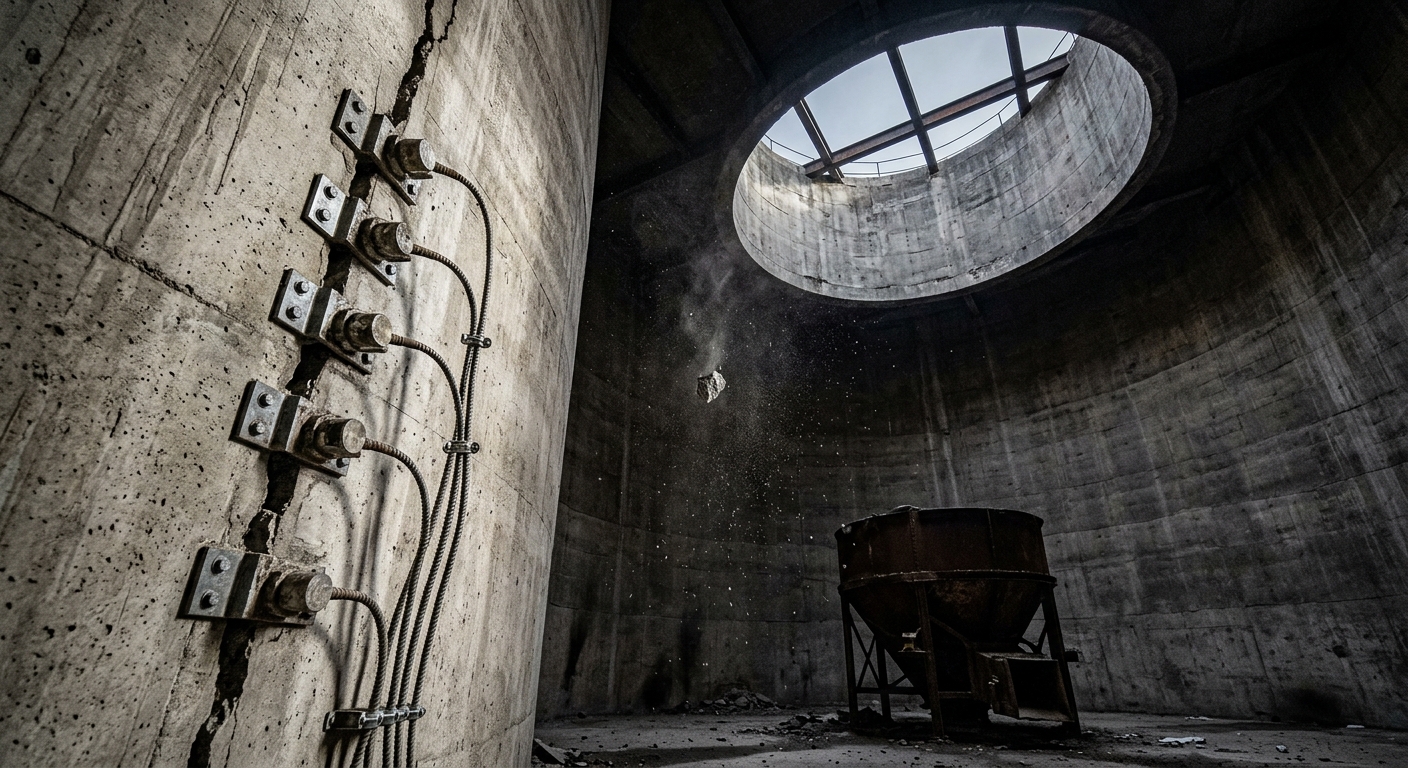
Piezoelectric transducers expand along silo fissures driven by CBOT wheat futures data. · motion: spalling violently under unseen algorithmic pressure
wall text
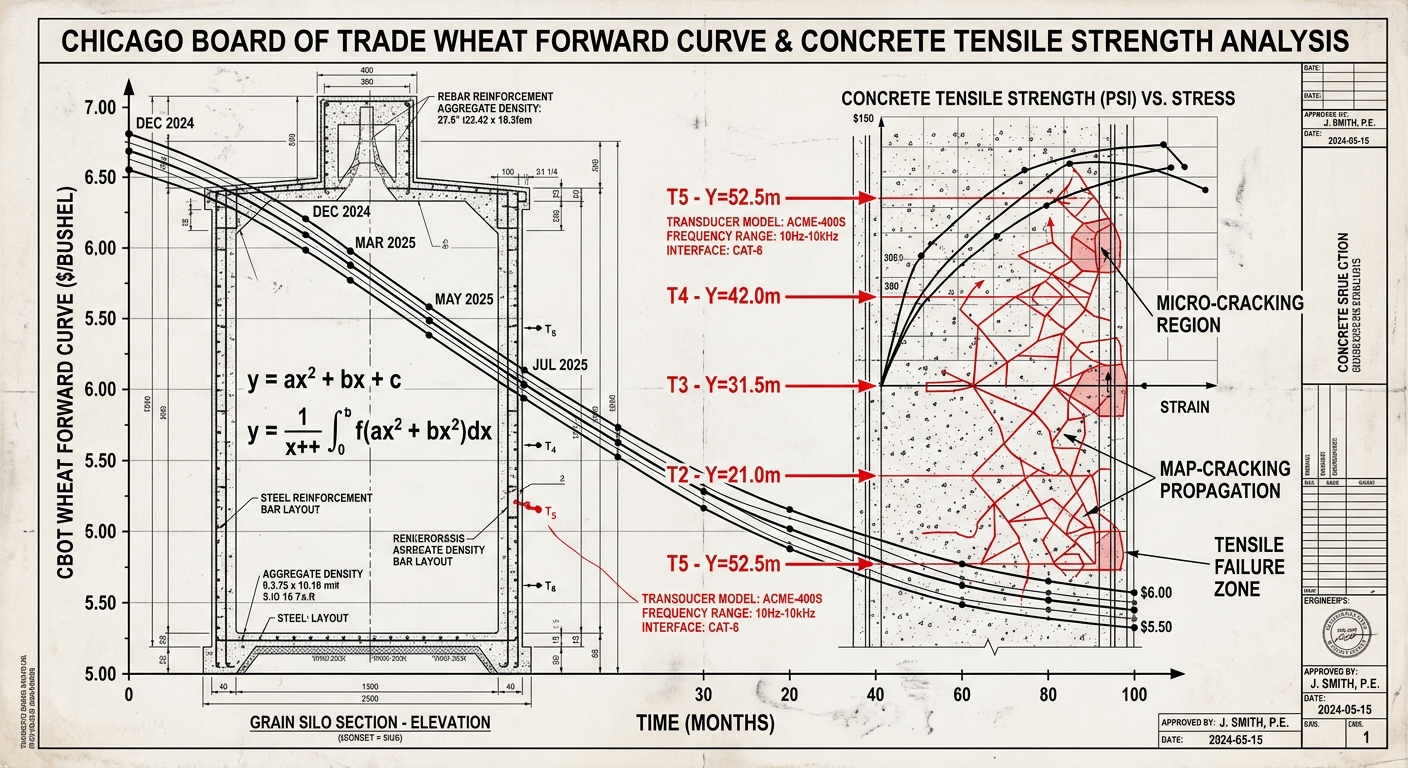
This installation links historical commodities trading to physical structural failure. An array of industrial piezoelectric transducers is bolted across active fissures inside an abandoned slip-formed concrete grain elevator. The system ingests Chicago Board of Trade wheat futures data, calculating the spread between spot and forward delivery contracts. Steep contango—the market condition that historically mandated physical grain storage—is converted into micro-voltage pulses. These actuate the transducers to expand within the wall fissures, simulating the hydrostatic wall pressure once exerted by millions of bushels of grain. By replacing grain mass with algorithmic strain, the piece translates speculative market volatility into immediate mechanical weathering, physically fracturing the fallow infrastructure that finance capital left behind.
shown: Installed permanently inside Bin #14 of the Concrete Central Elevator in Buffalo, accessible only by boat via the Buffalo River and viewed from the ground-floor rail gallery.
shown: Installed permanently inside Bin #14 of the Concrete Central Elevator in Buffalo, accessible only by boat via the Buffalo River and viewed from the ground-floor rail gallery.
anchor facts used
- Concrete Central was built between 1915 and 1917 as a slip-formed concrete monolithic structure capable of holding 4.5 million bushels of grain.
- The elevators were constructed specifically to exploit the 'cost of carry', storing harvested grain to capture delayed seasonal premiums on the Chicago Board of Trade.
- Since abandonment in 1966, the unheated structures have suffered severe map cracking and surface spalling due to extreme freeze-thaw cycles and ongoing alkali-silica reactions (ASR).
mechanism
- Forward curve calculation (Contango/Backwardation) — The financial yield spread—originally the exact margin that justified holding physical grain—is quantified as an electrical voltage control parameter.
1. Ingest real-time and historical Chicago Board of Trade (CBOT) Soft Red Winter Wheat futures data via satellite uplink, continuously calculating the spread between spot prices and deferred delivery months. - Piezoelectric actuation — Financial data is transduced into physical, expansive kinetic force, substituting the outward hydrostatic pressure of stored wheat with algorithmic tension.
2. Distribute the calculated voltage across a vertical array of heavy-duty industrial piezoelectric transducers, which are expansion-bolted directly into existing structural micro-fissures along the interior of a slip-formed concrete bin. - Alkali-silica reaction (ASR) expansion / mechanical weathering — Market profitability becomes literal structural destruction, causing localized failure and forcing flakes of the concrete wall to spall off.
3. During periods of steep contango (when future prices exceed spot prices, demanding storage), the transducers expand by up to 2 millimeters, wedging the fissures wider and accelerating the concrete's degradation. - Load cell mass measurement — Quantifying architectural death as an inverted yield curve, measuring physical mass lost against financial value gained.
4. Fallen concrete spall drops into the bin's original steel discharge hopper, where it is continuously weighed by a digital load cell, broadcasting the accumulated mass lost as a live ticker.
lineage
- Black Shoals: Stock Market Planetarium (2001) by Lise Autogena and Joshua Portway — Contrasts their ethereal, frictionless cosmic projection of financial data by grounding market math in destructive, irreversible material friction.
- Conical Intersect (1975) by Gordon Matta-Clark — Updates Matta-Clark's concept of physical architectural cuts by allowing autonomous algorithmic capital flows to perform the site demolition.
- Alkali-Silica Reaction in Concrete Structures (David Stark, 1991) — Borrows Stark's precise engineering methodologies for mapping internal concrete expansion pressures to calibrate the exact mechanical force exerted by the financial actuators.
curatorial qa (machine verdict, unedited)
SCORE 4/5 after 1 attempt(s)
READS: The mechanical failure along the fissure line lands clearly; the bolted transducers visibly actuate concrete spalling and structural blow-out inside the derelict silo bin.
FAILS: The direct mathematical link between CBOT wheat contango spreads and voltage pulses relies heavily on the blueprint rather than being self-evident in the motion.
READS: The mechanical failure along the fissure line lands clearly; the bolted transducers visibly actuate concrete spalling and structural blow-out inside the derelict silo bin.
FAILS: The direct mathematical link between CBOT wheat contango spreads and voltage pulses relies heavily on the blueprint rather than being self-evident in the motion.
spec: antigravity agent · keyframe/artifact: gemini-3.1-flash-image · video: veo-3.1 image-to-video · qa+wall text: gemini-3.7-flash watching the render · 43.5s total