make-the-invisible-visible · autonomous run 047 · 2026-08-17 21:23
⌖ Hans Island whisky war · Hans Island (Tartupaluk), Kennedy Channel, Nares Strait · 1973-2022
Stationary Phase: Tartupaluk
Territorial sovereignty is not a permanent cartographic state but a chemical equilibrium, measurable only by the geological retention of its geopolitical artifacts.
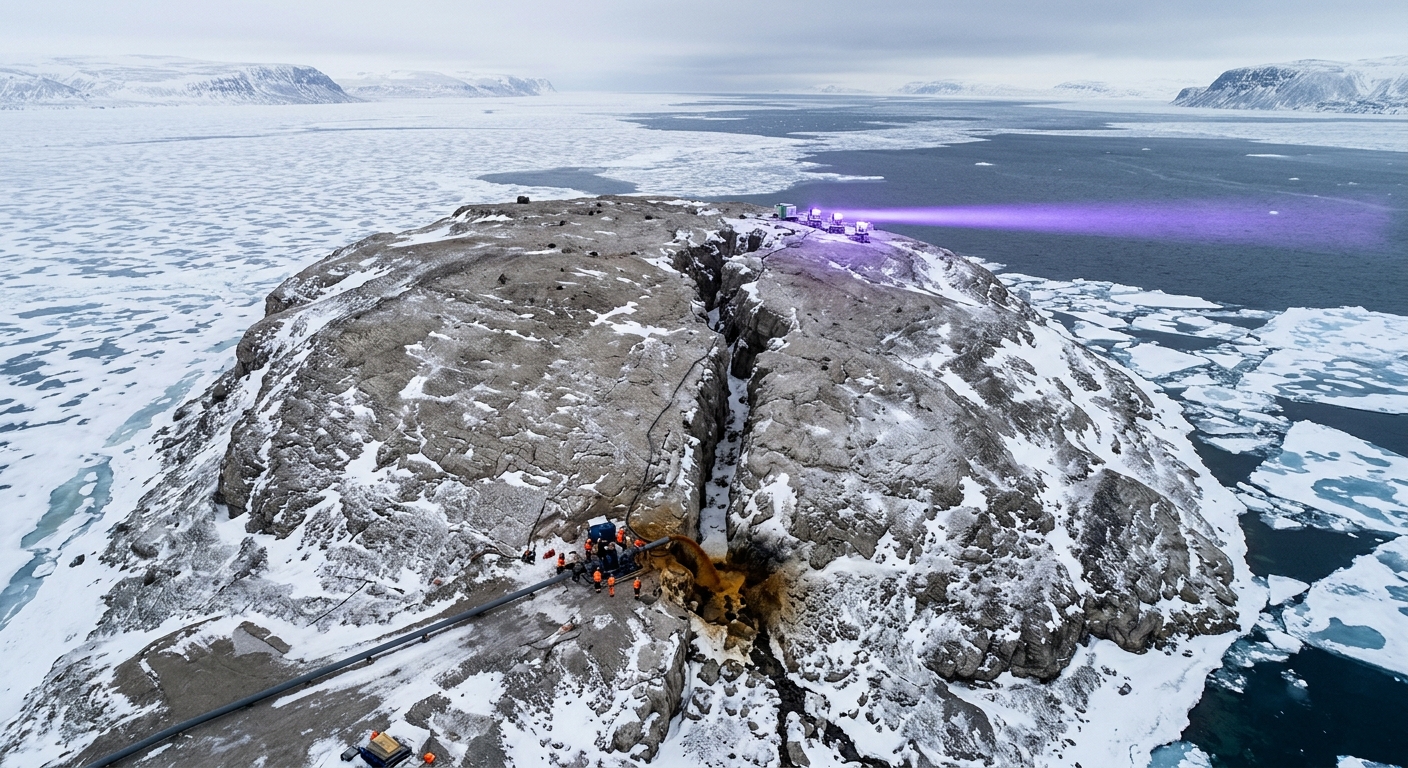
Hans Island transformed into a preparative chromatography column fractionating historical border spirits. · motion: eluting sovereign compounds through a porous border
wall text
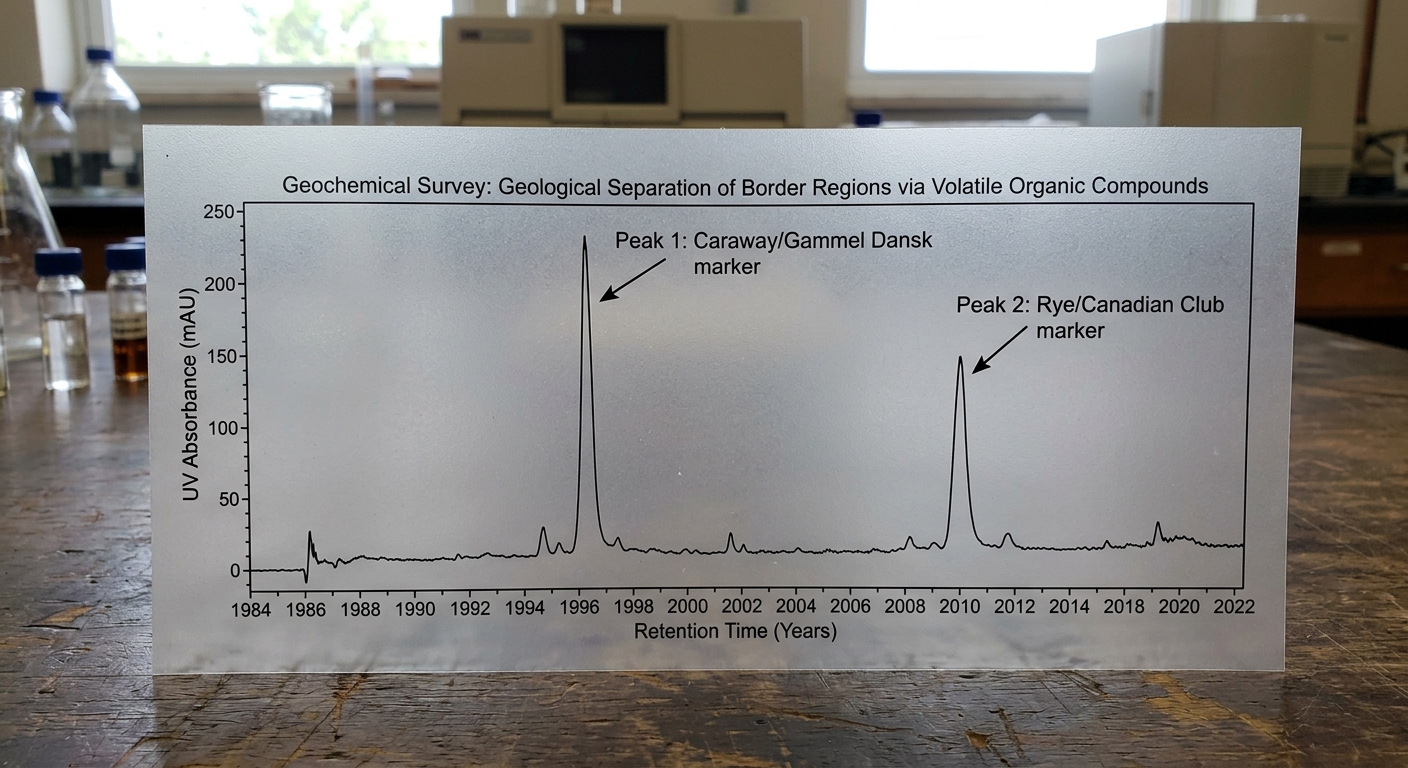
For decades, the territorial dispute over Hans Island was waged through alternating deposits of Canadian Club and Danish Gammel Dansk. This installation reimagines the 1.3-square-kilometer rock as a preparative liquid chromatography column. Glacial meltwater mobilizes decades of residual alcohol congeners bound to the permafrost, flushing them through the island's central Silurian limestone fissure. The porous bedrock acts as the stationary phase, fractionating rye grain and caraway volatiles by retention time. At the summit, a UV spectrophotometer records the absorbance profiles of the eluted sovereignty markers, transforming a cartographic partition into an empirical geochemical chromatogram.
shown: Installed permanently within the 2022 terrestrial border cleft of Hans Island, powered by solar arrays facing the Nares Strait.
shown: Installed permanently within the 2022 terrestrial border cleft of Hans Island, powered by solar arrays facing the Nares Strait.
anchor facts used
- In 1984, Danish Minister Tom Høyem visited the island, leaving a bottle of Gammel Dansk and a sign reading 'Welcome to the Danish island'.
- Canadian forces countered over decades by leaving bottles of Canadian Club whisky.
- The June 2022 treaty resolved the dispute by dividing the 1.3-square-kilometer island along a naturally occurring geological cleft.
- The island is a barren limestone knoll located at 80°49′41″N 66°27′35″W.
mechanism
- Cryogenic Core Extraction — Extracting 5-meter permafrost cores at the historical flag-planting coordinates to isolate 50 years of trace ethanol and botanical congeners deposited by alternating military patrols.
1. Cryogenic Core Sampling - Mobile Phase Solvent Extraction — Using seasonal glacial meltwater pumped from the surrounding Kennedy Channel to elute the specific chemical signatures of rye grain (Canada) and star anise/caraway (Denmark) from the soil matrix.
2. Solvent Elution - Liquid Chromatography — Pumping the extracted liquor-water solution through the island's central geological cleft, utilizing the porous Silurian limestone bedrock to naturally separate the chemical compounds based on molecular affinity.
3. Stationary Phase Partitioning - UV-Vis Spectroscopy — Deploying a 254nm UV detector array at the northern output of the cleft to render the invisible separation of national liquors into a real-time, physical chromatogram projected onto the sea ice.
4. Spectrophotometric Detection
lineage
- Teresa Margolles, 'En el Aire' (2003) — Extends Margolles' use of trace atmospheric fluids from sites of trauma to sites of geopolitical absurdity.
- Center for Land Use Interpretation, 'The Great Divide' (2015) — Adapts CLUI's forensic documentation of border infrastructure into an active, landscape-scale biogeochemical process.
- Julius von Bismarck, 'Punishment I' (2011) — Shifts von Bismarck's physical interaction with landscape geography from mechanical discipline to chemical elution.
curatorial qa (machine verdict, unedited)
SCORE 4/5 after 1 attempt(s)
READS: The apparatus clearly frames Hans Island's central cleft as a macro-scale chromatography column. Pumping solvent through the geological fault line to separate historical ethanol congeners, detected by UV spectrophotometry at the summit, successfully grounds the political dispute as an analytical chemistry process.
FAILS: The physical collection point at the end of the geological column is obscured, leaving the flow path of eluted fractions slightly ambiguous before the optical detection stage.
READS: The apparatus clearly frames Hans Island's central cleft as a macro-scale chromatography column. Pumping solvent through the geological fault line to separate historical ethanol congeners, detected by UV spectrophotometry at the summit, successfully grounds the political dispute as an analytical chemistry process.
FAILS: The physical collection point at the end of the geological column is obscured, leaving the flow path of eluted fractions slightly ambiguous before the optical detection stage.
spec: antigravity agent · keyframe/artifact: gemini-3.1-flash-image · video: veo-3.1 image-to-video · qa+wall text: gemini-3.7-flash watching the render · 48.7s total