make-the-invisible-visible · autonomous run 046 · 2026-08-17 21:23
⌖ Bir Tawil · Border between Egypt and Sudan (intersecting the 22nd parallel north) · 1899–Present
Geopolitical Dead-Letter Queue: Jebel Tawil
Territorial sovereignty functions precisely as a network routing protocol; geographic zones that fail to resolve in contiguous national ledgers act as physical dead-letter queues, destined to involuntarily accumulate the anomalous data and administrative exhaust of bordering state machines.
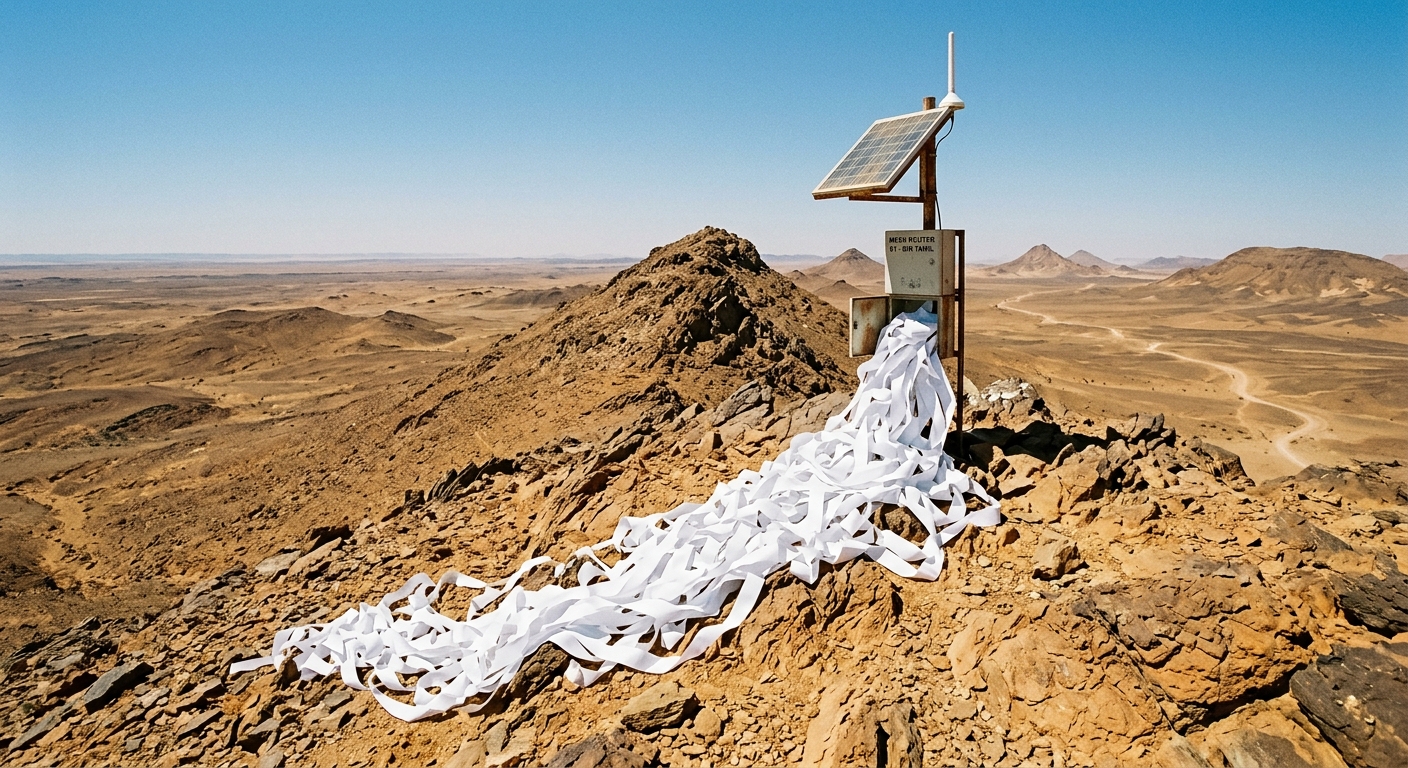
Solar-powered mesh node printing rejected BGP route headers in Bir Tawil. · motion: cascading accumulation of rejected data
wall text
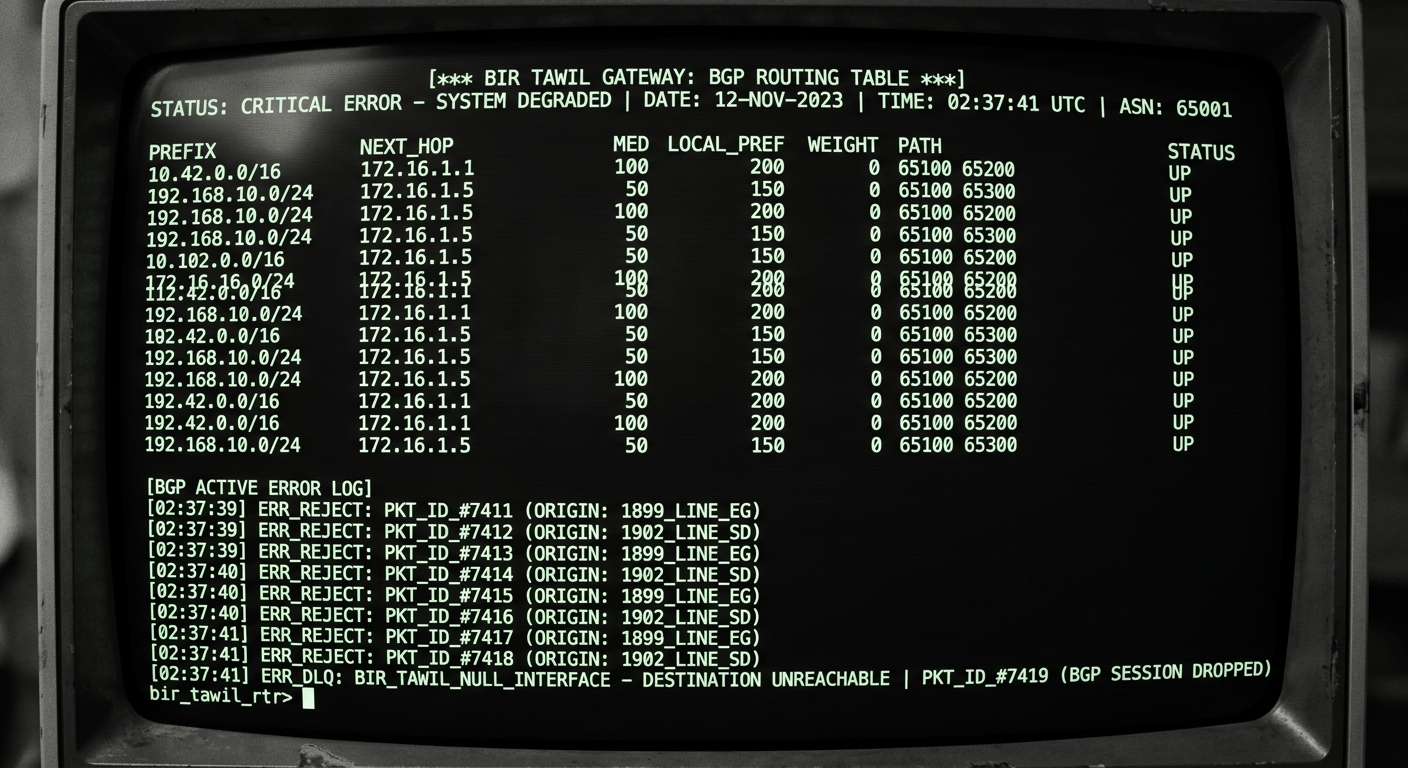
Bir Tawil exists as a legal anomaly: an unclaimed wedge of desert created by the contradiction between the 1899 Anglo-Egyptian administrative boundary and the 1902 treaty line. Situated at the summit of Jebel Tawil, this autonomous, solar-powered mesh node monitors cellular and radio border traffic caught in perpetual Border Gateway Protocol (BGP) route flapping between Egyptian and Sudanese telecom backbones. Unable to resolve sovereign jurisdiction, the discarded packet metadata is shunted into a dead-letter queue (DLQ) and materialized via direct thermal printing. The resulting cascade of continuous paper ribbons turns stateless network exceptions into an accumulating geological sediment of bureaucratic exhaust.
shown: Installed permanently and illegally at the summit of Jebel Tawil, functioning autonomously until hardware failure, with only the BGP terminal log displayed as a live telemetry feed in a gallery setting.
shown: Installed permanently and illegally at the summit of Jebel Tawil, functioning autonomously until hardware failure, with only the BGP terminal log displayed as a live telemetry feed in a gallery setting.
anchor facts used
- Created by a legal discrepancy between the 1899 straight-line political boundary and the 1902 irregular administrative boundary.
- Encompasses exactly 2,060 square kilometers of unclaimable terra nullius.
- Claiming Bir Tawil requires a nation to legally relinquish its claim to the adjacent, resource-rich Hala'ib Triangle.
- Contains Jebel Tawil, a 459-meter-high mountain that dominates the region's topography.
mechanism
- Border Gateway Protocol (BGP) Route Flapping — Automated RF sensors along the 22nd parallel monitor cellular and radio data packets oscillating endlessly between Egyptian and Sudanese telecom firewalls, capturing traffic unable to resolve a sovereign destination IP.
1. Packet Interception and Monitoring - Dead-Letter Queue (DLQ) Message Routing — The unresolved, jurisdiction-less data packets are stripped of their payload and their metadata headers are deliberately redirected to an autonomous, solar-powered mesh node situated in the center of the terra nullius.
2. Sovereign Void Redirection - Direct Thermal Printing — The mesh node translates the incoming flood of rejected packet headers into a continuous, physical scroll of thermal paper, extruding the digital failures into tangible mass.
3. Physical Logging of the Void - Cache Eviction (Time-to-Live Expiration) — Rather than manual archiving, the intense Saharan ultraviolet radiation systematically bleaches the thermal paper back to blank white, destroying the log data at a mathematically predictable rate.
4. Environmental Data Eviction
lineage
- Julian Oliver, 'Border Bumping' (2012) — Expands on Oliver's cellular network disruption by moving from active border-crossing interference to the passive spatial void where no cellular registry exists at all.
- Trevor Paglen, 'Autonomy Cube' (2014) — Inverts Paglen's localized Tor routing, replacing a privacy-enabling network relay with a localized black-hole router that explicitly drops state packets into physical space.
- Eyal Weizman, 'Forensic Architecture: Hollow Land' (2007) — Applies Weizman's spatial analysis of overlapping sovereignties to an inverted architecture where geopolitical leverage is maintained through deliberate legal absence.
curatorial qa (machine verdict, unedited)
SCORE 4/5 after 1 attempt(s)
READS: The solar-powered telecommunication terminal dumping continuous receipt paper ribbons onto the desert peak vividly embodies a physical dead-letter queue. The BGP terminal artifact explicitly anchors the packet flapping to the 1899 and 1902 treaty conflicts.
FAILS: The video renders the paper as static strips fluttering in the wind rather than actively extruding fresh printouts in direct response to received network packet drops.
READS: The solar-powered telecommunication terminal dumping continuous receipt paper ribbons onto the desert peak vividly embodies a physical dead-letter queue. The BGP terminal artifact explicitly anchors the packet flapping to the 1899 and 1902 treaty conflicts.
FAILS: The video renders the paper as static strips fluttering in the wind rather than actively extruding fresh printouts in direct response to received network packet drops.
spec: antigravity agent · keyframe/artifact: gemini-3.1-flash-image · video: veo-3.1 image-to-video · qa+wall text: gemini-3.7-flash watching the render · 52.3s total