make-the-invisible-visible · autonomous run 045 · 2026-08-17 21:23
⌖ Baarle-Hertog enclaves · Baarle-Hertog/Baarle-Nassau, border of Belgium and the Netherlands · 1843 (Treaty of Maastricht) to 1995 (Official Demarcation)
BGP_Voordeurregel: Autonomous System 22
Jurisdictional space is not a geographic container but a network routing protocol, where physical proximity is overridden by topological allegiance to a sovereign autonomous system.
Two meters apart, domestic data traverses two sovereign autonomous systems. · motion: pulsing across the boundary to materialize latency
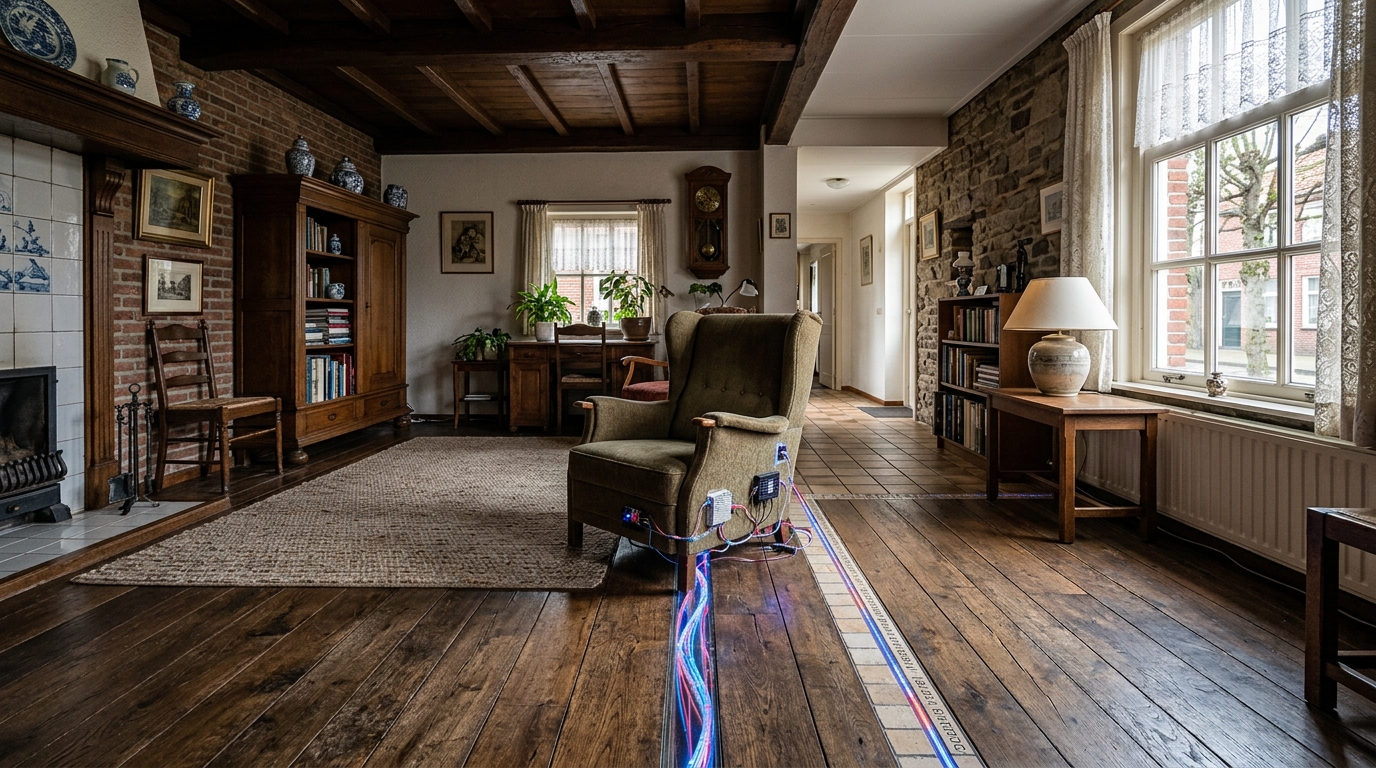
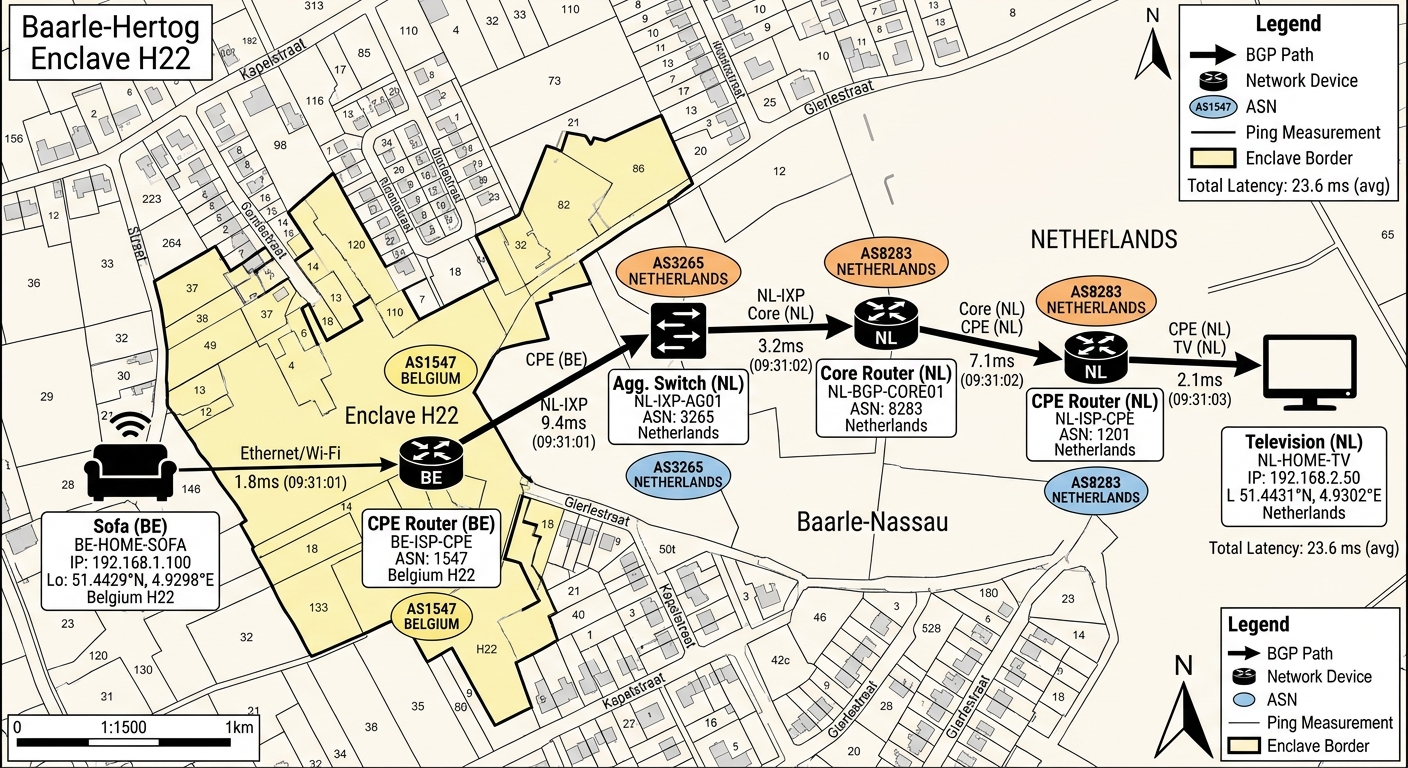
wall text
In Baarle-Hertog, sovereign borders bisect individual living rooms. This installation routes local data transmission between an armchair and a television across two distinct sovereign subnets matching the 1995 border survey. Rather than communicating locally over two meters, packets undergo BGP autonomous system routing—traveling out to national Internet Exchange Points in Belgium and the Netherlands before returning. Exposed floorboard channels illuminate packet flight times, translating CIDR subnet allocation and network routing latency into an immediate physical event where geopolitical demarcation dictates network topology.
shown: Installed permanently inside a bisected domestic living room in Baarle-Hertog Enclave H22, viewable by the public from the street through the front window.
shown: Installed permanently inside a bisected domestic living room in Baarle-Hertog Enclave H22, viewable by the public from the street through the front window.
anchor facts used
- The 'voordeurregel' (front door rule) legally determines a building's national jurisdiction based solely on which side of the border the front door is located.
- The geography consists of exactly 22 Belgian enclaves and 8 Dutch counter-enclaves.
- The 1995 border survey officially mapped the international boundary directly through private living rooms and businesses like Café In den Engel.
mechanism
- Classless Inter-Domain Routing (CIDR) subnet allocation — Spatializing digital network boundaries to exactly match physical sovereign anomalies within a domestic interior.
1. A physical router divides a single room into two separate subnets matching the 1995 survey line, assigning Belgian (AS 6848) and Dutch (AS 1136) IP blocks to devices based on their millimeter-precise floor coordinates. - BGP (Border Gateway Protocol) Autonomous System (AS) pathing — Forcing micro-local domestic data to traverse international macro-infrastructure, manifesting the border's bureaucratic distance.
2. Data packets sent between a smart TV and a mobile phone 2 meters apart across the room are forced to exit the local network, query a Dutch ISP, and return via a Belgian ISP. - Time-of-Flight (ToF) latency measurement — Translating nanosecond network routing delay into a visible, physical boundary wall of light.
3. Exposed fiber-optic cables embedded directly in the floorboards along the border illuminate to trace the packet's physical delay, visualizing the latency penalty of international routing over a 2-meter physical gap. - Dynamic Host Configuration Protocol (DHCP) lease renewal and TCP RST (Reset) packet generation — Automating the legal loophole where residents relocated their physical front doors to change their tax jurisdiction.
4. Moving a sensor-equipped armchair across the border line triggers a subroutine that updates its MAC address to the new national subnet, dropping all active connections.
lineage
- Julian Oliver, 'Border Bumping' (2012) — Extends Oliver's cellular border-mapping into fixed broadband infrastructure and interior domestic architecture.
- Eyal Weizman, 'Hollow Land' (2007) — Applies Weizman's analysis of 3D sovereign topology to the microscopic scale of digital packet routing.
- TeleGeography, 'Submarine Cable Map' — Inverts the oceanic scale of the map to document international routing anomalies occurring within a 5-meter domestic radius.
curatorial qa (machine verdict, unedited)
SCORE 3/5 after 2 attempt(s)
READS: The physical border bisecting the domestic interior, hardware attached to the armchair, and the architectural BGP routing diagram.
FAILS: The floating neon waveform feels like generic visual effects rather than grounded network latency or physicalized packet transit.
READS: The physical border bisecting the domestic interior, hardware attached to the armchair, and the architectural BGP routing diagram.
FAILS: The floating neon waveform feels like generic visual effects rather than grounded network latency or physicalized packet transit.
spec: antigravity agent · keyframe/artifact: gemini-3.1-flash-image · video: veo-3.1 image-to-video · qa+wall text: gemini-3.7-flash watching the render · 42.6s total