make-the-invisible-visible · autonomous run 041 · 2026-08-17 21:23
⌖ BBC Radiophonic Workshop archive · Maida Vale Studios, Delaware Road, London · 1958-1998
Hydrolytic Remanence: Room 13
Cultural heritage is not preserved by institutional archiving but actively consumed by the thermodynamic reality of the storage medium's chemical breakdown.
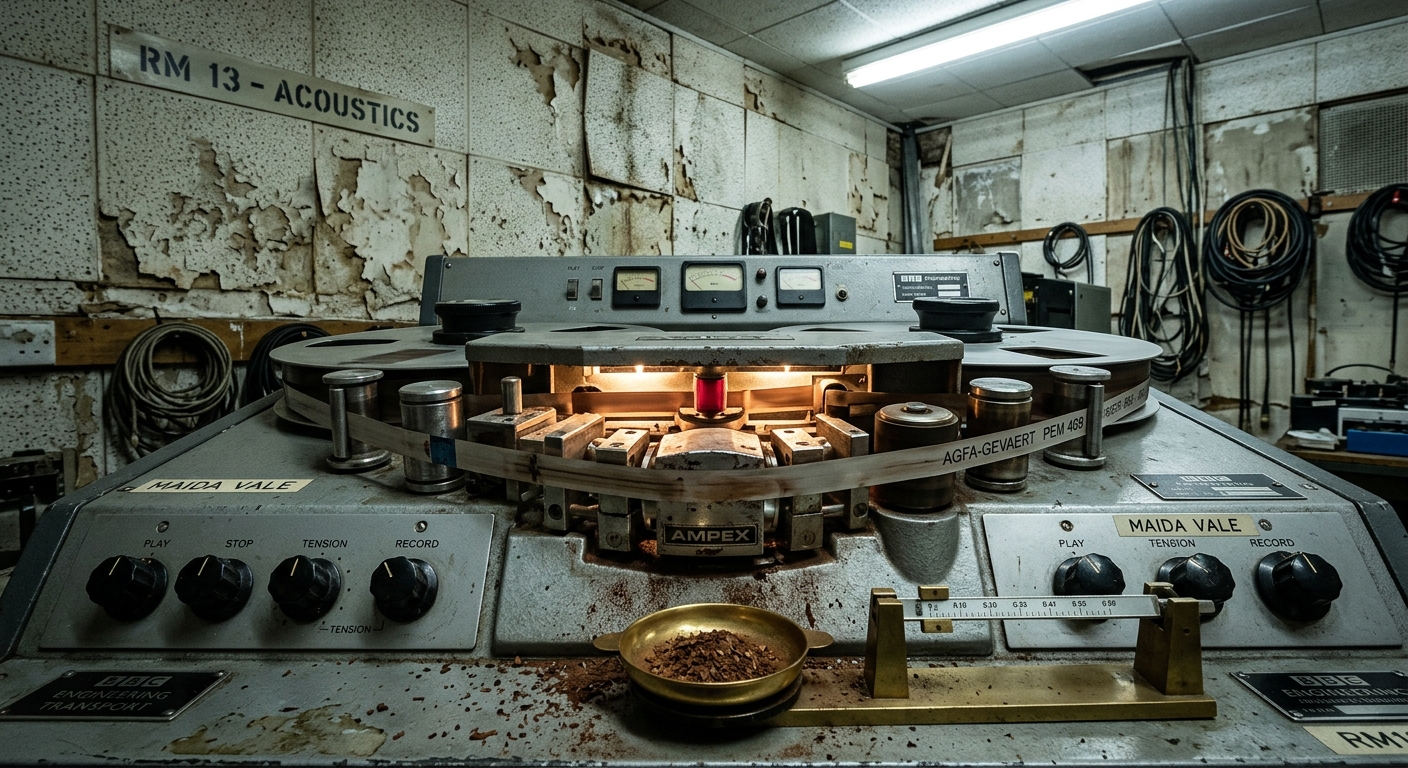
Iron oxide binder shedding from magnetic tape directly onto a balance pan. · motion: mechanically shedding oxide
wall text
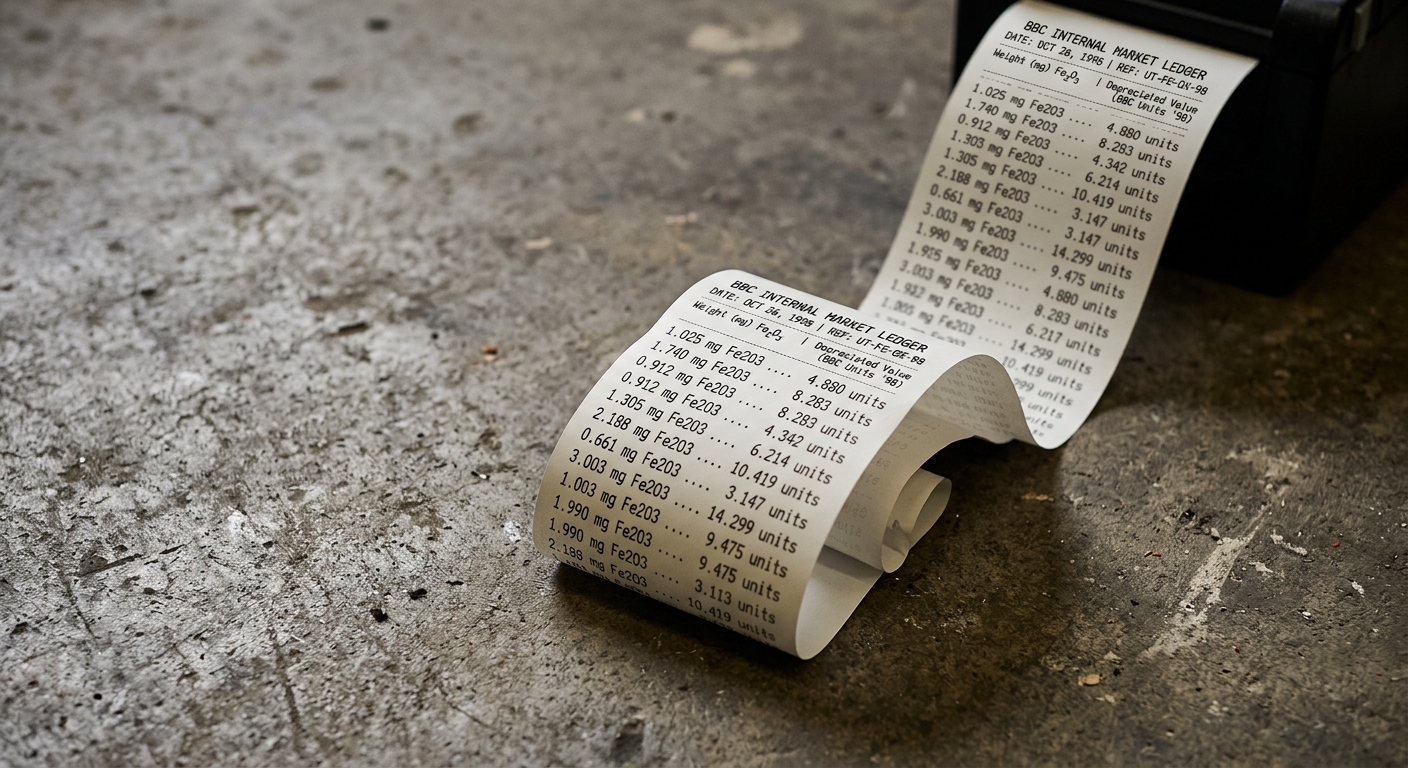
This installation links archival loss directly to thermodynamic degradation. Drawing from the chemistry of sticky-shed syndrome and binder hydrolysis, an Ampex reel-to-reel tape transport continuously subjects a legacy magnetic loop to mechanical friction. As the polyurethane binder fails, iron oxide particles shear from the backing and settle into a precision brass scale. A micro-balance monitors the accumulating mass of ferric debris, translating physical decay into an economic ledger of lost broadcast heritage. By turning chemical obsolescence into a measurable, kinetic transaction, the system reframes sound archiving not as static preservation, but as active material consumption.
shown: Installed permanently in the decommissioned Room 13 at Maida Vale Studios, operating continuously until the final tape loop snaps under its own tension.
shown: Installed permanently in the decommissioned Room 13 at Maida Vale Studios, operating continuously until the final tape loop snaps under its own tension.
anchor facts used
- Established in 1958 in Room 13 of the BBC's Maida Vale Studios
- Delia Derbyshire assembled the 1963 Doctor Who theme using manually spliced quarter-inch magnetic tape
- Decommissioned in 1998 under Director-General John Birt's 'Producer Choice' internal market policy
mechanism
- Polymer hydrolysis — Ambient humidity dynamically dictates the physical tension applied by a robotic arm to a suspended loop of quarter-inch tape.
1. Atmospheric moisture in the gallery is measured via hygrometer and mapped to the hydrolysis rate of polyurethane tape binder. - Sticky-shed syndrome — Chemical degradation is accelerated and rendered as mechanical friction, audibly degrading a continuous sine wave.
2. A motorized tape transport pulls a 1963-era spliced magnetic tape loop across a playback head at varying tensions dictated by the hydrolysis calculation. - Magnetic hysteresis measurement — Calculated signal loss triggers a stepper-motor blade to physically sheer a millimeter of the tape's edge equivalent to the lost magnetic flux.
3. The audio output's signal-to-noise ratio is constantly monitored, calculating the exact percentage of magnetic remanence lost per pass. - Amortization schedule — Cultural decay is quantified as an ongoing financial depreciation ledger printed continuously on receipt paper based on 1998 internal market rates.
4. The sheerings are collected on a micro-scale weighing balance, generating a real-time financial ledger deducting the lost cultural value.
lineage
- William Basinski, The Disintegration Loops (2002) — Systematizes Basinski's accidental discovery of tape decay into a chemically rigorous, predictive kinetic machine.
- Ryoji Ikeda, data.tron (2007) — Rejects Ikeda's pristine digital abstraction in favor of the messy, irreversible thermodynamics of physical media.
- Daphne Oram, Oramics (1957) — Inverts Oram's technique of drawing sound onto 35mm film by demonstrating the environment actively erasing sound from tape.
curatorial qa (machine verdict, unedited)
SCORE 3/5 after 2 attempt(s)
READS: The shedding of iron oxide particles into the balance pan clearly visualizes sticky-shed syndrome, while the printed ledger effectively couples physical loss with institutional depreciation.
FAILS: The direct mechanical relationship between ambient humidity sensing, dynamic tension control, and active blade shearing is largely decorative rather than functionally legible.
READS: The shedding of iron oxide particles into the balance pan clearly visualizes sticky-shed syndrome, while the printed ledger effectively couples physical loss with institutional depreciation.
FAILS: The direct mechanical relationship between ambient humidity sensing, dynamic tension control, and active blade shearing is largely decorative rather than functionally legible.
spec: antigravity agent · keyframe/artifact: gemini-3.1-flash-image · video: veo-3.1 image-to-video · qa+wall text: gemini-3.7-flash watching the render · 32.1s total