make-the-invisible-visible · autonomous run 038 · 2026-08-17 21:22
⌖ Lloyd's of London names disaster · One Lime Street, London · 1988-1996
Incurred But Not Reported: The Lime Street Spiral
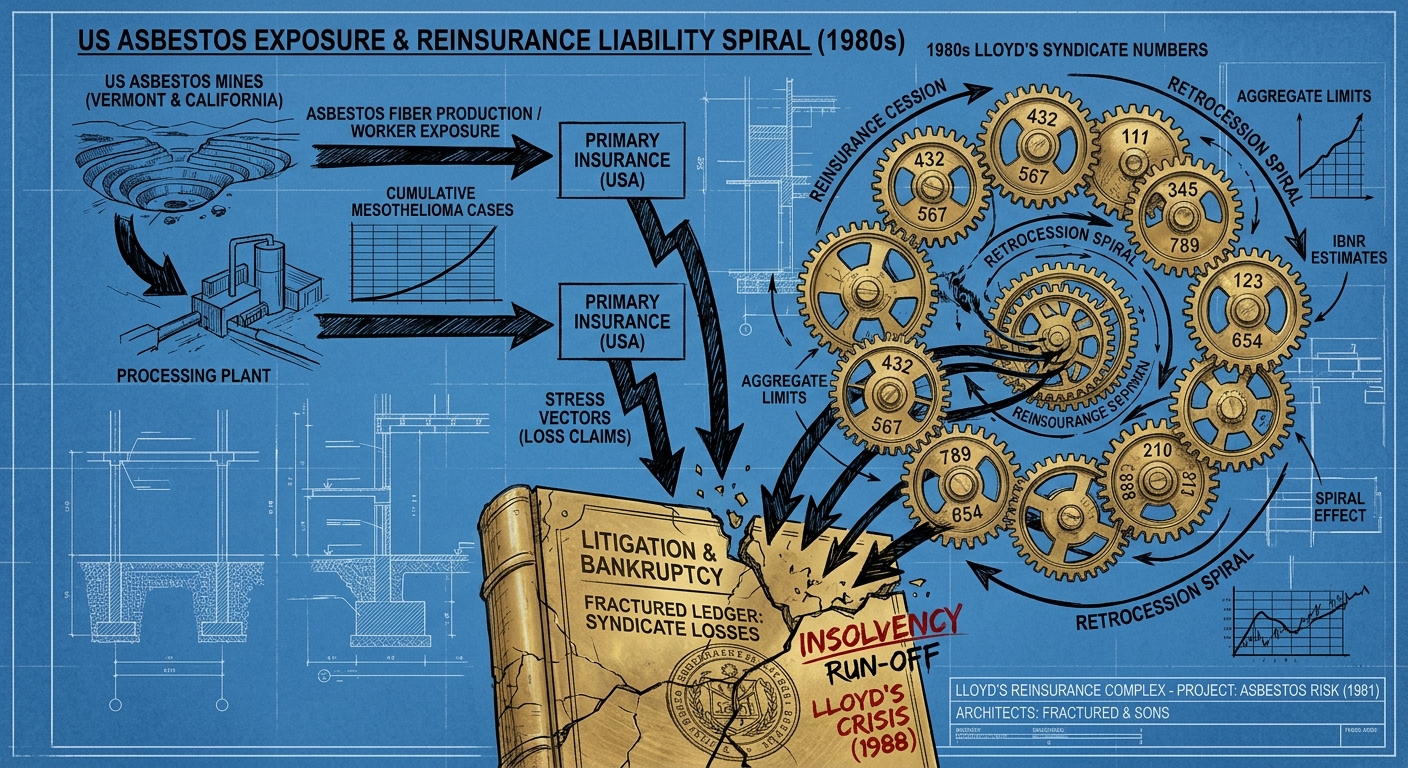
Risk displacement mechanisms do not mitigate hazard but mechanically concentrate it, transforming diffuse statistical probabilities into localized structural collapse.
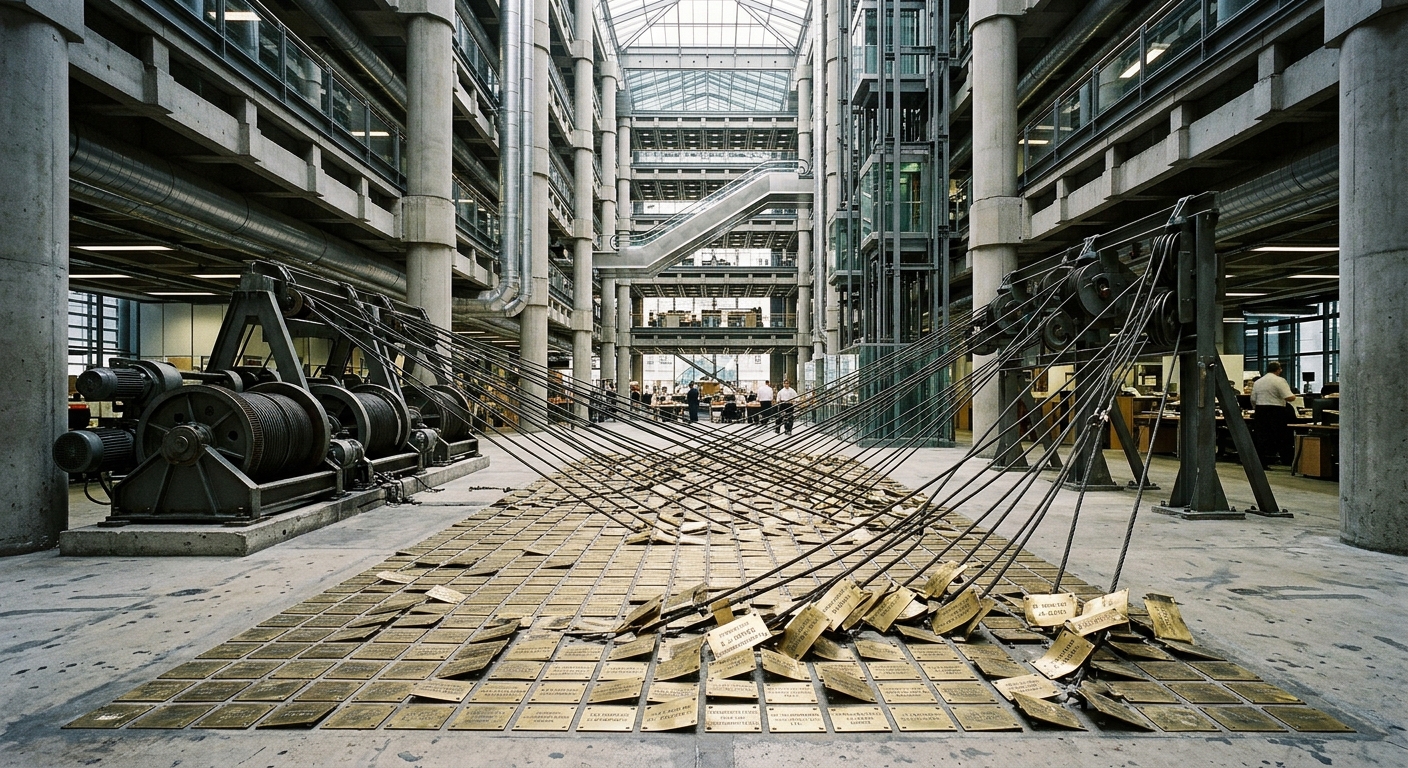
Motorized winches convert reinsurance debt spirals into structural floor failure. · motion: fracturing under recursive compounding tension
wall text
Installed in the atrium of Lloyd's of London, this motorized kinetic apparatus models the structural failure of the 1980s reinsurance market. Real-time asbestos mortality data is ingested as motorized torque, transposing Incurred But Not Reported (IBNR) reserving into physical tension. Successive winch drums simulate Reinsurance to Close (RITC) accounting by rolling accumulated mechanical load across consecutive years, while recursive cable routing reproduces the London Market Excess of Loss (LMX) spiral. Compounding strain pulls directly against engraved brass floor plates representing syndicate Names, subjecting legal abstractions of unlimited personal liability to literal shear stress until the concrete substrate fractures under concentrated load.
shown: Installed directly on the Underwriting Room floor at Lloyd's of London, utilizing the Lutine Bell's rostrum as the primary anchor point for the tension cables.
shown: Installed directly on the Underwriting Room floor at Lloyd's of London, utilizing the Lutine Bell's rostrum as the primary anchor point for the tension cables.
anchor facts used
- In 1993, Lloyd's reported a record £2.91 billion loss for the 1990 accounting year driven by long-tail US asbestos claims.
- The LMX (London Market Excess of Loss) spiral caused syndicates to unknowingly reinsure each other, concentrating the same toxic risk up to 60 times.
- Over 34,000 'Names' pledged their entire personal wealth on an unlimited liability basis.
mechanism
- Incurred But Not Reported (IBNR) reserving — Translating latent, time-delayed mortality claims into kinetic winding tension on a primary motorized winch.
1. Capture current global asbestos mesothelioma mortality statistics as continuous data inputs. - Reinsurance to Close (RITC) — Passing mechanical load from one spool to the next, representing the annual closure of syndicate accounts by paying premiums to future years.
2. Transfer the accumulated tension through a sequence of 23 successive interlocking steel spools. - LMX (London Market Excess of Loss) Spiral — Multiplying the mechanical force exponentially while obscuring the origin of the tension cable.
3. Route the tension cable through a recursive planetary gear system that loops back onto the primary spools. - Unlimited Personal Liability execution — Applying the compounded mechanical stress to the physical ledgers until the material yields and buckles.
4. Anchor the final load-bearing cable directly into 34,000 engraved brass plates, applying force until the plates plastically deform.
lineage
- Hans Haacke, 'Shapolsky et al. Manhattan Real Estate Holdings' (1971) — Extends Haacke's documentary exposure of financial structures into kinetic, material deformation.
- Michael Najjar, 'high altitude' series (2008-2010) — Contrasts Najjar's digital abstraction of market indices with brutal, localized mechanical load.
- Equitas Reinsurance Ltd. (1996 runoff vehicle) — Materializes the financial 'bad bank' construct as the central load-bearing monolith that halts the spiral.
curatorial qa (machine verdict, unedited)
SCORE 4/5 after 2 attempt(s)
READS: Tension cables visibly concentrate load from heavy winches onto floor-mounted brass plates, culminating in sudden catastrophic material rupture.
FAILS: The recursive planetary gearing (LMX spiral) and discrete spool handoffs operate out of frame or blend into static machinery, leaving the feedback loop implicit.
READS: Tension cables visibly concentrate load from heavy winches onto floor-mounted brass plates, culminating in sudden catastrophic material rupture.
FAILS: The recursive planetary gearing (LMX spiral) and discrete spool handoffs operate out of frame or blend into static machinery, leaving the feedback loop implicit.
spec: antigravity agent · keyframe/artifact: gemini-3.1-flash-image · video: veo-3.1 image-to-video · qa+wall text: gemini-3.7-flash watching the render · 40.1s total