make-the-invisible-visible · autonomous run 033 · 2026-08-17 21:22
⌖ Argentina corralito · Plaza de Mayo, Buenos Aires, outside Banco de la Nación Argentina · December 2001
Acoustophoresis of 250 Pesos
When liquid capital is artificially frozen by state decree, the resulting kinetic friction of the populace generates measurable acoustic pressure capable of structurally supporting the restricted capital in physical space.
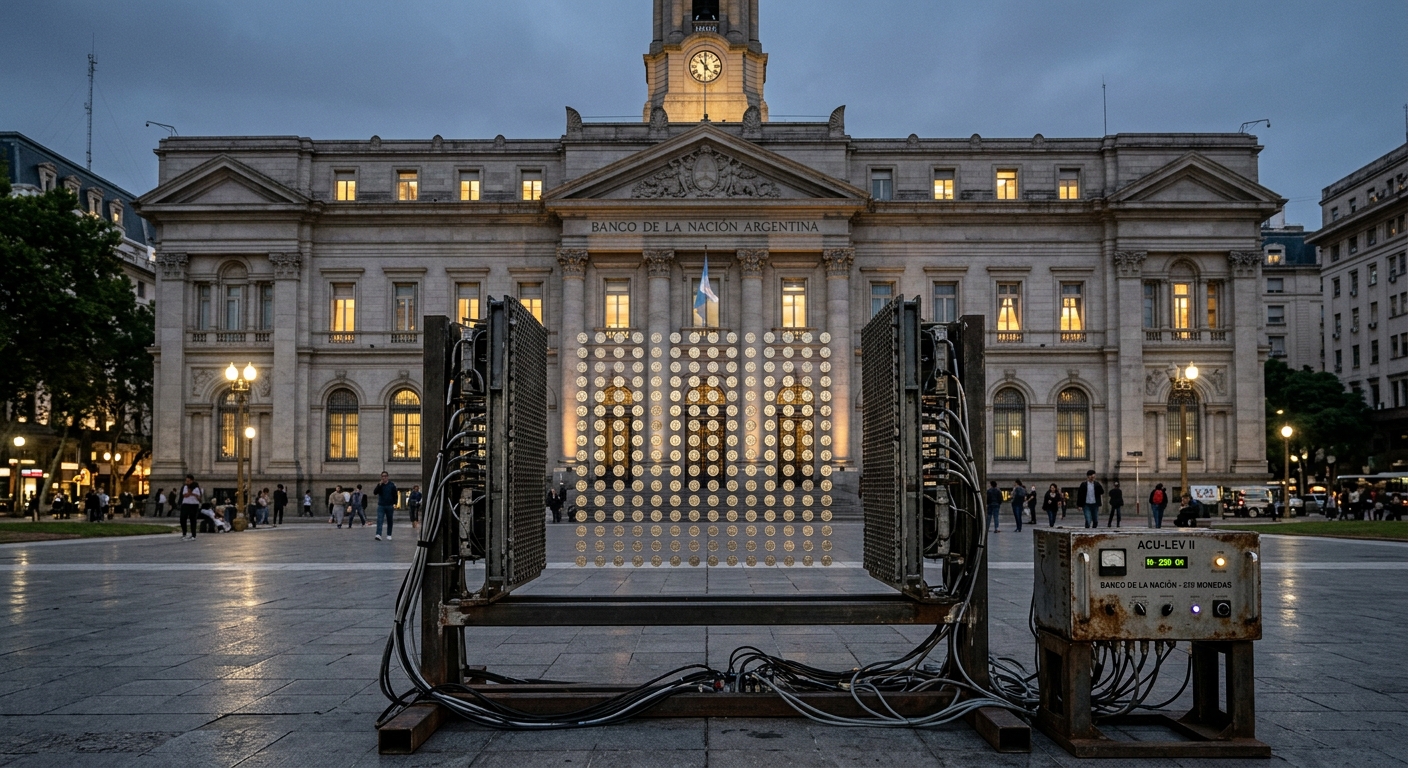
Ultrasonic array suspending 250 one-peso coins via standing waves in Buenos Aires. · motion: trembling rigidly within an invisible pressure gradient
wall text
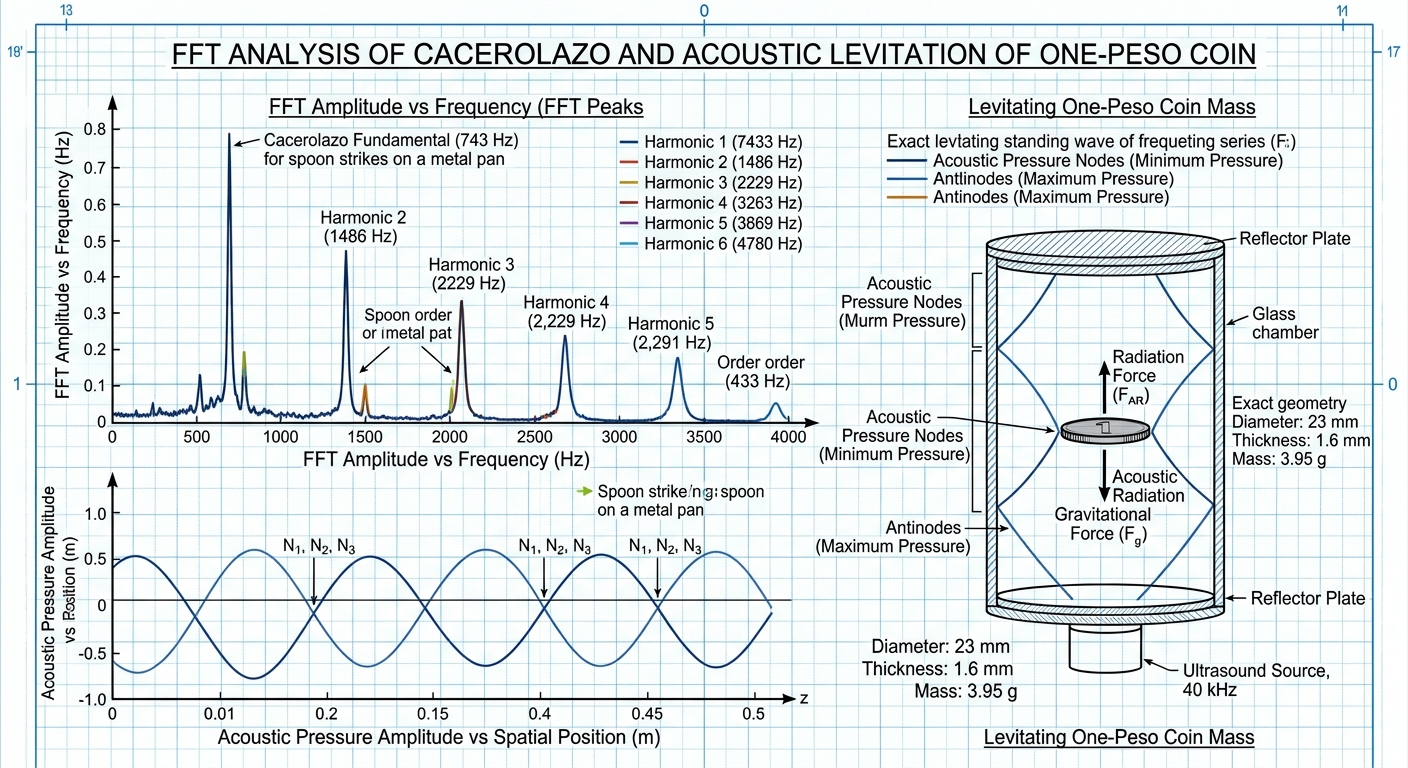
During Argentina's 2001 financial crisis, the 'corralito' froze bank accounts, limiting withdrawals to 250 pesos per week. In response, citizens banged pots and pans outside financial institutions. This installation transposes that kinetic friction into an acoustic levitation field. Using Fast Fourier Transform analysis on archival cacerolazo recordings, the dominant resonant frequencies of struck cookware are mapped to an ultrasonic transducer array. The resulting standing wave creates nodal traps that suspend exactly 250 one-peso coins in mid-air before the Banco de la Nación Argentina. The piece converts collective political sound into physical force, physically supporting the frozen capital in space.
shown: Installed directly on the sidewalk outside the main entrance of Banco de la Nación Argentina at Rivadavia 325, Buenos Aires.
shown: Installed directly on the sidewalk outside the main entrance of Banco de la Nación Argentina at Rivadavia 325, Buenos Aires.
anchor facts used
- Economy Minister Domingo Cavallo decreed a maximum cash withdrawal limit of 250 pesos or dollars per week on December 1, 2001.
- Citizens responded with the cacerolazo, generating massive localized acoustic energy by banging metal pots outside locked bank doors.
- The sudden freezing of liquid capital trapped billions of dollars in insolvent institutions, precipitating a structural halt to daily commerce.
mechanism
- Acoustic Impedance Matching — Measuring the specific acoustic reflection of the locked bronze and stone bank doors to calibrate the resonant frequency required to generate a standing wave.
1. Array calibration against the bank facade. - Fast Fourier Transform (FFT) signal processing — Analyzing archival audio recordings from December 19-20, 2001 in Plaza de Mayo to extract the dominant resonant frequencies of the banging metal pots.
2. Capture and amplification of impulse frequencies. - Acoustophoresis / Acoustic Levitation — Using an opposed phased array of heavy transducers to create nodes of minimal acoustic pressure in mid-air, powered by the FFT-analyzed protest audio.
3. Generation of an ultrasonic standing wave field. - Particle trapping at acoustic pressure nodes — Levitating exactly 250 physical one-peso coins in the nodes of the standing wave, rendering the inaccessible weekly withdrawal limit physically present but untouchable.
4. Suspension of the weekly liquidity limit.
lineage
- Teresa Margolles, 'Vaporización' (2001) — Shares the transposition of a grim socio-political reality into an invisible but physically sensible atmospheric medium.
- Douglas Diamond and Philip Dybvig, 'Bank Runs, Deposit Insurance, and Liquidity' (1983) — Manifests the paper's theoretical Nash equilibrium of panic as a literal, physical acoustic phenomenon supporting frozen assets.
- Ryoji Ikeda, 'micro | macro' (2015) — Adopts Ikeda's rigorous reliance on wave physics, but applies it to documented macroeconomic trauma rather than pure mathematics.
curatorial qa (machine verdict, unedited)
SCORE 3/5 after 2 attempt(s)
READS: The physical apparatus reliably conveys acoustic trapping, showing coins held in a stable standing wave grid before the Banco de la Nación.
FAILS: The direct translation of protest audio frequencies into the levitation field remains abstract and reliant on the supplementary diagram.
READS: The physical apparatus reliably conveys acoustic trapping, showing coins held in a stable standing wave grid before the Banco de la Nación.
FAILS: The direct translation of protest audio frequencies into the levitation field remains abstract and reliant on the supplementary diagram.
spec: antigravity agent · keyframe/artifact: gemini-3.1-flash-image · video: veo-3.1 image-to-video · qa+wall text: gemini-3.7-flash watching the render · 36.8s total