make-the-invisible-visible · autonomous run 028 · 2026-08-17 21:22
⌖ Gallagher's brickworks automation · Haverstraw, New York (historic James Gallagher brickyard footprint) · 1880s / Present
The Haverstraw Filter
The automation of physical labor does not eliminate human error, but rather fossilizes it by mathematically modeling and reproducing our historical inefficiencies as a machine-coded luxury aesthetic.
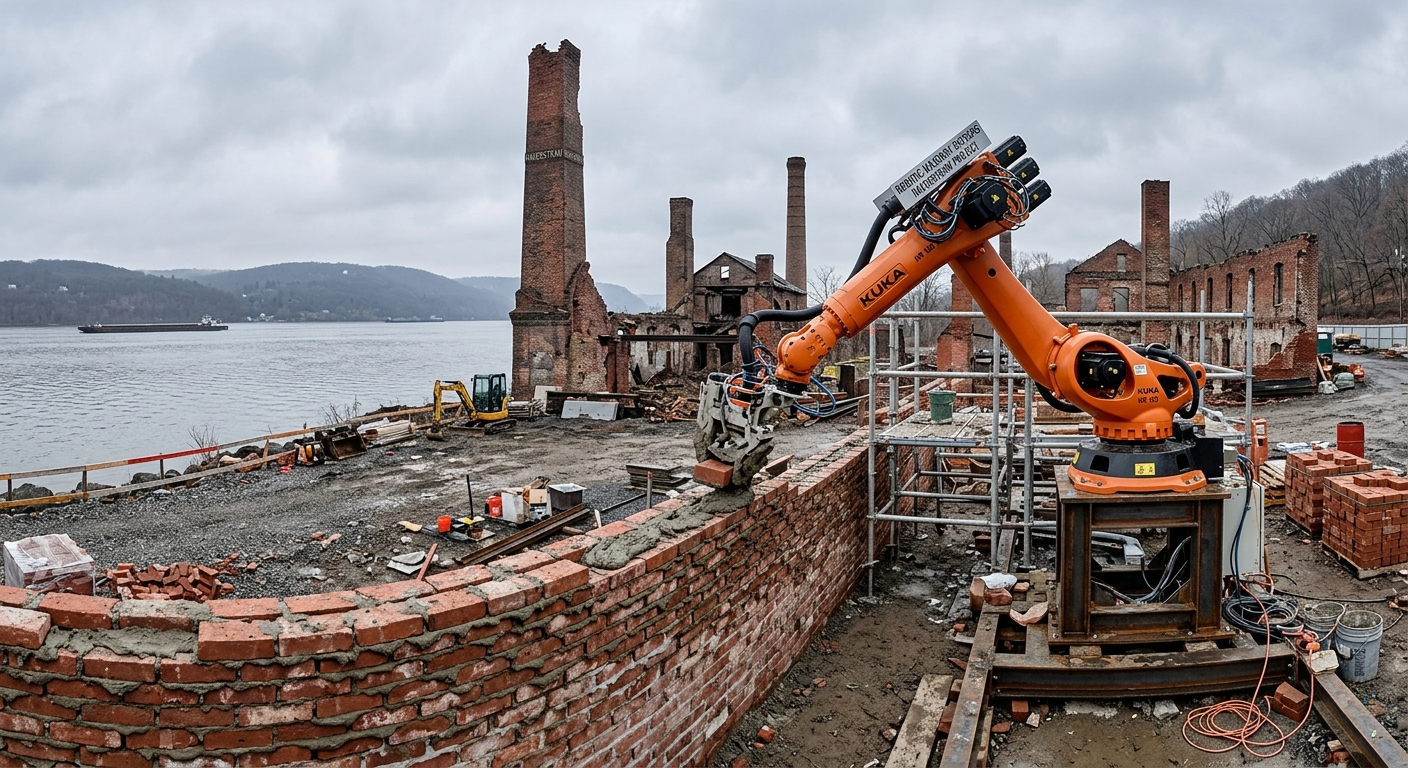
An industrial arm executing mathematically detuned joint trajectories to simulate human exhaustion. · motion: calculating and extruding synthetic fatigue
wall text
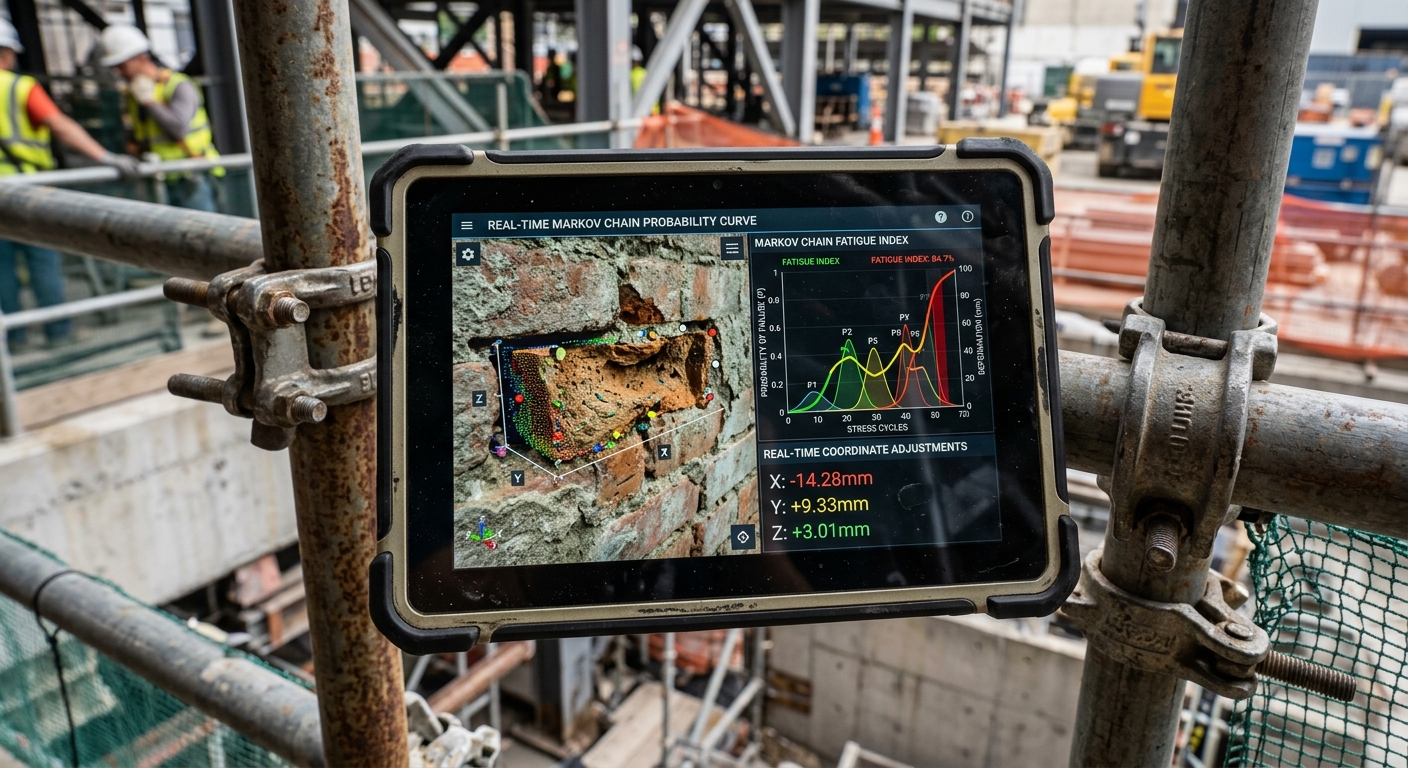
Industrial automation typically pursues repeatable precision, yet here standard robotic bricklaying is systematically corrupted. By combining photogrammetric point-cloud scans of 19th-century handmade bricks from the Hudson River Valley with Markov chain Monte Carlo fatigue simulations, the system models the biomechanical exhaustion of a 12-hour historical shift. These calculated fatigue curves are translated via inverse kinematics and detuned PID controllers into deliberate mechanical tremors. The articulated KUKA arm smears excess mortar and misaligns courses according to quantified human error, packaging the physical trauma of 1880s brickyard labor into an algorithmic, decorative veneer for contemporary architectural fabrication.
shown: Installed as a temporary, actively building architectural intervention on the exact shoreline footprint of the former James Gallagher brickyard in Haverstraw, New York.
shown: Installed as a temporary, actively building architectural intervention on the exact shoreline footprint of the former James Gallagher brickyard in Haverstraw, New York.
anchor facts used
- James Gallagher operated a massive hand-molding brickyard in Haverstraw, NY, contributing to the city's 300 million bricks-per-year peak output.
- Modern SAM100 (Semi-Automated Mason) systems use a laser-guided rail and 6-axis arm to lay up to 3,000 bricks per day.
- Hand-molded bricks exhibit unique 'creases' and off-center 'frogs' due to the physical fatigue of laborers throwing wet clay into wooden molds.
mechanism
- Non-destructive 3D photogrammetry and point-cloud generation — Scanning 10,000 surviving 19th-century handmade bricks from the Gallagher estate to extract the geometric deviations caused by human muscle failure.
1. Micro-deviation mapping - Markov chain Monte Carlo (MCMC) simulation — Building a predictive algorithm of human exhaustion over a 12-hour shift, mapping the probability of increasingly erratic clay-throws as the workday progresses.
2. Stochastic fatigue modeling - Inverse kinematics path planning — Converting the MCMC fatigue variables into precise joint-angle coordinates for a modern industrial robotic arm, forcing the machine to adopt the slumped posture of an exhausted worker.
3. Trajectory translation - Proportional-Integral-Derivative (PID) control detuning — Intentionally destabilizing the robot's error-correction loop, causing the end-effector to stutter and smear polyurethane adhesive, perfectly replicating 1880s manual labor exhaustion.
4. Automated imperfection
lineage
- Frank Gilbreth's 'Chronocyclegraphs' (1914) — Reverses Gilbreth's optimization of bricklaying by using motion-tracking to systematically re-introduce inefficiency rather than eliminate it.
- Gramazio Kohler Research's 'Flight Assembled Architecture' (2011) — Grounds their pristine automated aerial assembly in the messy, embodied history of manual clay throwing and muscular degradation.
- Harun Farocki's 'In Comparison' (2009) — Advances Farocki's cinematic study of brickmaking across cultures into a physical, algorithmic reenactment of labor conditions.
curatorial qa (machine verdict, unedited)
SCORE 4/5 after 2 attempt(s)
READS: The interface artifact clearly links Markov fatigue models to real-time spatial offsets, while the industrial arm precisely recreates historical masonry slumps and sloppy mortar extruded amid Hudson Valley brickyard ruins.
FAILS: The robot's physical movement in video appears slightly too smooth rather than visibly stuttering from detuned PID control loops.
READS: The interface artifact clearly links Markov fatigue models to real-time spatial offsets, while the industrial arm precisely recreates historical masonry slumps and sloppy mortar extruded amid Hudson Valley brickyard ruins.
FAILS: The robot's physical movement in video appears slightly too smooth rather than visibly stuttering from detuned PID control loops.
spec: antigravity agent · keyframe/artifact: gemini-3.1-flash-image · video: veo-3.1 image-to-video · qa+wall text: gemini-3.7-flash watching the render · 40.1s total