make-the-invisible-visible · autonomous run 018 · 2026-08-17 21:21
⌖ WIPP waste isolation · Carlsbad, New Mexico · 1999-present
Convergence Rate (This Is Not A Place Of Honor)
The physical geologic time of the Earth ultimately consumes the human capacity for semiotic transmission, rendering permanent warnings indistinguishable from natural landscape.
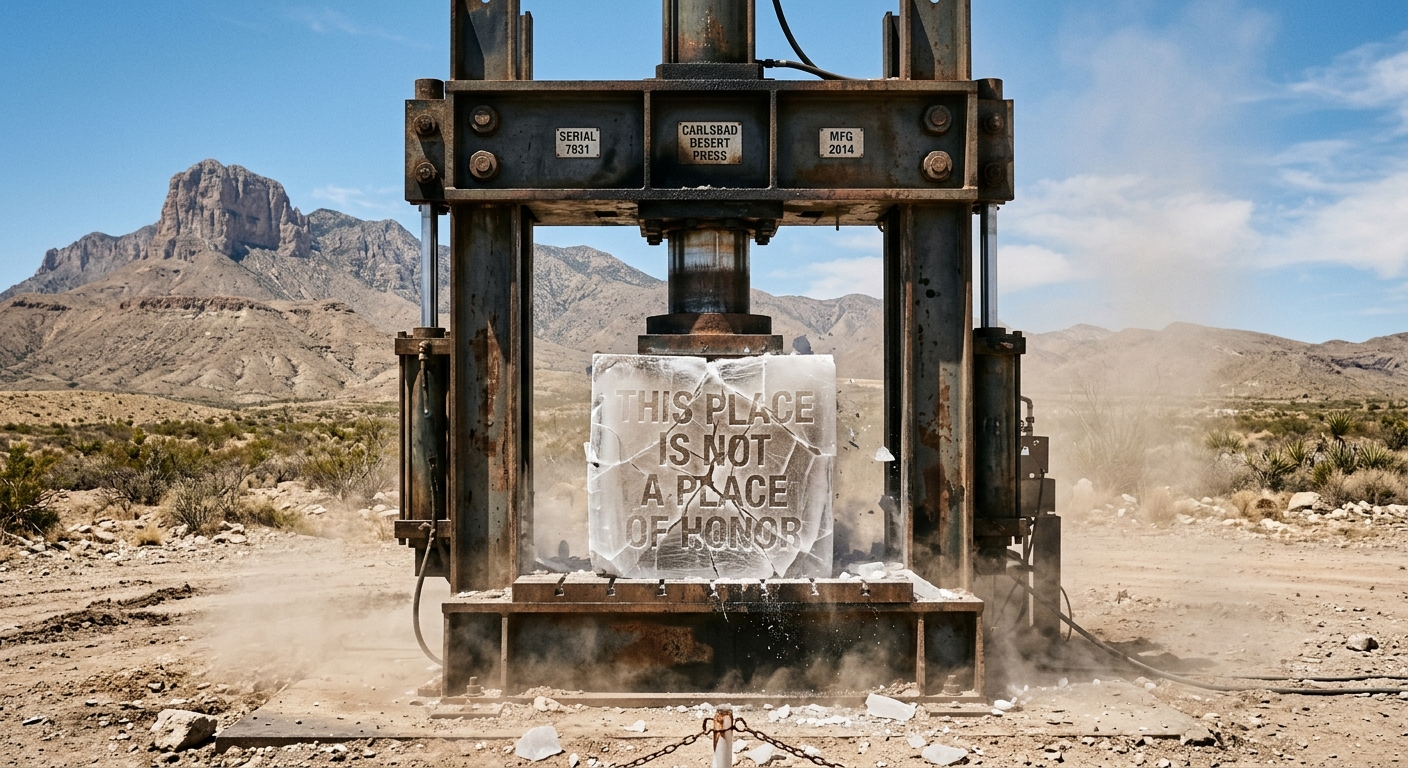
A hydraulic press compresses permanent nuclear warning text into desert rubble. · motion: compressing until illegible
wall text
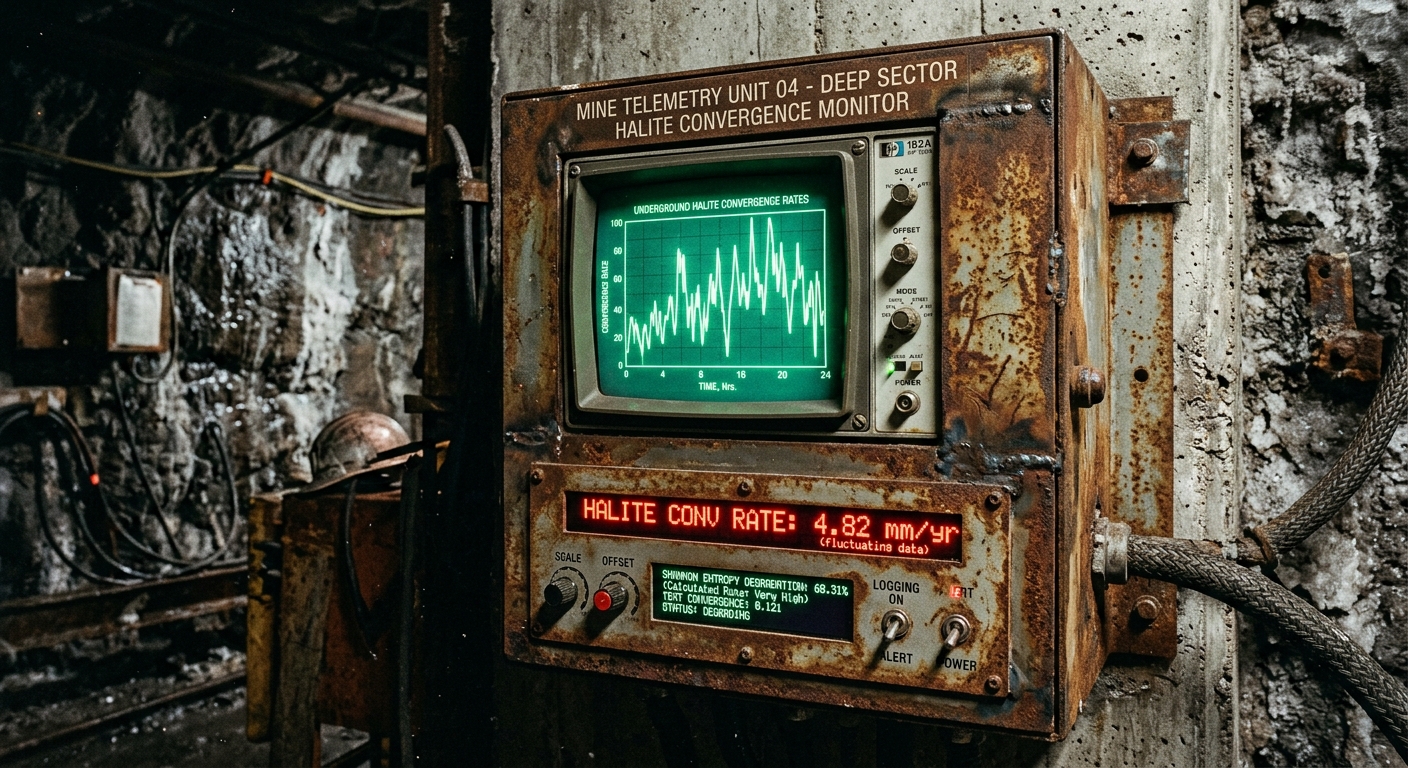
Deep in the Permian Basin, nuclear waste isolation relies on the natural viscoplastic creep of salt formations to swallow underground caverns over millennia. This installation transposes subterranean strain gauge telemetry directly to an outdoor hydraulic press on the surface. As the deep salt deposit converges at millimeters per year, the press scales that physical displacement to crush a cast halite monolith inscribed with standard nuclear semiotic markers ('THIS PLACE IS NOT A PLACE OF HONOR'). Optical entropy sensors calculate the rate of legibility loss as structural fractures dissolve the glyphs into mineral debris. Rather than preserving message integrity against deep time, the system automates its erasure through geological kinetics.
shown: Installed permanently at the surface boundary of the WIPP site in Carlsbad, New Mexico, operating continuously until the warning text is fully obliterated.
shown: Installed permanently at the surface boundary of the WIPP site in Carlsbad, New Mexico, operating continuously until the warning text is fully obliterated.
anchor facts used
- Repository is mined 2,150 feet underground in a 250-million-year-old Permian salt formation
- The salt formation naturally undergoes halite viscoplastic creep to seal and encapsulate the waste drums over centuries
- Human Interference Task Force designed a 10,000-year passive marker system including messages like 'This place is not a place of honor'
mechanism
- Strain gauge telemetry — Live extensometer data measuring the underground convergence rate of the salt walls is routed to a surface installation.
1. Telemetric synchronization - Halite viscoplastic creep — A surface hydraulic press slowly compresses a massive block of synthetic halite containing the 10,000-year warning text, matching the exact deformation rate of the underground repository.
2. Isotropic compression - Shannon information entropy — A computer vision system continuously scans the deforming salt block, calculating the exact mathematical loss of readable characters as they fracture into structural noise.
3. Legibility degradation - Proportional-integral-derivative (PID) control — The entropy calculation dictates the volume of a localized subsonic hum broadcast across the surface; as the text becomes more illegible, the sound diminishes to zero.
4. Acoustic dampening
lineage
- Human Interference Task Force (1984) / Sandia National Laboratories — Critiques the panel's assumption that symbolic language and architectural menace can outpace geologic material timescales.
- Trevor Paglen, 'The Last Pictures' (2012) — Extends the concept of deep-time archiving by introducing real-time material degradation as the primary vector of meaning.
- Robert Smithson, 'Spiral Jetty' (1970) — Mirrors the use of entropy in earthworks, but ties it to active radiological containment telemetry rather than passive landscape.
curatorial qa (machine verdict, unedited)
SCORE 4/5 after 1 attempt(s)
READS: The crushing of nuclear warning typography by a heavy industrial press in a desert landscape directly communicates semiotic destruction via physical force. The telemetry screen clearly links subsurface halite creep to informational decay.
FAILS: The press operates at rapid mechanical demolition speed rather than the hyper-slow, creeping timescale of viscoplastic geological convergence described in the mechanism.
READS: The crushing of nuclear warning typography by a heavy industrial press in a desert landscape directly communicates semiotic destruction via physical force. The telemetry screen clearly links subsurface halite creep to informational decay.
FAILS: The press operates at rapid mechanical demolition speed rather than the hyper-slow, creeping timescale of viscoplastic geological convergence described in the mechanism.
spec: antigravity agent · keyframe/artifact: gemini-3.1-flash-image · video: veo-3.1 image-to-video · qa+wall text: gemini-3.7-flash watching the render · 24.4s total