make-the-invisible-visible · autonomous run 014 · 2026-08-17 21:21
⌖ Sellafield nuclear reprocessing · Cumbria, England and the Irish Sea · 1947-present
Technetium Littoral Cell
The Irish Sea is not a boundary to the Sellafield complex, but an active, uncontained biogeochemical extension of its waste storage architecture.
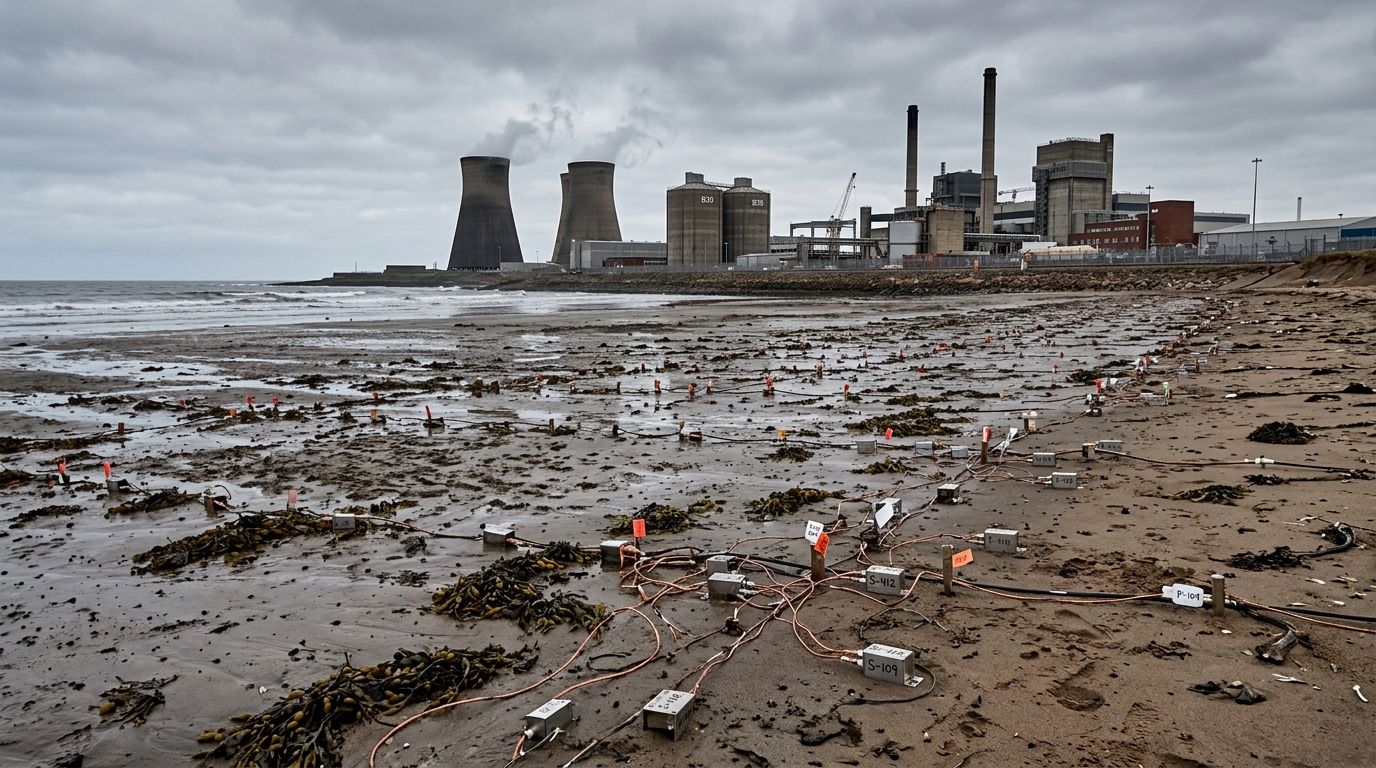
Intertidal sensor array logging simulated radionuclide flux on the Sellafield foreshore. · motion: rhythmic, tidal extrusion of contaminated data
wall text
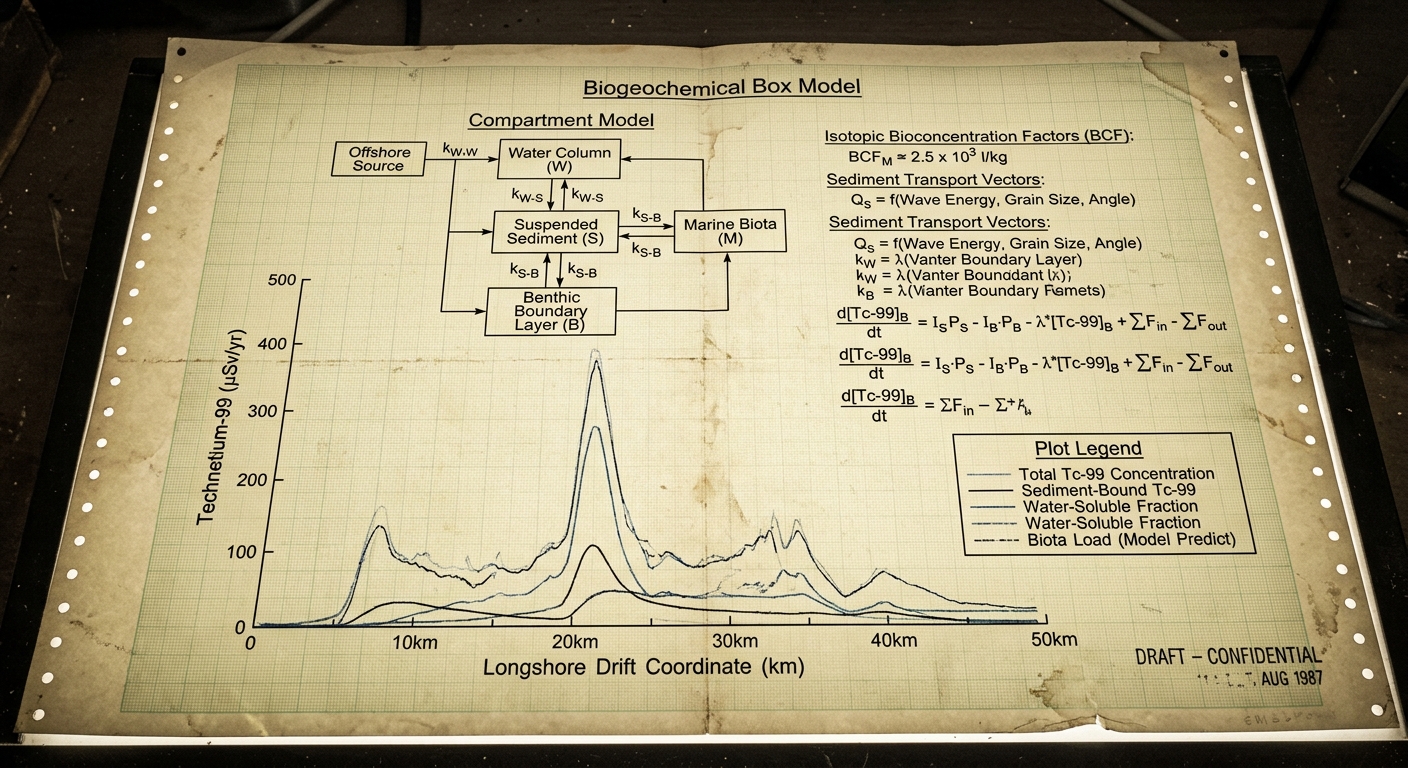
This installation interrogates the Irish Sea as an open-air hydrological extension of the Sellafield nuclear facility. By deploying an intertidal array of autonomous sensors, the work transposes in situ gamma spectrometry and longshore sediment transport modeling into a live field experiment. As tidal cycles submerge the coastal mudflats, the instrumentation registers simulated radionuclide migration through benthic sediments and bladderwrack (*Fucus vesiculosus*). The project reframes environmental dispersal models as continuous telemetry, tracking Technetium-99 uptake across coastal compartments and presenting marine erosion not as passive dispersion, but as an active metabolic component of the facility's waste architecture.
shown: Installed permanently in a modified, reinforced coastal observation bunker at Seascale beach, precisely two miles south of the Sellafield outfall pipe.
shown: Installed permanently in a modified, reinforced coastal observation bunker at Seascale beach, precisely two miles south of the Sellafield outfall pipe.
anchor facts used
- Sellafield historically discharged Technetium-99 (Tc-99) into the Irish Sea, which actively bioaccumulates in local marine flora like Fucus vesiculosus (bladderwrack).
- The Cumbrian coastline is undergoing active erosion, threatening to eventually expose legacy nuclear waste infrastructure.
- A subtidal mud patch in the eastern Irish Sea acts as a long-term sink for Sellafield-derived plutonium and americium.
mechanism
- In situ gamma-ray spectrometry — Deploying a grid of autonomous, tide-powered scintillators along the Sellafield foreshore to continuously log real-time ambient radiation levels in the shifting coastal sediment.
1. Sampling the source compartment. - Longshore drift sediment transport modeling — Mapping the movement of irradiated sand grains southward using bespoke acoustic Doppler profilers disguised as offshore lobster pots anchored to the seabed.
2. Calculating the transit rate. - Bioconcentration factor (BCF) calculation — Harvesting Fucus vesiculosus along the drift line, drying it, and plotting its Tc-99 content against the source telemetry to index the ocean's metabolic absorption.
3. Measuring biological uptake. - Pharmacokinetic compartmental modeling — Driving a continuous, motorized mechanical plotter that physically extrudes a shoreline-shaped wax barrier corresponding to the shifting isotopic burden of the coastal ecosystem.
4. Outputting the multi-compartment state.
lineage
- James Acord, 'The Hanford Reach' — Extends Acord's ambition to sculpt with nuclear materials by substituting direct handling with automated, landscape-scale biogeochemical biomonitoring.
- Mark Lombardi, 'Global Networks' — Translates Lombardi's hand-drawn financial topologies into physical, automated transport networks of radionuclides migrating through ecosystems.
- Susan Schuppli, 'Material Witness' — Operationalizes Schuppli's concept of matter recording its own history by forcing the coastal erosion to physically document its isotopic displacement.
curatorial qa (machine verdict, unedited)
SCORE 3/5 after 2 attempt(s)
READS: Tidal foreshore instrumentation linked visually to the nuclear complex, with sensor nodes activating as the surf washes over sediment.
FAILS: Sediment transport dynamics and biological uptake in marine flora remain largely conceptual rather than visibly demonstrated across the tidal cycle.
READS: Tidal foreshore instrumentation linked visually to the nuclear complex, with sensor nodes activating as the surf washes over sediment.
FAILS: Sediment transport dynamics and biological uptake in marine flora remain largely conceptual rather than visibly demonstrated across the tidal cycle.
spec: antigravity agent · keyframe/artifact: gemini-3.1-flash-image · video: veo-3.1 image-to-video · qa+wall text: gemini-3.7-flash watching the render · 32.9s total