make-the-invisible-visible · autonomous run 007 · 2026-08-17 21:21
⌖ Aral Sea ship graveyard · Moynaq, Karakalpakstan, Uzbekistan · 1960s-present
Benthic Dust: Dry ADCP
The ocean never vanished; it merely underwent a phase change into a toxic atmospheric fluid, carrying the exact chemical legacy of the agricultural debt that displaced it.
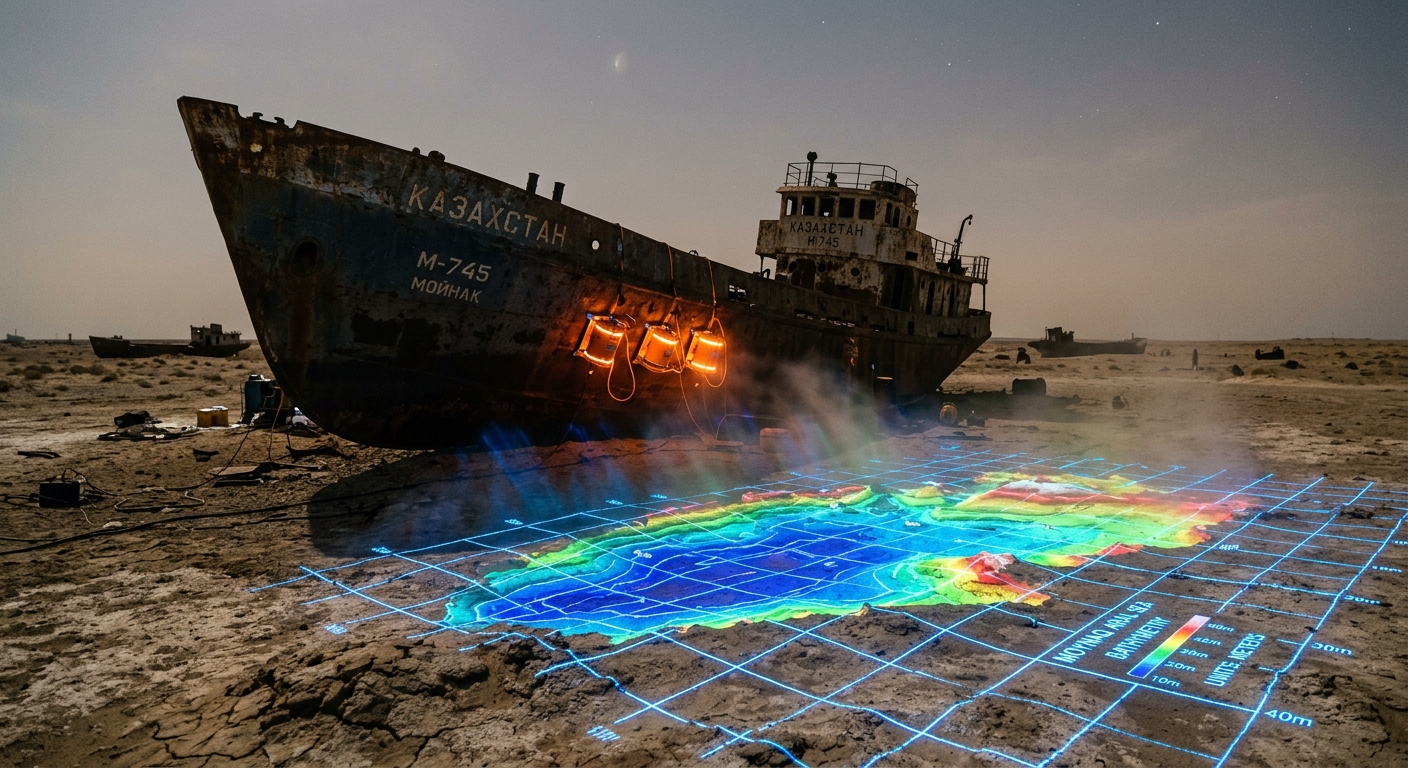
Stranded trawlers use acoustic Doppler profiling to map airborne dust as bathymetry. · motion: visualizing the phantom water column by rendering blowing dust as fluid backscatter
wall text
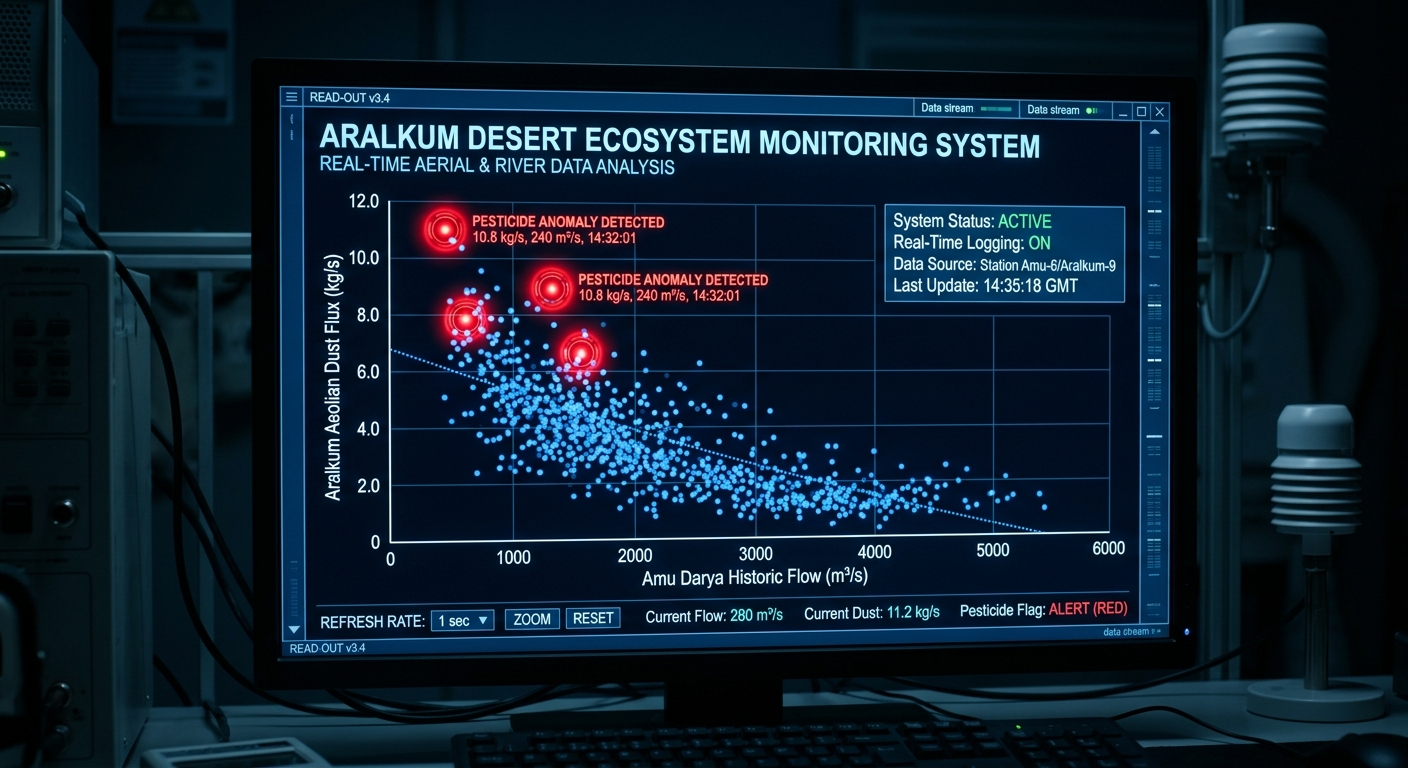
Stranded across the Aralkum desert, the rusted fishing fleet of Moynaq has been retrofitted as an atmospheric monitoring array. Transposing Acoustic Doppler Current Profiling from marine hydrology to aeolian particulate dynamics, the installation tracks the density and velocity of blowing desert dust. Suspended matter is analyzed via mass spectrometry for residual organochlorine pesticides and cross-referenced against historical Amu Darya river discharge. By translating toxic dust flux back into missing liquid displacement, multibeam bathymetric projections map the phantom water column directly onto the cracked seabed. The work frames the desiccated Aral Sea not as vanished water, but as an airborne, toxic fluid phase.
shown: Permanently installed directly on the hull of the 'Muynak' trawler at the Moynaq ship graveyard, operating autonomously on solar power until the metal completely rusts away.
shown: Permanently installed directly on the hull of the 'Muynak' trawler at the Moynaq ship graveyard, operating autonomously on solar power until the metal completely rusts away.
anchor facts used
- In the 1960s, Soviet irrigation projects diverted the Amu Darya and Syr Darya rivers to fuel cotton production.
- The sea shrank to less than 10% of its original size, leaving the Moynaq fishing fleet stranded 150km from the receding shoreline.
- The exposed seabed formed the Aralkum Desert, which now generates massive dust storms laced with agricultural pesticides and marine salt.
mechanism
- Acoustic Doppler Current Profiling (ADCP) backscatter measurement — Calibrated to measure atmospheric dust particulate velocity and density instead of suspended sediment in a liquid water column.
1. Retrofit the rusted hulls of the Moynaq fleet with acoustic sensors. - Gas chromatography-mass spectrometry (GC-MS) — Operating as a dry 'salinity and pollution' sensor, analyzing the ocean of air for historically deposited agricultural chemicals.
2. Continuously sample the aerosolized matter hitting the ships. - Hydrological mass balance calculation (ΔS = P - E - Q) — Calculating the volume of the 'ghost sea' passing over the ships as a dry mass equivalent to the missing liquid volume.
3. Map the contemporary aeolian dust flux to historical water flow rates. - Multibeam echosounder bathymetry — Projecting the invisible volumetric flow of toxic dust as shifting, luminous underwater topography directly onto the dry desert floor.
4. Render the acoustic and particulate data as a real-time topographic projection.
lineage
- Hans Haacke, 'Condensation Cube' (1965) — Expands Haacke's closed-system hydrological cycle into a catastrophic open-system atmospheric phase change.
- Forensic Architecture, 'Cloud Studies' (2021) — Adopts their methodology of weaponized atmosphere analysis but applies it to chronic agricultural terraforming rather than acute conflict.
- NASA Earth Observatory, 'Aral Sea' satellite time-series (2000-2018) — Reverses the macro-orbital perspective of ecological loss by capturing the data at a micro-benthic, human scale on the ground.
curatorial qa (machine verdict, unedited)
SCORE 4/5 after 1 attempt(s)
READS: The stranded ship retrofitted with glowing instrumentation, ground-projected bathymetric contours, and the direct correlation between aeolian toxic dust flux and displaced river volume on the telemetry screen.
FAILS: The vertical laser beams read more like decorative stage lighting than precise acoustic Doppler profilers sampling volumetric atmospheric backscatter.
READS: The stranded ship retrofitted with glowing instrumentation, ground-projected bathymetric contours, and the direct correlation between aeolian toxic dust flux and displaced river volume on the telemetry screen.
FAILS: The vertical laser beams read more like decorative stage lighting than precise acoustic Doppler profilers sampling volumetric atmospheric backscatter.
spec: antigravity agent · keyframe/artifact: gemini-3.1-flash-image · video: veo-3.1 image-to-video · qa+wall text: gemini-3.7-flash watching the render · 35.7s total