make-the-invisible-visible · autonomous run 005 · 2026-08-17 21:21
⌖ Sachsenhausen · Oranienburg, Germany · 1936-1950
Archard's Track (Special Camp No. 7)
The violent extraction of human kinetic energy to validate commercial infrastructure leaves an indelible, quantifiable material deficit in the soil, persisting across the transition of opposing totalitarian regimes.
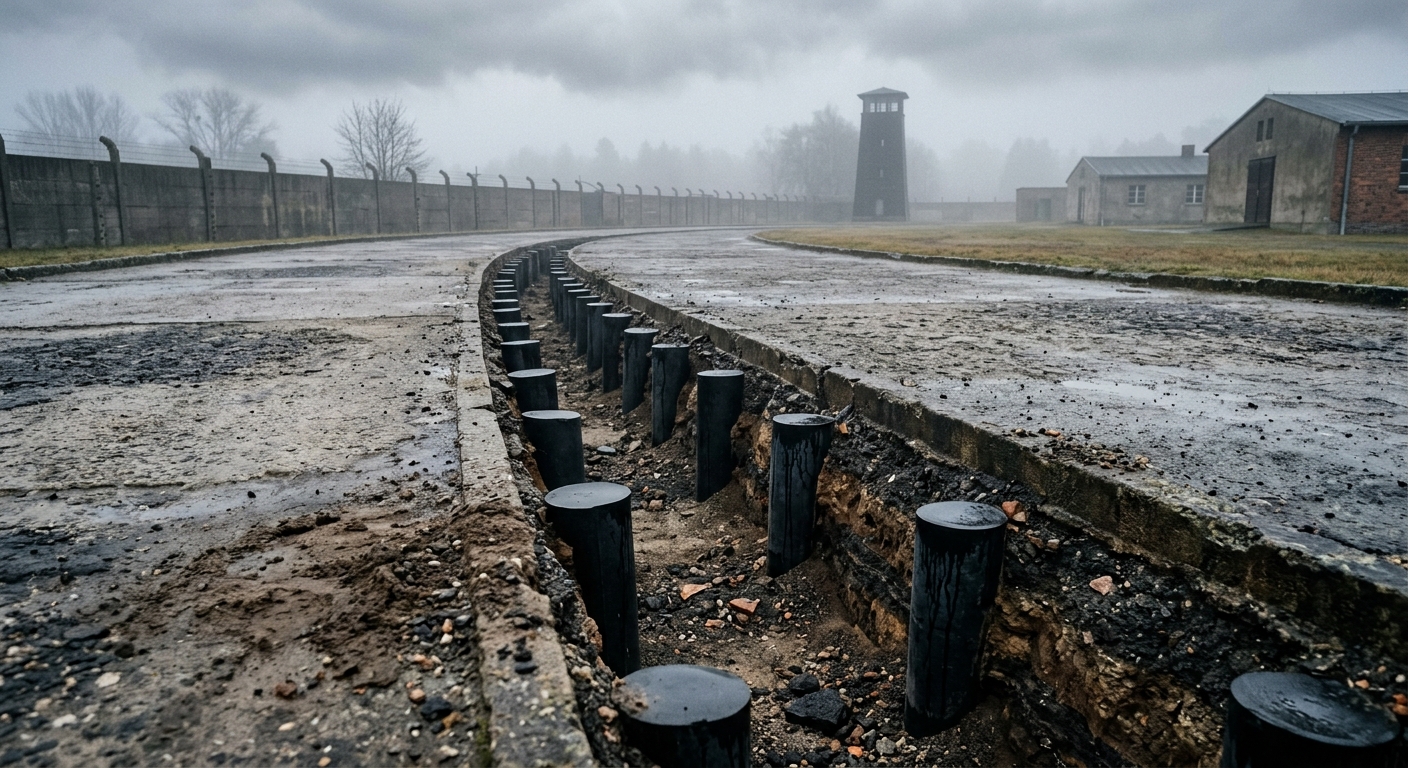
Core sample trench revealing forced-march soil compaction along the shoe-testing track. · motion: slowly descending into the stratified trench to reveal sub-surface historical compression
wall text
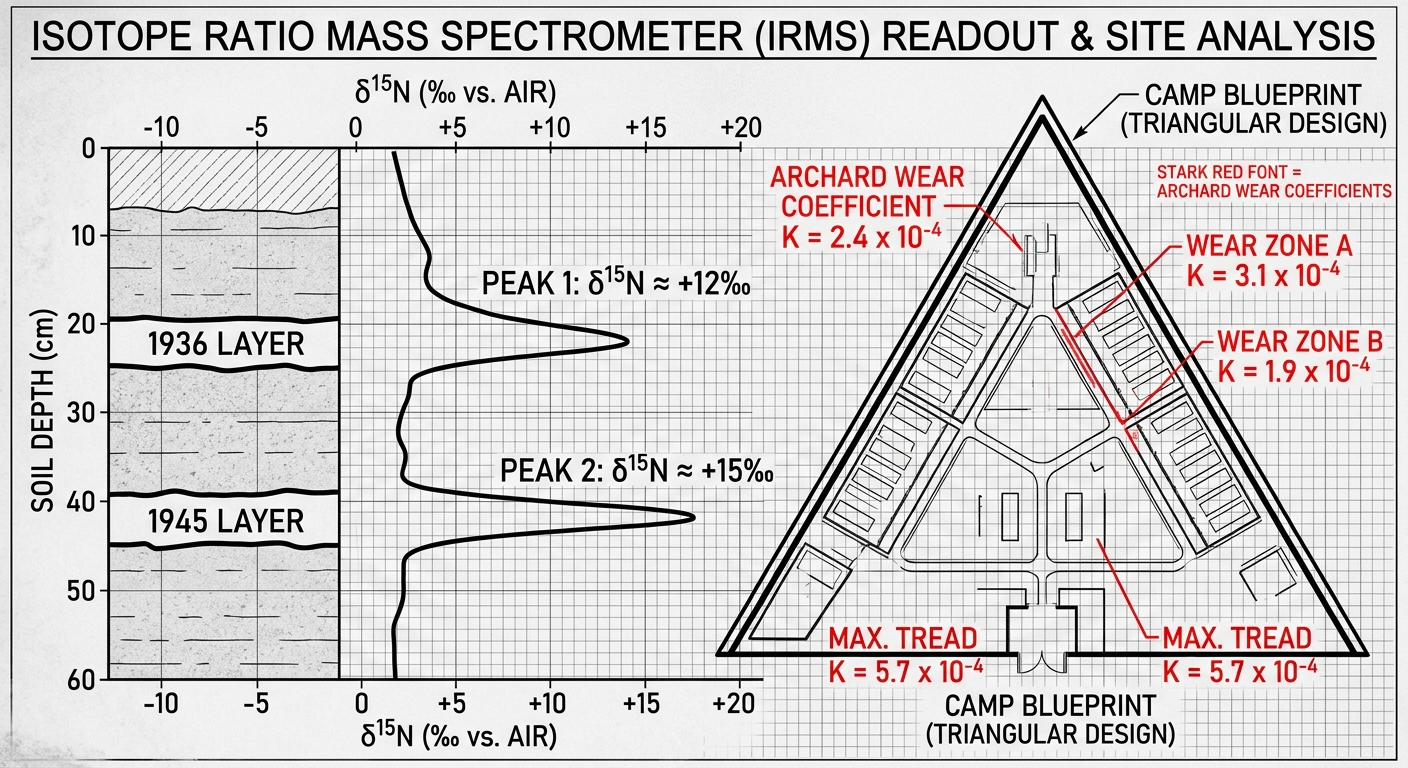
At Sachsenhausen, inmates were forced to march up to forty kilometers daily to test industrial footwear materials for German manufacturers across a 700-meter multi-surface track. This project samples soil cores along that test circuit, transposing geotechnical core stratigraphy and Archard's wear equation to model the volumetric tissue and bone lost to frictional load. By coupling mechanical erosion equations with Isotope Ratio Mass Spectrometry (IRMS), the work isolates chemical nitrogen-15 markers that delineate the camp's 1936–1945 Nazi operation from its subsequent 1945–1950 use as Soviet Special Camp No. 7. The resulting core data maps the mechanical extraction of human energy into durable ground stratigraphy across totalitarian regimes.
shown: Installed permanently as a series of subsurface viewing trenches directly intersecting the original shoe-testing track at the Sachsenhausen Memorial and Museum in Oranienburg.
shown: Installed permanently as a series of subsurface viewing trenches directly intersecting the original shoe-testing track at the Sachsenhausen Memorial and Museum in Oranienburg.
anchor facts used
- The camp was designed as an 'ideal' equilateral triangle with Tower A commanding a 180-degree panoptic view.
- It contained a 700-meter Schuhläufer-Kommando (shoe-testing track) with various surfaces like cinders and concrete where prisoners marched 40km daily.
- The infrastructure was seamlessly repurposed by the Soviet NKVD as Special Camp No. 7 from 1945 to 1950.
- The SS leased prisoner labor to civilian German shoe and rubber cartels to test synthetic Buna rubber soles.
mechanism
- Soil Core Stratigraphy — Extracting intact 10cm-diameter soil columns down to the 1936 sedimentary baseline along the exact arc of the testing track, preserving the physical compression layers.
1. Stratigraphic extraction - Archard's wear equation — Reversing the standard tribological equation to calculate the specific volume of human bone, cartilage, and cellular tissue lost as friction against the track surfaces.
2. Wear quantification - Isotope Ratio Mass Spectrometry (IRMS) — Isolating the distinct nitrogen-15 and strontium isotopic signatures to demarcate the 1936-1945 SS administrative layer from the 1945-1950 Soviet NKVD layer.
3. Regime differentiation - Computer Numerical Control (CNC) Subtractive Milling — Milling the calculated human volumetric void into massive blocks of modern synthetic rubber, translating statistical bodily erosion into physical negative space.
4. Deficit rendering
lineage
- Forensic Architecture, 'The Holocaust in Ukraine' — Builds on their spatial ground-penetrating radar methodology by applying tribological wear equations to human motion and commercial complicity.
- Teresa Margolles, 'En el Aire' — Extends her translation of systemic violence into physical atmosphere by quantifying the exact material residue left in the earth.
- Hans Haacke, 'Germania' (1993) — Shifts his excavation of the German Pavilion floor from architectural disruption to molecular-level stratigraphic debt.
curatorial qa (machine verdict, unedited)
SCORE 4/5 after 1 attempt(s)
READS: The excavated Schuhprüfstrecke trench with core samples and descending view into compressed soil layers clearly registers physical stratigraphic trauma.
FAILS: The transition between Nazi and Soviet occupation regimes is purely in the diagrams; the physical soil cross-section lacks visual differentiation between the 1936-1945 and 1945-1950 layers.
READS: The excavated Schuhprüfstrecke trench with core samples and descending view into compressed soil layers clearly registers physical stratigraphic trauma.
FAILS: The transition between Nazi and Soviet occupation regimes is purely in the diagrams; the physical soil cross-section lacks visual differentiation between the 1936-1945 and 1945-1950 layers.
spec: antigravity agent · keyframe/artifact: gemini-3.1-flash-image · video: veo-3.1 image-to-video · qa+wall text: gemini-3.7-flash watching the render · 30.1s total