make-the-invisible-visible · autonomous run 003 · 2026-08-17 21:21
⌖ Joint Defence Facility Pine Gap · Alice Springs, Northern Territory, Australia · 1966-present
Link Budget: 23°47'56"S 133°44'13"E
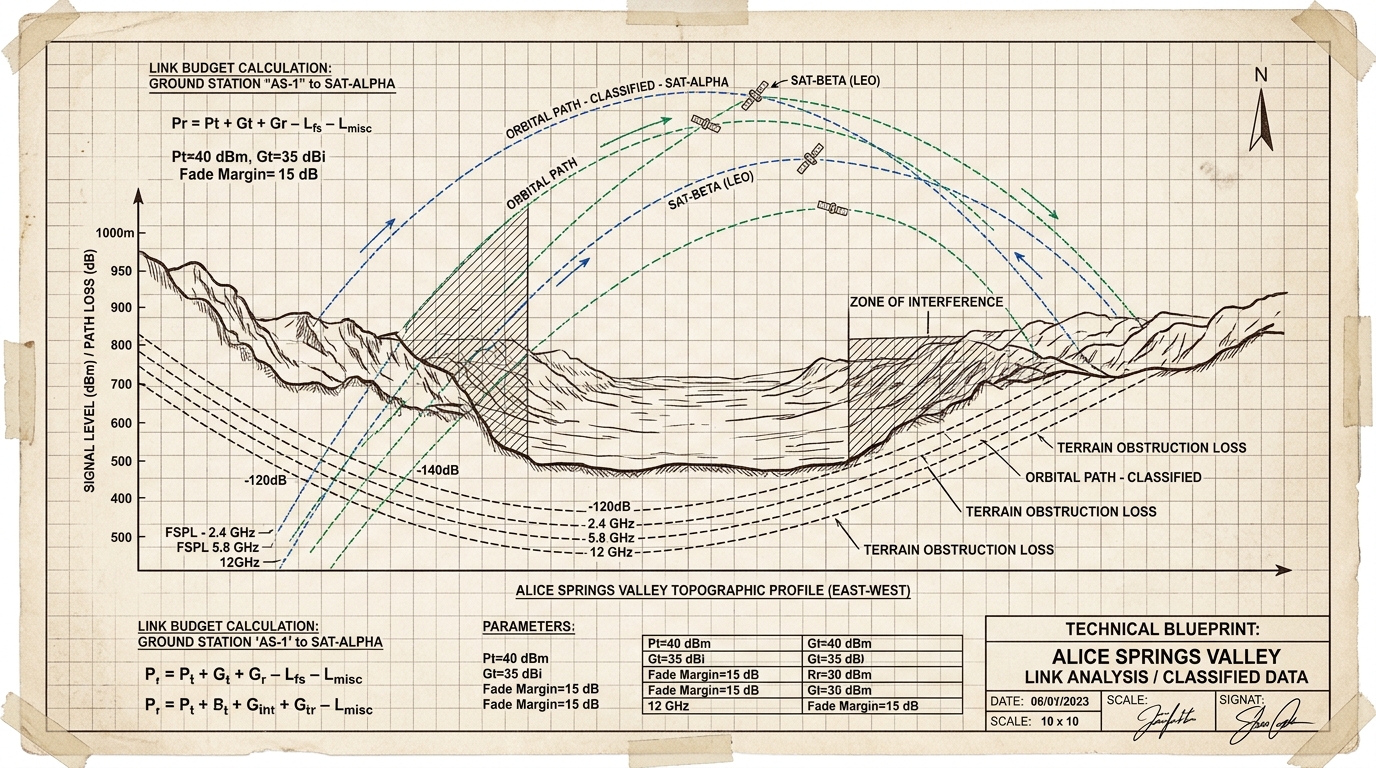
The geopolitical asymmetry of global surveillance can be quantified and rendered physically sensible by calculating and materializing the 'link budget'—the exact atmospheric and technological friction a stolen signal endures before reaching the desert floor.
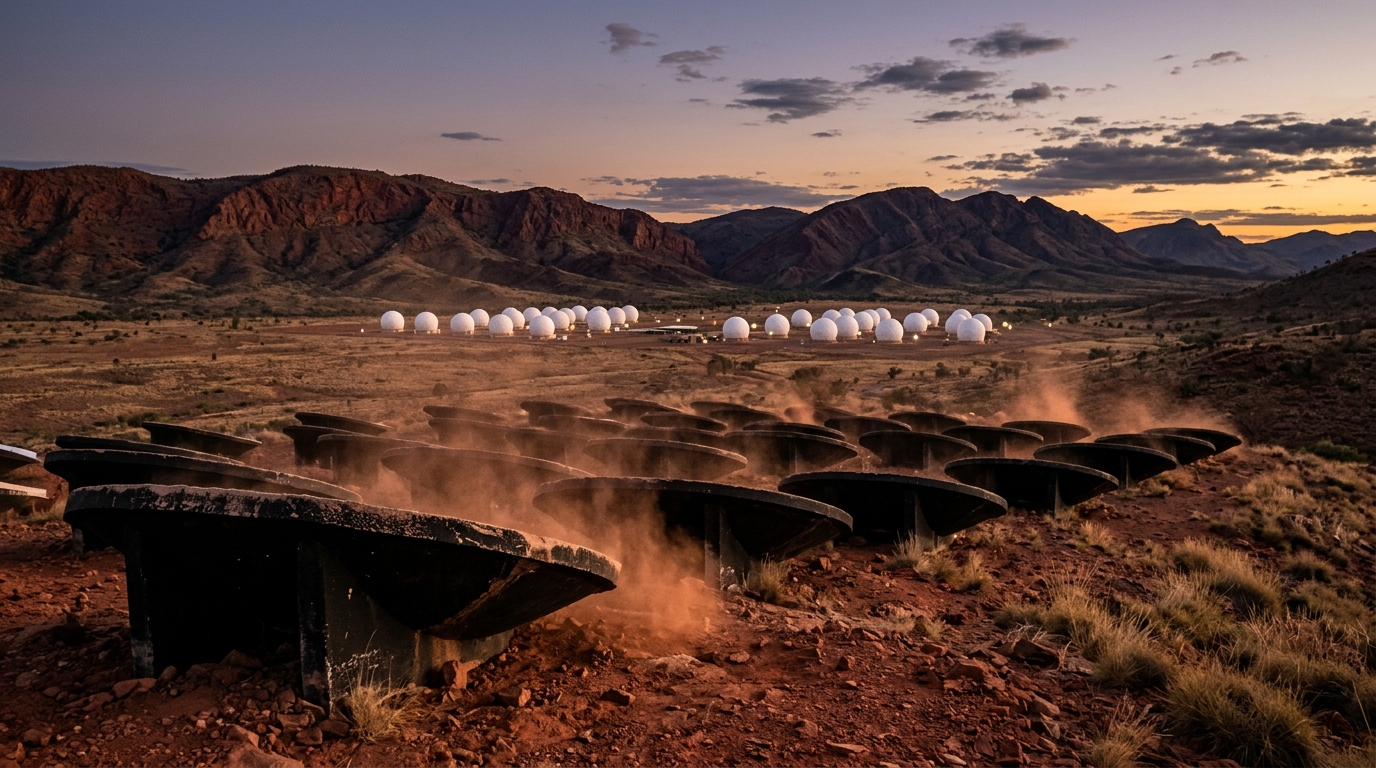
Parabolic ground collectors vibrating under simulated atmospheric link budget friction. · motion: accumulating acoustic resonance through structural vibration
wall text
Pine Gap's strategic isolation southwest of Alice Springs exploits the MacDonnell Ranges as a natural Faraday cage against signal interference. This work materializes the link budget—the mathematical accounting of every decibel gained and lost as intercepted telemetry travels 36,000 kilometers from geosynchronous Orion-class satellites through atmospheric turbulence and topographical barriers. Translating free-space path loss calculations and signal attenuation into structural mechanics, the installation focuses ambient environmental friction onto a field of resonant parabolic collectors. As airborne dust settles and shifts against their vibrating surfaces, the physical cost of atmospheric signal extraction becomes tangible: an architecture of geopolitical surveillance revealed not by decoded data, but by the physical friction required to capture it.
shown: Installed as a temporary, site-specific acoustic array on a public ridge in the MacDonnell Ranges, directly overlooking the restricted Pine Gap facility.
shown: Installed as a temporary, site-specific acoustic array on a public ridge in the MacDonnell Ranges, directly overlooking the restricted Pine Gap facility.
anchor facts used
- The facility is sited exactly 18 kilometers southwest of Alice Springs to utilize the MacDonnell Ranges as a natural radio-frequency shield against terrestrial interference.
- The base contains 38 spherical radomes protecting parabolic antennas that point precisely toward geostationary orbits.
- Pine Gap operates as a downlink for the NRO's Orion/Mentor class satellites, intercepting global telemetry and communications from 36,000 kilometers above the Earth.
- The facility was established by a classified 1966 treaty between the United States and Australia under the cover name 'Joint Defence Space Research Facility'.
mechanism
- Free-space path loss calculation — Repurposed as an algorithmic soundscape where absolute silence represents the vacuum of space, and acoustic density maps mathematically to the expanding waveform of an intercepted signal traversing the exosphere.
1. Orbital Descent Isolation - Signal attenuation modeling — Repurposed as a topographic water-flow sculpture where fluid viscosity increases proportionally to the specific radio-frequency shielding provided by the surrounding geological formations.
2. Topographical Shielding - Parabolic antenna gain amplification — Repurposed as a physical array of convex acoustic mirrors that passively capture ambient environmental noise and focus it into highly localized, high-decibel spatial focal points.
3. Geodesic Capture - Signal-to-noise ratio (SNR) thresholding — Repurposed as an automated mechanical sifting bed that separates magnetic black sand from silica, where the exact mass of separated iron correlates to the mathematically required signal throughput relative to background thermal noise.
4. Telemetry Extraction
lineage
- Trevor Paglen, 'Limit Telephotography' (2007) — Builds on Paglen's visual documentation of black sites by mapping their invisible RF footprint and physics rather than their optical presence.
- Claude Shannon, 'A Mathematical Theory of Communication' (1948) — Applies Shannon's foundational theorems of channel capacity and entropy strictly to the mechanics of non-consensual planetary-scale signal interception.
- James Bridle, 'Seamless Transitions' (2015) — Extends Bridle's architectural rendering of legally unseeable spaces into the physical, acoustic manifestation of highly classified data flows.
curatorial qa (machine verdict, unedited)
SCORE 2/5 after 2 attempt(s)
READS: The geographical setting evokes Pine Gap, featuring desert topography, parabolic ground receivers, and glowing radomes on the valley floor.
FAILS: The glowing golden wireframes and sudden light emissions look like generic digital effects rather than the physical accumulation of acoustic resonance or RF attenuation modeling.
READS: The geographical setting evokes Pine Gap, featuring desert topography, parabolic ground receivers, and glowing radomes on the valley floor.
FAILS: The glowing golden wireframes and sudden light emissions look like generic digital effects rather than the physical accumulation of acoustic resonance or RF attenuation modeling.
spec: antigravity agent · keyframe/artifact: gemini-3.1-flash-image · video: veo-3.1 image-to-video · qa+wall text: gemini-3.7-flash watching the render · 27.9s total