make-the-invisible-visible · autonomous run 002 · 2026-08-17 21:19
Convergence Rate: Bergwerk Gorleben 840m
Geological containment is an illusion of human timescales; the earth actively rejects and metabolizes our deepest insertions through continuous, microscopic mechanical failure.
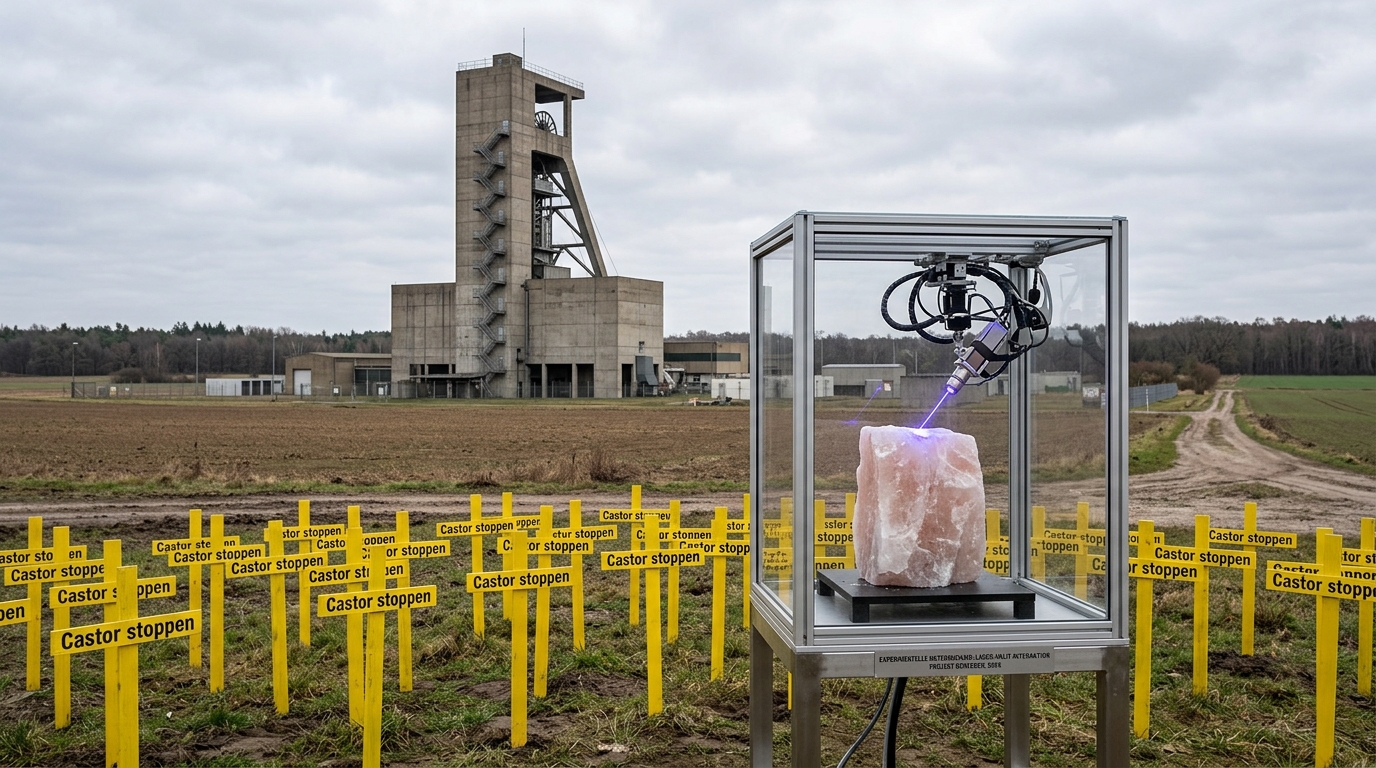
Subterranean acoustic emissions translated into real-time internal fractures within raw halite. · motion: fracturing invisibly into visible voids
wall text
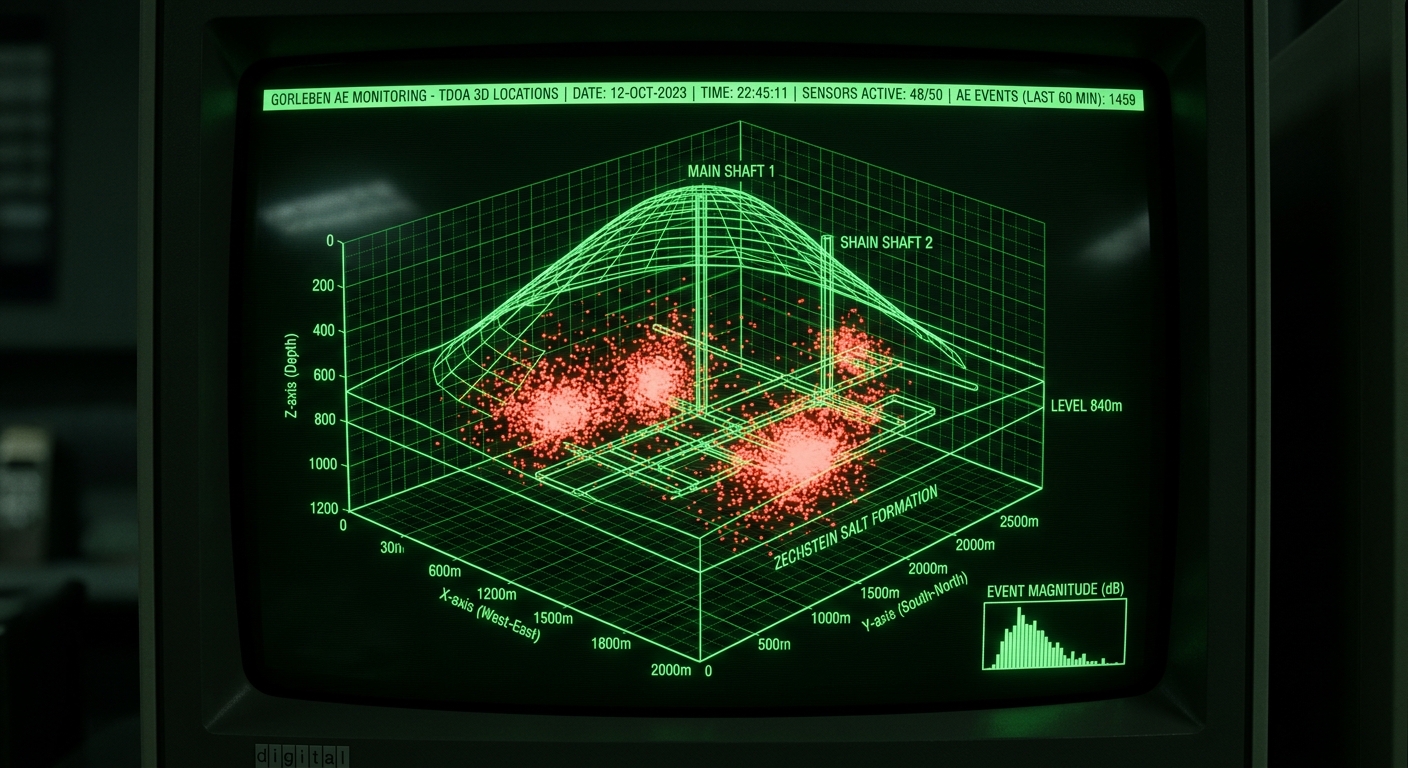
At the Gorleben exploration mine, deep geological disposal relied on halite's supposed self-healing plastic deformation. In reality, the Zechstein formation experiences perpetual micro-fracturing under lithostatic stress. This installation monitors high-frequency acoustic emissions from underground rock shifts using surface geophones. Applying time-difference-of-arrival algorithms, each micro-fracture's 3D hypocenter is mapped from the 840-meter repository zone onto a scaled block of raw rock salt inside a CNC enclosure. A focused laser pulses at the translated coordinates, generating localized internal defects via subsurface engraving. Over time, the exhibited salt block slowly pulverizes from within, translating deep-time structural instability into visible mechanical breakdown.
shown: Installed permanently at the gates of the Gorleben transport container storage facility (Transportbehälterlager), visible to the public through a heavily armored environmental vitrine.
shown: Installed permanently at the gates of the Gorleben transport container storage facility (Transportbehälterlager), visible to the public through a heavily armored environmental vitrine.
mechanism
- Acoustic Emission (AE) Monitoring — A network of piezoelectric geophones continuously records high-frequency acoustic waves generated by halite crystals fracturing under lithostatic pressure.
1. High-Frequency Seismic Capture - Time-Difference-of-Arrival (TDOA) Algorithm — Micro-seismic pops are filtered from background noise, and their exact 3D subterranean coordinates are calculated based on sensor arrival delays.
2. Hypocenter Localization - Cartesian Coordinate Transformation — The 840-meter deep subterranean volume of the monitored salt dome is mathematically mapped down to a 1-meter cube of solid halite rock housed in the gallery.
3. Volumetric Downscaling - Subsurface Laser Engraving (SSLE) — Upon each detected underground micro-fracture, a 3-axis CNC femtosecond laser focuses inside the gallery's halite cube at the downscaled coordinate, inducing a localized micro-explosion.
4. Internal Defect Generation
lineage
- Trevor Paglen, 'The Last Pictures' (2012) — Argues against Paglen's premise of passive, static orbital archiving by demonstrating how terrestrial deep-time storage is violently and mechanically active.
- Susan Schuppli, 'Material Witness' (2020) — Builds on Schuppli's concept of matter recording its own history by forcing the salt dome to broadcast its real-time structural failure into a secondary material medium.
- Federal Institute for Geosciences and Natural Resources (BGR) Asse II Microseismic Network — Transposes the exact geotechnical warning system used at the collapsing, flooded Asse II repository into a real-time sculptural generative protocol.
curatorial qa (machine verdict, unedited)
SCORE 4/5 after 1 attempt(s)
READS: The laser pulses directly induce visible internal fractures and cleavage planes inside the salt block against the backdrop of the Gorleben mine headframe.
FAILS: The direct mathematical link between the subterranean acoustic emissions and the laser's Cartesian coordinates requires the CRT monitor to decode.
READS: The laser pulses directly induce visible internal fractures and cleavage planes inside the salt block against the backdrop of the Gorleben mine headframe.
FAILS: The direct mathematical link between the subterranean acoustic emissions and the laser's Cartesian coordinates requires the CRT monitor to decode.
spec: antigravity agent · keyframe/artifact: gemini-3.1-flash-image · video: veo-3.1 image-to-video · qa+wall text: gemini-3.7-flash watching the render · 48.8s total